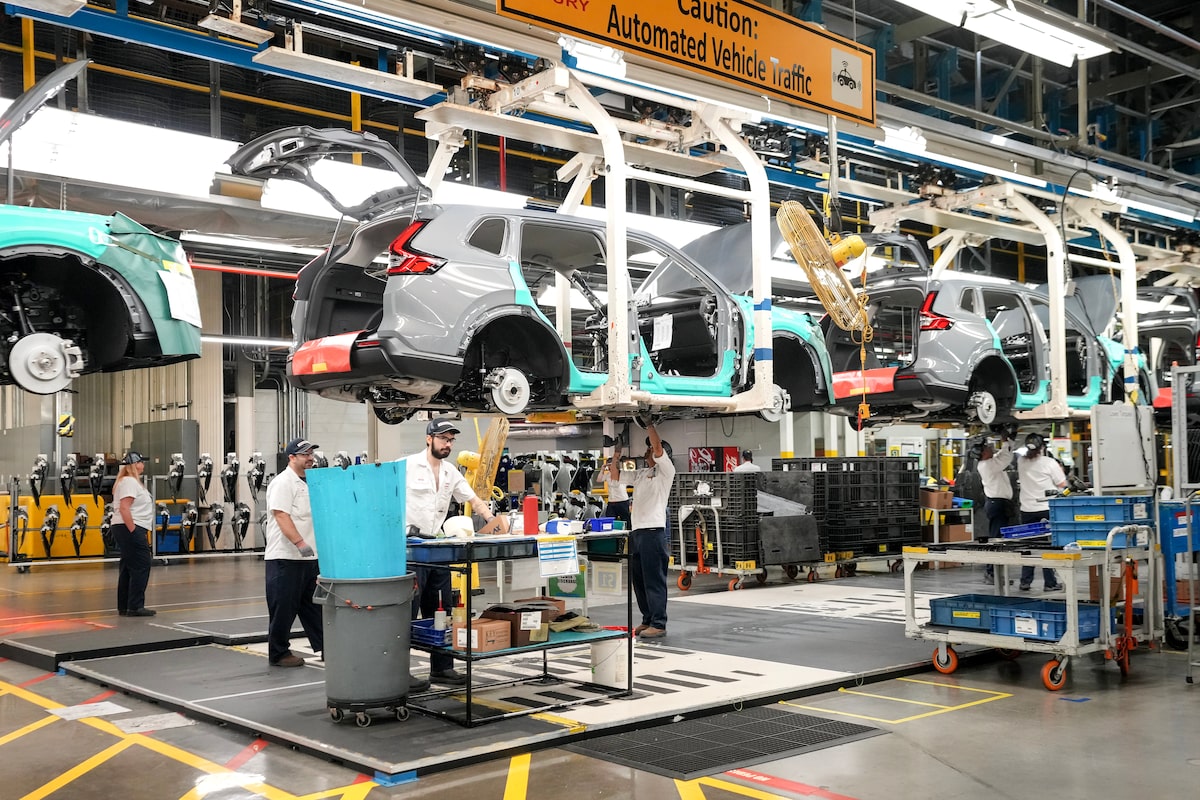
Open this photo in gallery:Honda employees work along the vehicle assembly line in Alliston, Ont. U.S. President Donald Trump has threatened to impose tariffs of 50 per cent on a further US$20-billion of Canadian exports on Aug. 19.Nathan Denette/The Canadian PressCanadian officials are weighing a proposal that would see Ottawa accept U.S. auto tariffs in exchange for a reduction on levies for vehicles compliant with USMCA, according to three sources on both sides of the border.The proposal would also maintain an exemption for the value of American content in cars exported from Canada.The Globe and Mail is not identifying the sources as they were not authorized to publicly discuss the top-secret talks.Live at 1 p.m.: Our experts answer your questions about Trump's latest tariff threatOne U.S. industry source with knowledge of the bilateral trade talks unfolding in Washington said this proposal has been discussed by Canadian and American negotiators. A Canadian industry source said Canada’s negotiating team had talked about such a proposal but it was unclear whether they had yet pitched it to their U.S. counterparts. A provincial source said it had been talked about with Canadian industry.Prime Minister Mark Carney has promised a deal that reduces U.S. President Donald Trump’s tariffs on autos, steel, aluminum and forestry products. But so far, as The Globe has reported, the contours of an agreement for steel and aluminum have been clearer than one for autos. The two sides are aiming for a pact by Aug. 19, when Mr. Trump has threatened to impose tariffs of 50 per cent on a further US$20-billion of Canadian exports.Not only is the auto industry central to the bilateral trade relationship, but it is politically crucial: The United States wants Canadian premiers to stop their bans on American alcohol sales as part of the deal, which would require the agreement of Ontario Premier Doug Ford, whose province contains most of the country’s auto industry.Now, the first details of what a potential autos deal could look like are emerging.Under the plan, according to the U.S. and Canadian industry sources, Mr. Trump’s auto tariff, imposed under Section 232 of the Trade Expansion Act of 1962, would be reduced from its current rate of 25 per cent on all Canadian auto exports that comply with the United States-Mexico-Canada Agreement. In addition, all U.S. content in Canadian-made autos would continue to be excluded from the tariff calculation. If a Canadian-made car contains 50-per-cent U.S. content, for instance, the tariff is charged on only half the value of the car.The Canadian industry source said Canadian officials had also discussed a proposal to have the tariffs apply only to any content in a vehicle that originated outside North America, which would have the effect of reducing the levies to a very small amount.Canada’s top negotiator told U.S. counterparts Aug. 19 tariffs could halt trade talks, sources sayTwo sources directly briefed on the talks said Canadian negotiators have been consulting with industry leaders to determine what concessions they could live with. A provincial source said that, in the case of the auto sector, the industry has said that it could survive a tariff of 10 to 15 per cent if U.S. content in the car were not subject to the levy. Because of the two countries’ integrated supply chains, the source pointed out, about 50 per cent of a Canadian-made car originates in the United States.In addition to the auto industry consultations, one source said, negotiators have also consulted with agriculture, steel and aluminum industry representatives.In separate negotiations with Mexico, the U.S. has demanded a requirement that would oblige all vehicles manufactured in Mexico and exported to the U.S. to contain at least 50 per cent U.S. content.Gabriel Brunet, a spokesperson for Dominic LeBlanc, the minister responsible for Canada-U.S. trade, declined to comment on the auto proposal.It was not immediately clear how receptive U.S. negotiators would be to the idea of a reduced auto tariff. The U.S. is also demanding that Canada drop all of its retaliatory tariffs on the U.S. auto sector.Opinion: U.S. alcohol industry rightly fears a nasty hangover from Trump’s trade war with CanadaThe Canadian industry source said that the U.S. has so far appeared to hold back on negotiating auto tariffs because they are its most powerful point of leverage. The source, however, expected that autos would be part of the deal, even if an agreement comes at the last minute.One Canadian official, however, was skeptical that such complicated issues could be sorted out by Aug. 19. This source said that it was more likely the Aug. 19 deal would simply be for Mr. Trump to hold off on his next round of tariffs while talks continue. This source said that no deal on 232 tariffs would be possible without auto 232 levies being part of it.Mr. Trump last year imposed Section 232 tariffs on steel, aluminum, autos and forest products. In the Washington talks, the U.S. is demanding that Canada agree to a long list of trade concessions in exchange for reducing – but not eliminating – those tariffs. Under such a deal, Canada would accept some level of U.S. tariffs without retaliating against them in exchange for not being hit with even higher tariffs.Open this photo in gallery:U.S. President Donald Trump waves as he disembarks Air Force One at Joint Base Andrews, Maryland, U.S., on Sunday.Elizabeth Frantz/ReutersLast month, Mr. Trump unveiled a plan to hit more Canadian goods with 50-per-cent tariffs under Section 338 of the Smoot-Hawley Tariff Act of 1930. This latest threat lit a fire under the previously sluggish talks between the two countries.The Smoot-Hawley tariffs would target, among other things, alcohol, dairy products and electronic equipment. The largest tranche of tariffs would be imposed as retaliation against Canada’s retaliatory tariffs on U.S. autos.Mr. LeBlanc has met with U.S. Trade Representative Jamieson Greer three times in as many weeks at the latter’s office in the Winder Building near the White House. In their most recent sit-down on Tuesday, the pair met for about an hour. The minister’s office said he remained in Washington on Wednesday.Janice Charette, Canada’s chief negotiator, has been holed up at the Canadian embassy in Washington with officials and experts working on a deal.The U.S. industry source said that, at last week’s meeting between Mr. Greer, Mr. LeBlanc and Ms. Charette, the U.S. gave Canada feedback on a proposal the Canadians had presented a few days earlier. The Canadian industry source said that Canada and the U.S. traded additional written proposals this week. Ms. Charette last week told Mr. Greer that if there is no deal by Aug. 19 and Mr. Trump’s newest tariffs take effect, Canada would be forced to retaliate and negotiations would come to a halt, The Globe has reported. The U.S. industry source said the Americans understand the political pressures in Canada and are optimistic about a deal, but worry about the Carney government’s ability to sell it to the Canadian public.Ottawa discussing trade concessions with U.S. in return for some tariff relief, sources sayA new report from the Canadian American Business Council concludes that since the U.S. and Canada began integrating their auto industries in 1965, the close connection has helped the North American industry maintain its competitiveness against Asian and European manufacturers. The report, prepared by Oxford Economics, points out that since single components cross the border up to eight times before a vehicle is completed, Mr. Trump’s tariffs are damaging the economy in both countries.“The costs of higher tariffs fall not only on consumers via higher inflation but also on the manufacturing workers, states and provinces that tariff policy is designed to help,” the report says.Beth Burke, the group’s chief executive officer, said her organization commissioned the report as part of an education campaign to soften the ground in Washington for a renegotiated trade deal. It has also launched games targeted at everyday consumers to raise more awareness on Main Street of how integrated the two countries’ economies are. Despite all the trade talk since Mr. Trump won the 2016 election, people don’t always understand how important a market Canada is to the U.S. economy, she said.“Canada isn’t just a neighbour or a trading partner. For many states, it’s their most important customer,” Ms. Burke said.
Ottawa weighs proposal on auto tariffs as it presses U.S. for reprieve, sources say
Full Article
Original Source
Read the full article at Theglobeandmail →KhanList aggregates and links to publicly available news content. We do not host full articles from third-party sources. Always verify important information with original sources.