
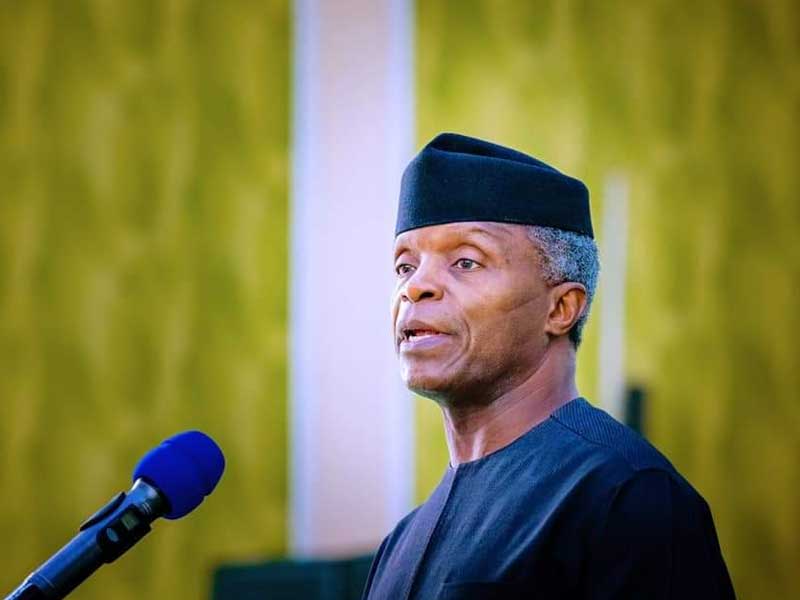
• Adewale Martins urges leaders to obey laws, serve the people Former Vice President, Prof. Yemi Osinbajo, yesterday called on Nigerians to hold political leaders accountable and demand strict compliance with the rule of law, warning that the country will continue to move in cycles unless citizens unite to elect credible leaders and insist on accountability. Osinbajo spoke in Lagos as the guest speaker at the 2026 Annual Lecture of the Anthony Cardinal Okogie Foundation (ACOF), with the theme, “Rule of Law in Nigeria: The Challenges of Leadership Compliance,” organised by the Lagos Archdiocese Catholic Men Organisation of Nigeria (LACMON). He said although politicians everywhere were known to over-promise during election campaigns, citizens had a responsibility to challenge their promises and ensure that those elected were capable of delivering on their commitments. “Generally speaking, if you look at politicians everywhere, of course they always over-promise. It is the duty of the electorates to challenge them and demand accountability,” he said. According to him, Nigeria’s major challenge was compounded by the tendency of citizens, including members of the elite, to divide themselves along ethnic and religious lines rather than confront the real issues affecting the country. He said such divisions often influenced voting patterns, with citizens choosing candidates because of their ethnic identity rather than their competence, character or ability to address national challenges. “Unfortunately, we find ourselves divided, even among the elites, along tribal and religious lines, rather than facing the real issues that confront us,” Osinbajo said. He added that Nigerians must move beyond identity politics and unite in voting for the right leaders while scrutinising campaign promises and demanding that elected officials fulfil them after assuming office. “I think the issues that confront our nation are very real. But we must be able, in a united way, to vote for the right people, ensure that whatever they are saying now during campaigns are things they can do when they get to office,” he said. The former Vice President stressed that accountability must remain a continuous responsibility rather than an obligation limited to election periods. “So, we must hold leadership accountable and demand accountability always, otherwise we are going to keep moving in cycles,” he said. Earlier in his keynote address, Osinbajo argued that the rule of law must ultimately be measured by its ability to protect ordinary citizens and deliver practical justice, rather than merely by the existence of laws and judicial institutions. He said majority of cases before Nigerian courts did not involve government but were disputes between individuals and organisations, making the enforcement of judgments one of the most important challenges facing ordinary Nigerians. “The majority of cases that go to our courts are not cases involving government. The vast majority are cases between individuals and organisations,” he said. According to him, the critical question for citizens who obtain judgments is whether they can actually enforce those judgments. “The big question is whether, when you obtain a judgment, you are still able to enforce that judgment, whatever that judgment may be,” he said. Osinbajo said the challenge required Nigeria to adopt a people-centred approach to justice, which would design the justice system from the perspective of the people who depend on it rather than solely from that of lawyers and legal institutions. He asked whether the justice system actually served the people for whom it was created and, if not, what should be done to correct the situation. He illustrated the challenge with stories of ordinary Nigerians who had encountered the justice system after suffering the loss of property, land, livelihoods and family support. According to him, for a widow dispossessed of her home and car after the death of her husband, justice would simply mean recovering her property and protecting her children. For a teacher who had saved money to purchase land only for another person to take possession of it, justice would mean an effective court order restoring the land and protecting her from further dispossession, he stressed. Similarly, for the widow of a bricklayer killed in an accident, justice would mean obtaining appropriate compensation to enable her to care for herself and her six children, he added. “These are all stories, but these are not technical cases. They are the real experiences of Nigerians whose lives and livelihoods were suddenly thrown into disarray,” he said. Osinbajo warned that the denial or delay of justice was not merely a legal problem but a developmental, governance and moral crisis. He said when poor citizens were unable to access justice, poverty and inequality became entrenched, while women, particularly those in rural areas, bore a disproportionate share of the burden. He also warned that when citizens lost confidence in formal justice institutions, disputes could escalate into wider community conflicts as people resorted to self-help. “The absence of justice actually fuels mistrust—mistrust in government because the government is supposed to be the protector,” he said. Osinbajo also referred to the World Justice Project’s 2024 Rule of Law Index, arguing that the evidence showed significant weaknesses in the accessibility and effectiveness of Nigeria’s justice system. He therefore called for reforms that would make justice more accessible, affordable and responsive to citizens. According to him, justice institutions should use technology to make it easier for citizens to obtain information, lodge complaints and follow their cases without repeated visits. He also advocated assistance in local languages and better collection of data on the legal problems faced by ordinary Nigerians. Most importantly, he said, the justice system should be judged by outcomes. “How many people were able to get justice? How long did it take? What did it cost them? Did the outcome make their lives better?” he asked. Osinbajo also criticised excessive legal technicalities that could cause cases to fail after years of litigation, arguing that the justice system must always consider the human consequences of judicial decisions. He said law students should be trained not only to identify rules and precedents but also to understand the consequences of those rules for ordinary people. Judges, he added, should consider whether their decisions advanced constitutional values such as dignity, equality and justice, while lawyers should see themselves not merely as legal technicians but as participants in a public system whose credibility was essential to democracy. “If the justice system does not work for the nation, if it is inaccessible, if it is unaffordable, if it is incomplete, or if there is undue delay, then no matter how elegant our laws are, the system simply does not work,” he said. He maintained that justice was ultimately larger than the courthouse and the law itself because the purpose of the justice system was to protect people. In his opening remarks, the Chairman of the Board of Trustees of ACOF and Chairman of Globus Bank Limited, Peter Amangbo, said the foundation was committed to sustaining the legacy of Cardinal Anthony Olubunmi Okogie through education, human empowerment and social welfare. Amangbo, a former Managing Director of Zenith Bank, said the foundation’s scholarship programme had helped deserving young Nigerians who might otherwise have been unable to pursue higher education. He disclosed that the foundation spent N80 million on school-fee payments in 2026 and appealed to corporate organisations, philanthropists and business leaders to support its programmes. Also speaking, the Archbishop of Lagos, Most Rev. Alfred Adewale Martins, said respect for the rule of law was both a civic and moral responsibility. Martins said leaders must submit themselves to the same laws they expect citizens to obey, stressing that public office was a trust rather than a personal possession. He identified corruption, impunity, political interference, selective application of the law, disregard for due process and abuse of public office as major challenges to the rule of law. The Archbishop urged Catholics and other Nigerians to reject corruption and injustice, defend human dignity and promote the common good. He prayed for Nigerian leaders to have the wisdom to govern justly, the courage to obey the law and the humility to serve the people entrusted to their care.
Osinbajo to Nigerians: Hold Leaders Accountable, Demand Compliance With Rule of Law
Full Article
Original Source
Read the full article at Thisdaylive →KhanList aggregates and links to publicly available news content. We do not host full articles from third-party sources. Always verify important information with original sources.