
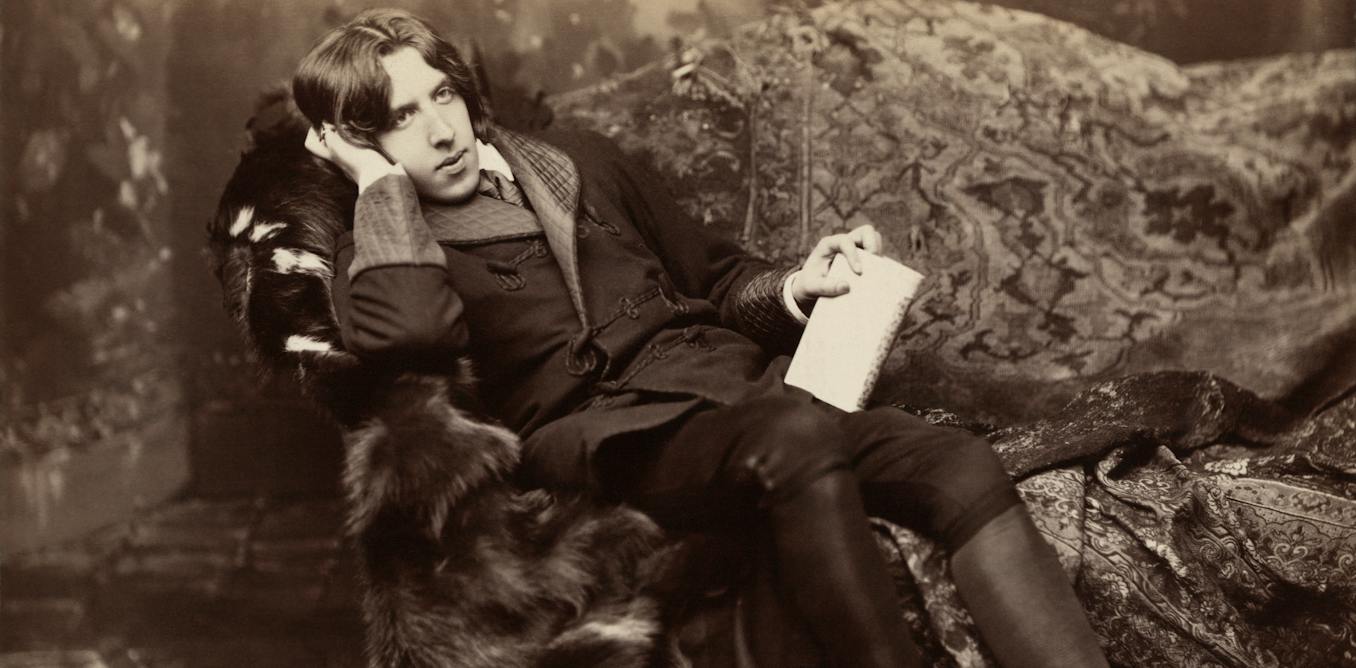
Oscar Wilde, the Victorian writer of “The Picture of Dorian Gray” and “The Importance of Being Earnest,” was a fashionable icon known as much for his refined manner and conversation as for his writings. So the image of Wilde exploring Colorado’s frontier towns and rugged mines sounds like a scene from a dream. But that is exactly what happened during his extensive tour of the U.S. in 1882. Wilde arrived in the U.S. from Europe with much aplomb. The impresario Richard D’Oyly Carte, the promoter of the acclaimed operetta duo W.S. Gilbert and Arthur Sullivan, bankrolled Wilde’s tour. Gilbert and Sullivan had recently written a new comic opera, “Patience,” which mocked the aesthetic movement, of which Wilde was an icon. Championing artifice and refinement in all aspects of life, aesthetes dressed in ornate, unusual ways, such as Wilde’s habit of wearing an unnatural green carnation on his lapel. The often-mocked figure of the dandy, a wealthy man who dressed in the most bizarre and fanciful fashions of day, was an inspiration for aesthetes. I study 19th-century literature in the English-speaking world, and I see Wilde’s western journey to my home state of Colorado as an example of how intellectual writers in the Victorian era were interested in the working class and how that curiosity was, perhaps surprisingly, mutual. Wilde’s journey to the ‘Wild West’ Carte brought Wilde to America around the time of the U.S. premiere of “Patience” to help popularize the idea of the aesthete. While on tour, Wilde visited major cities, such as New York and Philadelphia, giving almost 100 interviews. But he also was interested in the “Wild West.” His curiosity may seem paradoxical: Tawdry saloons and dusty main streets were a stark contrast to the atmosphere of luxurious refinement he cultivated. Yet, above all, Wilde craved the novel and unexpected. He sought experiences and people who were the opposite of the conventionality he saw as chaining Victorian society. The slightly anarchic roughness of the West appealed to him. He called it “the most beautiful part” of the country. Wilde arrived in Colorado Springs in April 1882. Railroad baron William Jackson Palmer had founded this booming resort town in 1871. The town, a short railway journey from Denver, served as a health retreat for those suffering from tuberculosis – one of the deadliest diseases in the nation at the time. Befitting its growing popularity, Colorado Springs had a thriving arts scene. According to the Colorado Springs Pioneers Museum, “interest in the arts began almost immediately” and was distinguished by the opening of an opera house in 1881. Crafting it in red brick and sandstone, the architects took inspiration from Madison Square Theater in New York. It became one of the most impressive buildings in the state. Wilde gave his lecture on “The Decorative Arts” at this opera house. He did not condescend to his Colorado audience, nor did he suggest that the highest quality art could only exist in the refined settings of Europe. Instead, he insisted that art should be a part of ordinary existence. “Art,” he declared, “is not something which you can take or leave” but rather “a necessity of human life.” For Wilde, art meant “value to the workman” and “the pleasure which he must necessarily take in making a beautiful thing.” The quality of art for Wilde was not about luxury and extravagance but about creativity and honesty in creation. Oscar Wilde dressed the part of ‘high’ art in the 19th century. ilbusca/iStock via Getty Images Plus The local paper, The Daily Gazette – now The Gazette – reviewed his talk positively in a column from April 15, 1882. The column praises Wilde for how “the entire evening he commanded the closest attention of his audience.” Reportedly, when he “would give expression to a brilliant thought or idea a murmur of applause would pass through the audience.” The article finishes by exclaiming that the lecture “was instructive and interesting and appreciated by all who were present.” A dandy among the miners Wilde’s popularity in the West reveals the oversimplistic nature of the divide between the “highbrow” culture of the literati and the culture of “common” society. His visit to the isolated, high-elevation mountain town of Leadville makes this blending of “high” and “low” culture even more vital. In this hardscrabble town, which owed its existence to the hard labor of miners, workers came to the Tabor Opera House to hear the lavish aesthete. Similar to his speech in Colorado Springs, he discussed how “beautiful and rational designs are necessary in all work.” For Wilde, the roughness of his surroundings were closer to his ideal than the conventionality of Eastern U.S. cities, with their “bad wall-papers horribly designed.” In 1882, Oscar Wilde gave a lecture on art at the Tabor Opera House in Leadville, Colo. Jerrye and Roy Klotz MD CC BY-SA 3.0 via Wikimedia Commons The relationship between Wilde and his Leadville audience was symbiotic. The artist found what he desired in the hard-edged mountain town, far from the pomp and conventions of Europe. “The revolver was their book of etiquette,” Wilde wrote of the town, not altogether disapprovingly. He drank with miners, some of whom lowered him into the depths of the Matchless Mine, a riotous atmosphere he found rather exciting. The miners, he wrote in his “Impressions of America,” were “very charming and not at all rough.” According to Wilde, these miners likewise found value in his discussions about art. Beyond the ‘highbrow-lowbrow’ divide Newspaper articles about Wilde’s lectures in Colorado do not emphasize the cultural gap between him and his audiences. That dynamic may not have seemed odd – other than the novelty of a foreign celebrity visiting towns in the interior of the country. In addition, 19th-century literary culture may not have conceived of the rigid divide between highbrow literati interests and those of the working class that exists today. The historian Lawrence Levine, in his influential 1990 book “Highbrow/Lowbrow,” asserts that supposedly elite pursuits actually had wide appeal in 19th-century American culture. For instance, opera was not associated primarily with multimillionaires in fancy tuxedos and evening gowns, but was also a popular pastime for all ages and social classes. That opera houses even existed in the frontier towns of Colorado demonstrates Levine’s point. Working-class residents of Leadville appreciated the chance to hear Wilde lecture about art as much as he relished the chance to travel to a real mining town and talk with its residents. In my view, economic and cultural divides of today can be bridged so everyone can engage intellectual insights and reflections. Witty, sophisticated authors like Wilde do not simply belong to exclusive elite circles.
Oscar Wilde had a surprising rapport with Colorado miners – why it is hard to imagine that happening today
Full Article
Original Source
Read the full article at Theconversation →KhanList aggregates and links to publicly available news content. We do not host full articles from third-party sources. Always verify important information with original sources.