
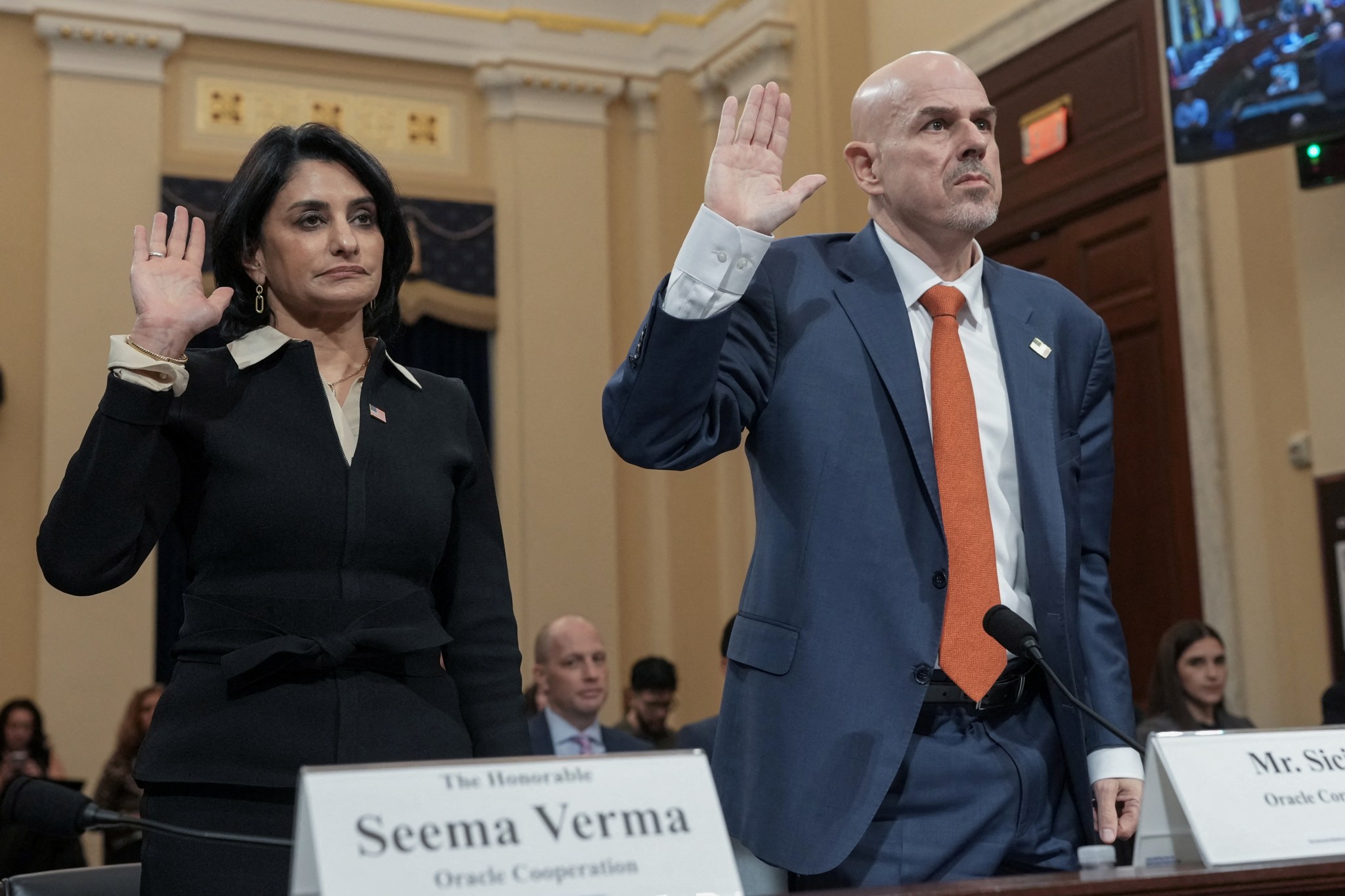
Oracle Corporation CEO Michael Sicilia told House lawmakers Thursday that neither he nor company founder and tech billionaire Larry Ellison had sought to influence negotiations on a growing contract with the Department of Veterans Affairs. However, Sicilia had not asked Ellison directly whether he had discussed Oracle’s contract with President Donald Trump or other White House officials. Sicilia testified under subpoena before the House Committee on Veterans’ Affairs after the VA raised the ceiling estimate on its electronic health record contract by nearly $17 billion. Democrats on the committee wanted to learn the extent of the leaders’ involvement, citing Ellison’s personal friendship with Trump. “I’ve never talked with anybody in the White House about the VA contract,” Sicilia said. He told the committee that VA procurement officials and Oracle employees working on the health records modernization project had handled the contract negotiation. Oracle initially proposed raising the ceiling by about $18.5 billion in July. After negotiations, it submitted a final proposal Aug. 14 for a roughly $16.9 billion increase. The VA awarded the modification Aug. 18, bringing the ceiling to $26.94 billion. That amount is the maximum the VA can order under the contract. The department negotiates and prices individual task orders separately. VA Deputy Secretary Paul Lawrence told the committee in September that a separate acquisition team handled the negotiations and that neither he nor Dr. Neil Evans, who leads the modernization program, took part. Lawrence said they received a broad account of the process. When Rep. Morgan Luttrell, R-Texas, asked whether anyone at the VA had questioned the need for another $17 billion, Lawrence said he didn’t know what was discussed in the acquisition talks. Sicilia said that after the program reset and changes in scope, the original $10 billion ceiling would cover deployments at about 50 of the 170 VA medical centers in the rollout plan. Sicilia attributed the higher contract ceiling to a longer rollout and additional work. The new health record system is live at 19 VA medical centers. The VA plans to start its next round of installations in January, with 26 medical centers scheduled for 2027. The committee voted 19-0 in September to subpoena Sicilia and Ellison after representatives from Oracle didn’t appear at an earlier hearing on the increased contract. “Having to compel your testimony through a subpoena is absolutely unacceptable, and I expect a commitment from you today that this will never happen again,” said Rep. Mark Takano, D-Calif., the ranking Democrat on the committee. On Thursday, lawmakers entered emails between Oracle’s sales team and the VA contracting office into the record. Takano also requested Oracle’s communications with White House and VA officials about its work for the department. Ellison is expected to testify under subpoena to the committee on Dec. 10, Takano said. Ranking Member of the House Committee on Veterans’ Affairs, Mark Takano, D-Calif., asks questions to Oracle CEO Michael Sicilia during a hearing on Nov. 19, 2026. (Ken Cedeno/Reuters) During the hearing, Rep. Maggie Goodlander, D-N.H., read back Sicilia’s 2022 pledge to absorb significant cost overruns and asked whether Oracle had kept it. “We’re trying to get to the truth of whether a promise was made and broken,” she said. Sicilia said he believed Oracle had kept its promise and argued that it came with an exception for a significant change in scope. Neither Sicilia nor Oracle executive Seema Verma told lawmakers how much the company had absorbed. Rep. Maxine Dexter, D-Ore., recounted the case of Raymond Sands, a 77-year-old Marine veteran whose antibiotics for pneumonia were delayed after a software error. Sands died eight days after he was hospitalized. The VA told his family that a change in the records system contributed to the delay, which the department later classified as catastrophic, according to records reported by The Washington Post. Verma said she would provide figures after Rep. Nancy Mace, R-S.C., asked how many open software tickets were more than 90 days old and how many were flagged for patient safety. Rep. Kimberlyn King-Hinds, a Republican representing the Northern Mariana Islands, proposed quarterly reports that would track unresolved defects, as well as show how much the VA pays for work it added to the contract and how much goes toward correcting software defects. Toward the end of the hearing, Takano noted that Oracle hired a lobbying firm established by a former chief of staff for VA Secretary Doug Collins when Collins represented Georgia’s 9th Congressional District. In the past year, Oracle has paid $120,000 to retain lobbyist Brendan Belair of Duddington Global Strategies. Federal law allows former senior congressional staff to lobby Congress or the executive branch after a year-long “cooling off” period, and Belair left the Hill after Collins lost a bid for the U.S. Senate in 2021. Takano asked Oracle executives to clarify what Belair does for the company regarding government relations. “I’d be interested in knowing what specific benefits and access Oracle receives from retaining Secretary Collins’ former chief of staff as a lobbyist,” Takano said. Senior writer Patricia Kime contributed to this article.
Oracle leaders did not influence negotiations on overrun VA contract, CEO testifies
Full Article
Original Source
Read the full article at Militarytimes →KhanList aggregates and links to publicly available news content. We do not host full articles from third-party sources. Always verify important information with original sources.