
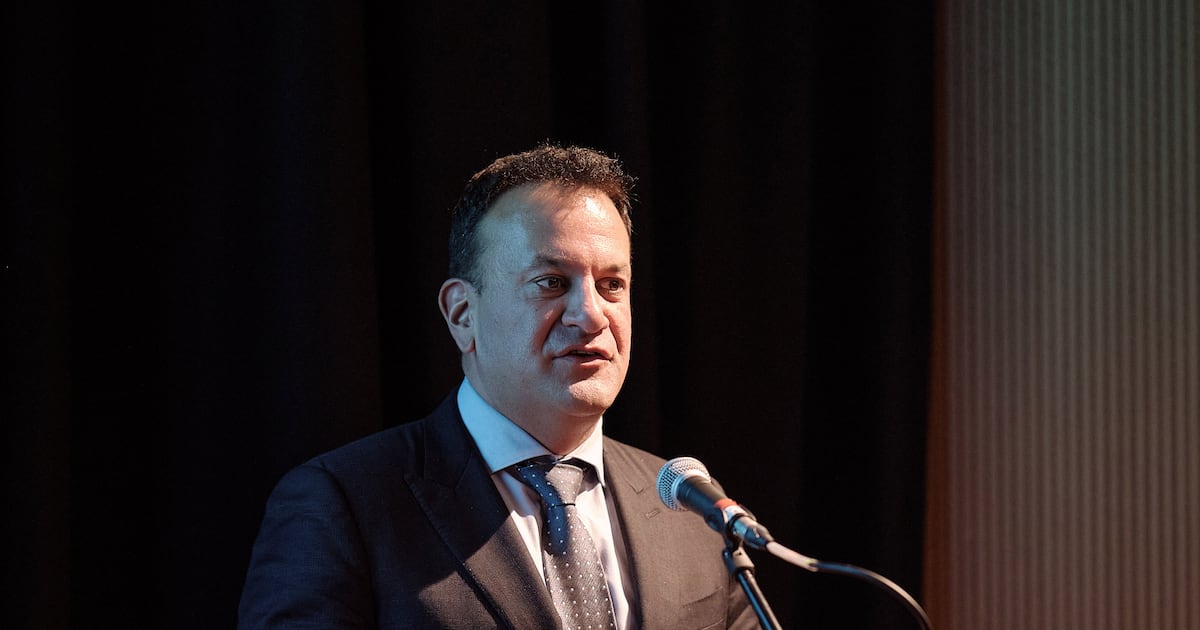
Leo Varadkar believes people living south of the Border will one day have to apologise for abandoning northern nationalists after partition a century ago. The former taoiseach’s words in Dungannon earlier this month will be taken as a statement of the obvious by many, or most northern nationalists, since they have believed it for generations.However, Varadkar’s speech deserves far greater scrutiny than it has so far attracted, especially his argument that southern nationalists “went off and built our State and largely forgot about what happened up here for a very long time”.Varadkar does not elaborate on what should be on the apologies list. Reconciliation, however, should start with everyone acknowledging – especially northern nationalists – that southern Irish nationalists did not create partition. Nor were they responsible for, or could they have done much about Stormont’s discrimination against Catholics. That responsibility lies with London and a unionist-dominated Stormont.No Irish nationalist wanted partition. Partition was created by Westminster. With the exception of a tiny number of Irish Parliamentary Party MPs, no Irish nationalist was consulted about the Government of Ireland Act, 1920, nor voted for it.READ MORENorthern Ireland was a fait accompli by the time the Anglo-Irish Treaty talks began in late 1921, when London made clear from the off that Northern Ireland ‘s status was not up for negotiation.Nevertheless, Arthur Griffith won a Boundary Commission to redraw the Border in line with inhabitants’ wishes; it would, the Irish believed, make Northern Ireland unviable. But it proved a disaster for nationalists. The Cumann na nGaedheal government took it seriously, producing thousands of documents to back up its claims. However, it appointed Eoin MacNeill, who proved a clueless interlocutor and inept Free State negotiator.If Varadkar believes an apology is owed, he should start here. Two critical errors made by Fine Gael’s Cumann na nGaedheal forebears copper-fastened partition in its early days.Firstly, they reinforced the hard Border in 1923 by establishing customs posts. Customs were governments’ main source of revenues then. Equally, they were intended as a declaration of Irish sovereignty but they made partition a reality for Border communities – on both sides of the religious divide, and on both sides of the Border – who did not want to be where they were on the map.When the Boundary Commission’s findings were leaked in November 1925, showing only modest adjustments and even ceding parts of the Free State, the Cumann na nGaedheal government sought to suppress it. In return for keeping the Border in place, the British government agreed to write off Ireland’s share of the UK imperial debt, the equivalent then of 80 per cent of the new State’s annual GDP.William T Cosgrave and his northern counterpart, James Craig, promised a new era. Cosgrave took the debt write-down but they never met again. Indeed, the leaders of both jurisdictions would not do so for 40 years, when Fianna Fáil’s Seán Lemass and the Ulster Unionist Party’s Terence O’Neill met in Stormont Castle in January 1965.If Cumann na nGaedheal’s attitude to partition can be characterised as one of cynical neglect, the same cannot be said of Fianna Fáil. In and out of office, Éamon de Valera was obsessed with partition. Articles 2 and 3 of his 1937 Constitution refused to recognise it, with Dublin claiming jurisdiction as a matter of law. In 1938, he did make progress with Neville Chamberlain during talks to end the Economic War.Chamberlain was prepared to state that Britain had “no selfish, strategic or economic interest” in Northern Ireland and that Britain would leave when, and if, a majority wanted.However, such a declaration was scuppered by the IRA’s 1939 bombing campaign and the second World War. In 1940, de Valera rejected Winston Churchill’s offer to end partition in return for Ireland’s entry into the war, believing it would not be honoured. De Valera continued to campaign against partition after leaving office, but his international tour was a failure. Back in Dublin, the inter-party coalition government led by John A Costello decided to fund nationalist candidates in the North.Instead of aiding the nationalist minority, however, the action galvanised the unionist majority into coalescing around the Ulster Unionist Party in the 1949 Stormont elections. Successive Irish governments failed to end partition not because they were uninterested, but because their campaigning to end it was counterproductive.[ No friends in the North: Partition has become embedded in the daily lives of people on the islandOpens in new window ]Ireland’s second World War neutrality meant there was never any realistic chance of bringing international pressure on London. Meanwhile, Costello’s government was busy creating a confessional Catholic state inimical to Ulster unionists.Lemass wanted to end partition, but he saw the problem differently to de Valera. De Valera blamed the British for it. Therefore, only the British could end it. Lemass saw it as an issue between unionists and nationalists. “I could see it as almost a disease which would ultimately destroy the nation, and I therefore began to talk about unity as a spiritual and not a political conception,” Lemass remarked. Lemass and O’Neill parked partition, concentrating on issues of concern. Their lead was followed by Jack Lynch, but Northern Ireland erupted when the Troubles began in 1969. In August 1969, Lynch made his “standing idly by” speech, raising expectations that the Irish army would save northern nationalists from loyalist mobs. In reality, it was in no position to invade anyone, let alone a large military power.That imbalance in strength was there from the beginning. Could partition have been overturned in the 1920s? There were attempts, beginning with the IRA’s May/June 1922 offensive, but it was a complete failure.When a contingent of pro- and anti-Treaty forces captured the villages of Pettigo and Belleek in June 1922, Churchill deployed 1,000 British troops, who shelled the Irish positions.Churchill’s action was overkill, but it was deliberately done. Any adventurism by Irish nationalists would be met by an overwhelming response. The message was understood clearly in Dublin.Irish governments in later years were central to one effort after another to bring peace: Sunningdale, the Anglo-Irish Agreement; the 1993 Framework Document, the 1998 Belfast Agreement. Varadkar leveraged EU support to prevent a hard Irish Border after Brexit. Taoiseach Micheál Martin established the Shared Island fund which is backing projects on both sides of the Border. None of these are the actions of bystanders.The reconciliation sought by Varadkar between southern and northern nationalists must first answer a few key questions: what should, or could the South have done differently? What options did it have?If Varadkar, and the many others who agree with him, believes there should be a process of reconciliation between northern and southern nationalists, it should be informed by facts.Ronan McGreevy is an Irish Times journalist and a historian.
Opinion: Varadkar wants the south to apologise to Northern nationalists, but it’s more complicated
Full Article
Original Source
Read the full article at Irishtimes →KhanList aggregates and links to publicly available news content. We do not host full articles from third-party sources. Always verify important information with original sources.