
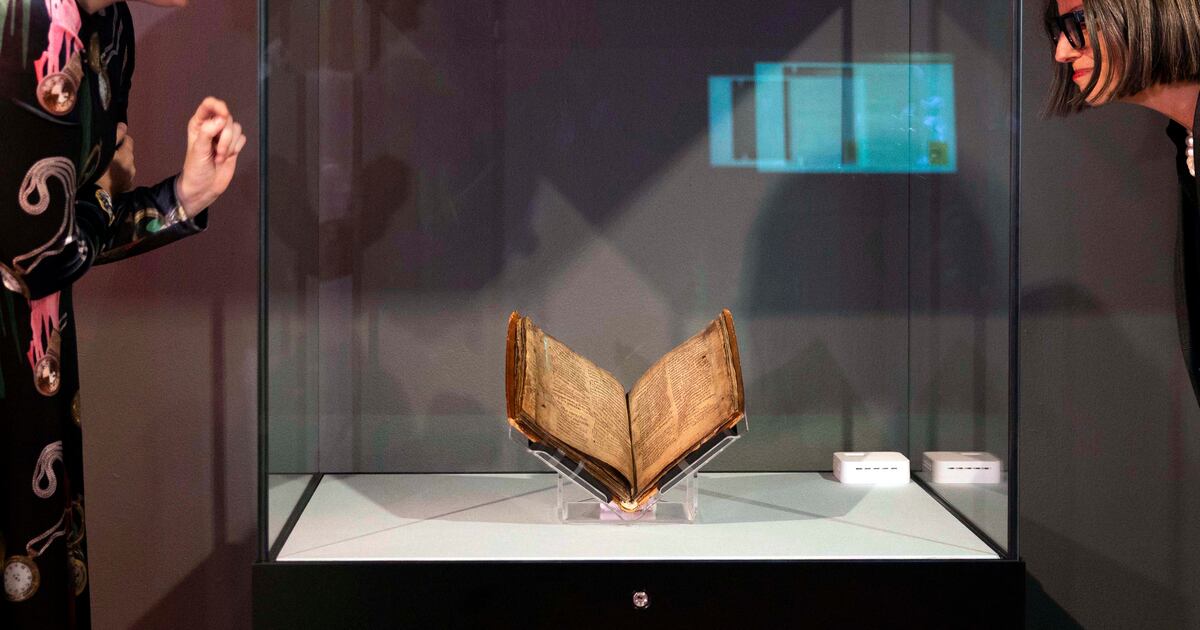
For the past two months, the Annals of Inisfallen, a medieval Irish manuscript of immense historical importance, has been on public display at the Glucksman museum, University College Cork. Soon, however, this little book of just 57 vellum leaves, recognised as a priceless national treasure, will leave these shores and return to the University of Oxford’s main Bodleian Library, where it has been kept since the 1750s. The last time the Annals of Inisfallen came home was in 1983 when they were exhibited at Muckross House, Killarney, Co Kerry. Then, as now, there were calls for the manuscript’s permanent return to Ireland. People wonder why such an important Irish artefact should be housed in a British library. For anyone unfamiliar, the Annals of Inisfallen are a record of important events in Ireland, chiefly Munster, and abroad between the years 433 and 1450. Written on calfskin vellum, the manuscript was created by more than 30 scribes over the course of about 500 years at different locations. It is thought it was initially copied in the monastery of Lismore, Co Waterford, from materials created in the monasteries of Clonmacnoise in Co Offaly and Emly in Co Tipperary, and Inisfallen monastery on Lough Leane, Killarney, was the last place it was worked on. The text includes references to Saxon attacks, celestial phenomena including a comet, inter-monastic warfare, deadly plagues, Norse raids on Skellig Michael, Brian Boru’s Viking campaigns, Norman invaders, Irish king lists, the deaths of feted poets, saints, clergy, heroes, villains and so on. The good and the bad of the Irish medieval past: they’re all in there.One of Ireland's most significant medieval manuscripts is on view in the Glucksman Gallery in UCC until November 1st. Close to a thousand years old, The Annals of Inisfallen document the history of Ireland before the arrival of St Patrick and afterwards. Photograph: Clare Keogh As a result of Henry VIII’s dissolution of monasteries in Ireland, England and Wales (1536-1540), Inisfallen monastery was later abandoned. By the 1590s, the annals had found their way into the collection of Finghín MacCarthy Reagh, a leading nobleman and scholar. Imprisoned in the Tower of London over a period of 40 years, MacCarthy Reagh had little choice but to sell his manuscripts to finance his release. This is probably how James Ware (1594-1666), a senior civil servant and prolific manuscript collector, came into possession of the annals. It is quite possible that it was Ware who gave the book its name, simply as a catalogue entry. After Ware’s death, the manuscript had different owners until it was bought by Richard Rawlinson (1690-1755), a noted clergyman and antiquarian. Rawlinson bequeathed his enormous manuscript collection, including the annals, to his alma mater, the University of Oxford and the Bodleian Library. The Annals of Inisfallen have been in the Bodleian archive ever since. Undoubtedly, if it were not for collectors such as Ware and Rawlinson, who were genuinely interested in the scholarly study of Irish manuscripts, and without the Bodleian Library’s enduring stewardship, the book would likely have been lost. Their dedication to conservation should be acknowledged.READ MOREHowever, the world has changed, and former colonies are increasingly seeking the return of their ancestral heritage. Museums across the globe, our own included, are examining and engaging in ways to make that process more accessible. Indeed, just this year, the Irish Heritage Council published a report advising the Government on best practices for the restitution and repatriation from Irish institutions of “cultural objects that may have been illegally or unethically elicited or traded”. UK cultural institution have their own way of doing things. The University of Oxford’s museums and libraries, which includes the Bodleian, have procedures in place to deal with claims for the return of cultural objects, stating they will deal with each claim on a “case-by-case basis”. But, this is not as straightforward as it might appear in relation to the Annals of Inisfallen, given that they were purchased legally and given freely to the library. So, where to from here? This past summer, I spent time in Munster where I asked people how they felt about the Annals of Inisfallen. The overall consensus was that the manuscript should be here, not in some foreign institution. The question of legal ownership didn’t really matter. I realised that, while Irish people might not be aware of the finer details of the book, they feel its absence. When I mentioned that the Annals of Inisfallen are freely available online for anyone to view either in English translation or in the original Irish and Latin, that didn’t seem to matter to them. This really is the heart of the issue. Why does an inanimate object such as a book, written long ago, mean so much? It is perhaps because of what that book represents. The Annals of Inisfallen are a reminder of a thriving, independent civilisation that existed before the colonisation that destroyed so much of Ireland’s culture. The annals, which were last on exhibit in Ireland in 1983, present a continuous, year-by-year narrative of death, conflict, dramatic weather events and unusual occurrences. They chronicle events such as Viking raids on Skellig Michael off the Co Kerry coast in 823; the arrival of a group believed to be Ireland’s first Jews in 1079 and the life spans of kings and poets. For centuries, there have been calls to bring the book back home to Ireland, but to no avail. In the 1730s, Dean Jonathan Swift tried in vain to obtain them for Trinity College Dublin. Since Swift’s day, many have sought the annals’ permanent restoration. But, artefacts acquired by British cultural institutions during imperial expansion and colonisation are incredibly well protected by law. And even here in Ireland, any calls for the Annals of Inisfallen’s return are often dismissed as opportunistic political stunts. Small wonder that attempts to repatriate the annals to Ireland have fallen by the wayside. [ Gulliver’s Travels at 300: Did Jonathan Swift predict AI?Opens in new window ]It is a recognised right of people everywhere to determine what happens to their own cultural heritage. Article 11 of the United Nations Declaration on the Rights of Indigenous Peoples (2007) states that “indigenous peoples have the right to ... maintain, protect and develop the past, present and future manifestations of their cultures ...[and] ... artefacts.” The Irish experience of colonisation influences how we feel about our ancestral heritage, especially when that heritage is held outside this country. Our British neighbours may not quite grasp this because they do not share our experience of colonisation. Chris Doyle is lecturer in medieval history at the University of Galway
Opinion: The Annals of Inisfallen are part of Irish history. They don’t belong in a British library
Full Article
Original Source
Read the full article at Irishtimes →KhanList aggregates and links to publicly available news content. We do not host full articles from third-party sources. Always verify important information with original sources.