
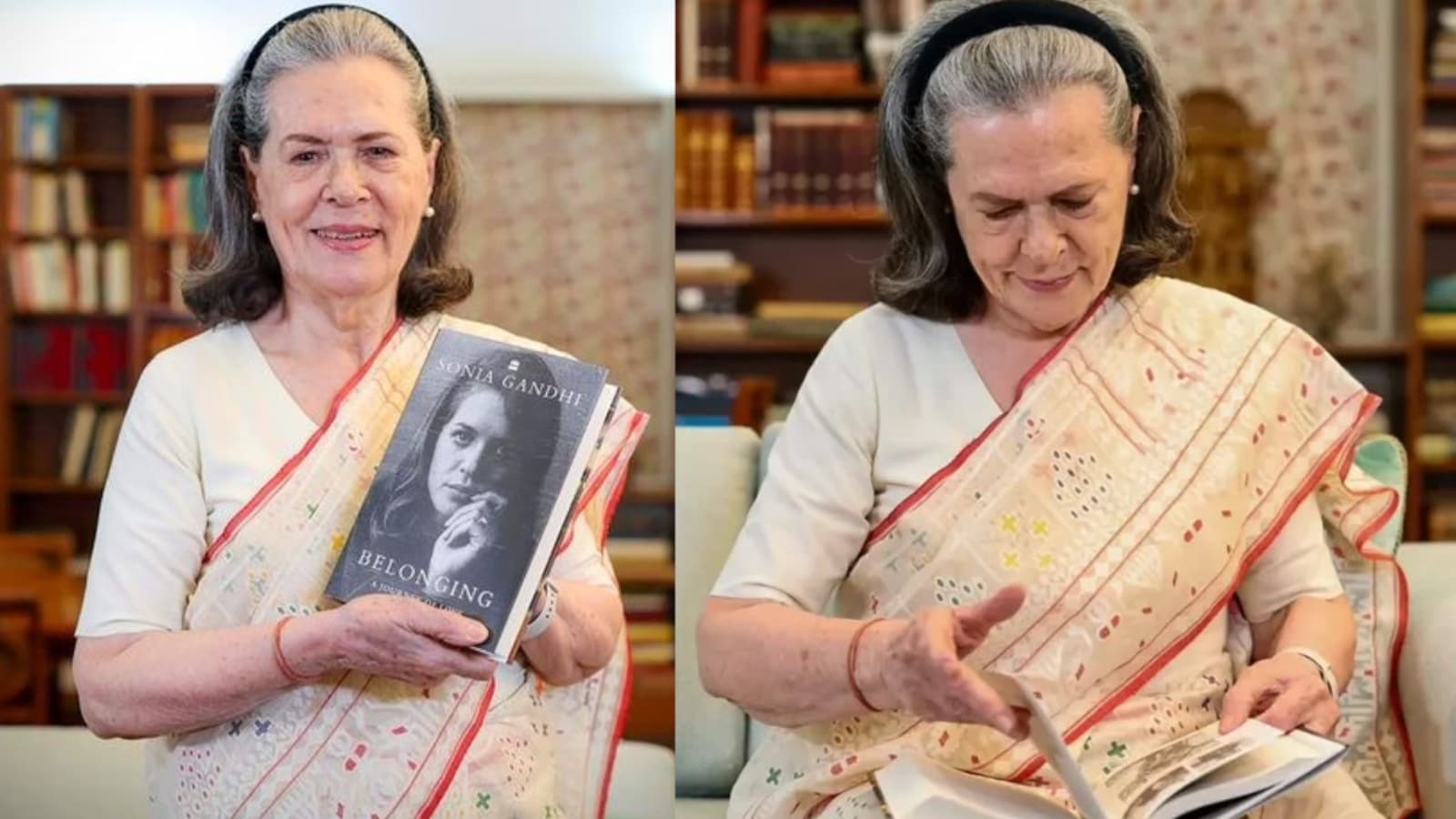
Readers learn of the quiet, painful rupture with Maneka Gandhi after Sanjay's death In the prologue to Belonging: A Journey of Love, Sonia Gandhi makes it clear to her readers that her book is a "personal memoir, one for which politics is the background noise." For a figure long defined in the Indian imagination by her reticence to speak publicly, her inscrutable silences in public, and her unflappable resilience in dealing with the relentless turbulence of Indian statecraft, this opening declaration is both a disarming invitation and a quiet assertion of ownership over her own story. True to her word, the book resists the conventions of the standard political tell-all, choosing instead to chronicle the slow, arduous, and ultimately transformative journey of how a young woman from a provincial Italian town came to make India her permanent home and committed herself to it. Well-being.The opening sections of the memoir are deeply affecting, driven by unexpected emotional candor. Gandhi writes with unvarnished sincerity about her childhood in Piedmont and her complicated relationship with her stern, traditionalist father, Stefano Maino. Far from the familiar trope of an Indian family resisting a foreign daughter-in-law, it was her own father who objected to her marriage, refused to attend the wedding, and sent a brief, cold letter afterward reminding her that his door would always remain open - a gesture that moved her to tears as she wondered whether he doubted her ability to adapt to her new circumstances. Her fierce, enduring love for Rajiv Gandhi, described with utter honesty and genuineness in words that will move the hardest-hearted reader, saw her through every trauma of adjustment and upheaval. She recounts with remarkable vulnerability the daily struggles of adjusting to life in New Delhi - navigating unfamiliar customs and food, learning a new language, coping with a larger-than-life mother-in-law (who would punish errant aides by making them stand in a corner like naughty kindergarteners), then gradually becoming a vital part of the family and slowly shedding her status as an outsider.At the emotional core of these early chapters are intimate portraits of family life and shared grief that have remained largely hidden from the public eye. Most devastating is her account of losing her firstborn son in January 1969, delivered prematurely two months before his due date. Having fallen instantly in love with the tiny, perfectly formed infant in his incubator, Sonia and Rajiv were shattered when he died the following morning, weeping together despite Rajiv's habitual emotional reserve. She writes poignantly of rejecting the traditional Hindu practice of immersing a newborn's body in a river, leading to agonizing family discussions before Rajiv and Sanjay buried the child beneath a bougainvillea bush at Feroze Gandhi's farmhouse in Mehrauli, a spot where the couple would pause for years afterward to leave flowers. A single flower. Equally striking are her personal glimpses of Indira Gandhi, who emerges very differently from the iron-willed stateswoman of history books, as a tender, protective, yet mercurial matriarch and doting grandmother. When her first-born grandchild died, Indira cut short an official tour to rush to the hospital with red, swollen eyes to comfort her grieving children, even as she remained a woman of distinct moods and a fierce temper (her household staff and physician routinely checked whether her "mood toh theek hai?" before entering her room).Throughout these pages, surprising revelations about the family's private world humanise figures long rendered two-dimensional by political mythology. Readers learn of the quiet, painful rupture with Maneka Gandhi after Sanjay's death, sparked when Indira judged the twenty-three-year-old mother too young for an immediate political role and deepened when Maneka moved out of the household while Indira was in London. In later chapters, the author is equally forthright about her own closely-guarded health battles during the second UPA government, revealing that she traveled not to New York, as the press had widely speculated, but to Milan in 2010 for the removal of breast tumors and to Rotterdam in 2011 for pancreatic surgery. She had two reasons for these choices: to protect her privacy, since details would have leaked from any Indian hospital, and to be near her supportive sisters. By sharing these private trials with genuineness and without self-pity, the author opens a rare window into her soul, allowing readers to see the sensitive, deeply feeling heart beating beneath an exterior that decades of public scrutiny had taught her to clad in armor.Of course, in a life intertwined with the destiny of modern India, politics cannot remain merely a faint murmur; inevitably, the storms of history penetrate the boundaries of the personal memoir, the "background noise" crashing through the windows of the First Family's household. Sonia Gandhi revisits defining national crises - the 1975 Emergency, which she candidly terms a mistake even while maintaining that Indira Gandhi was a democrat at heart upon whom the suspension of civil liberties sat heavily, as well as Operation Blue Star, the assassination of her mother-in-law, and the 1991 tragedy that took Rajiv's life. Her account of the years following 1991 captures the torment of a woman who detested politics and fought against entering it, until a sense of duty, crystallised by her assiduous learning from the Bhagavad Gita, compelled her to step forward in 1998. In these political sections, there are intriguing disclosures: she recounts her reasoning for declining the prime ministership in 2004 in favour of Dr Manmohan Singh, implies that Pranab Mukherjee suggested she oust Singh in 2010 during a difficult phase for the coalition, and fiercely rebukes former media advisor Sanjaya Baru's 'The Accidental Prime Minister' as a tissue of falsehoods designed to drive a wedge between her and Singh. Yet her silences are just as telling and entirely understandable. True to her lifelong instinct for discretion, she declines to name the political leader she felt betrayed her trust during the 1999 coalition negotiations, passes over the estrangement between the Gandhi and Bachchan families in dignified silence (which will strike the reader as odd because of her affectionate description of the Bachchans during their early friendship), omits specifics on the Bofors scandal and Ottavio Quattrocchi, says nothing startling or headline-worthy about current political figures, avoids entirely the controversy about her relations with Narasimha Rao, and generally avoids the score-settling that characterizes most contemporary political memoirs.Historians and political analysts searching Belonging for such revelations, detailed political post-mortems, or vengeful partisan polemics are barking up the wrong tree. This is not a "political" biography; it is, as she has made clear at the start, a personal memoir above all. Those who are expending ink on the errors and omissions in its pages will inevitably find them; identify all the gaps you want, fail to find sensational gossip or shattering political revelations, and you may come away disappointed. But if you want to understand the human being behind those events you know about, then this is the book for you. Read Belonging, as I did, not as a political history, but as the intimate portrait of a human being who has chosen finally to tell her own story - a woman who crossed continents for love, endured unimaginable personal bereavement under the glare of a nation, even harbouring dark, suicidal thoughts in the wake of her husband's assassination, and slowly, with uncommon devotion and commitment, earned her place in the soil of her adopted country and in the hearts of her fellow Indians.
Opinion: Sonia Gandhi, Belonging And Why This Story Lies On Other Side Of Politics - By Shashi Tharoor
Full Article
Original Source
Read the full article at Ndtv →KhanList aggregates and links to publicly available news content. We do not host full articles from third-party sources. Always verify important information with original sources.