
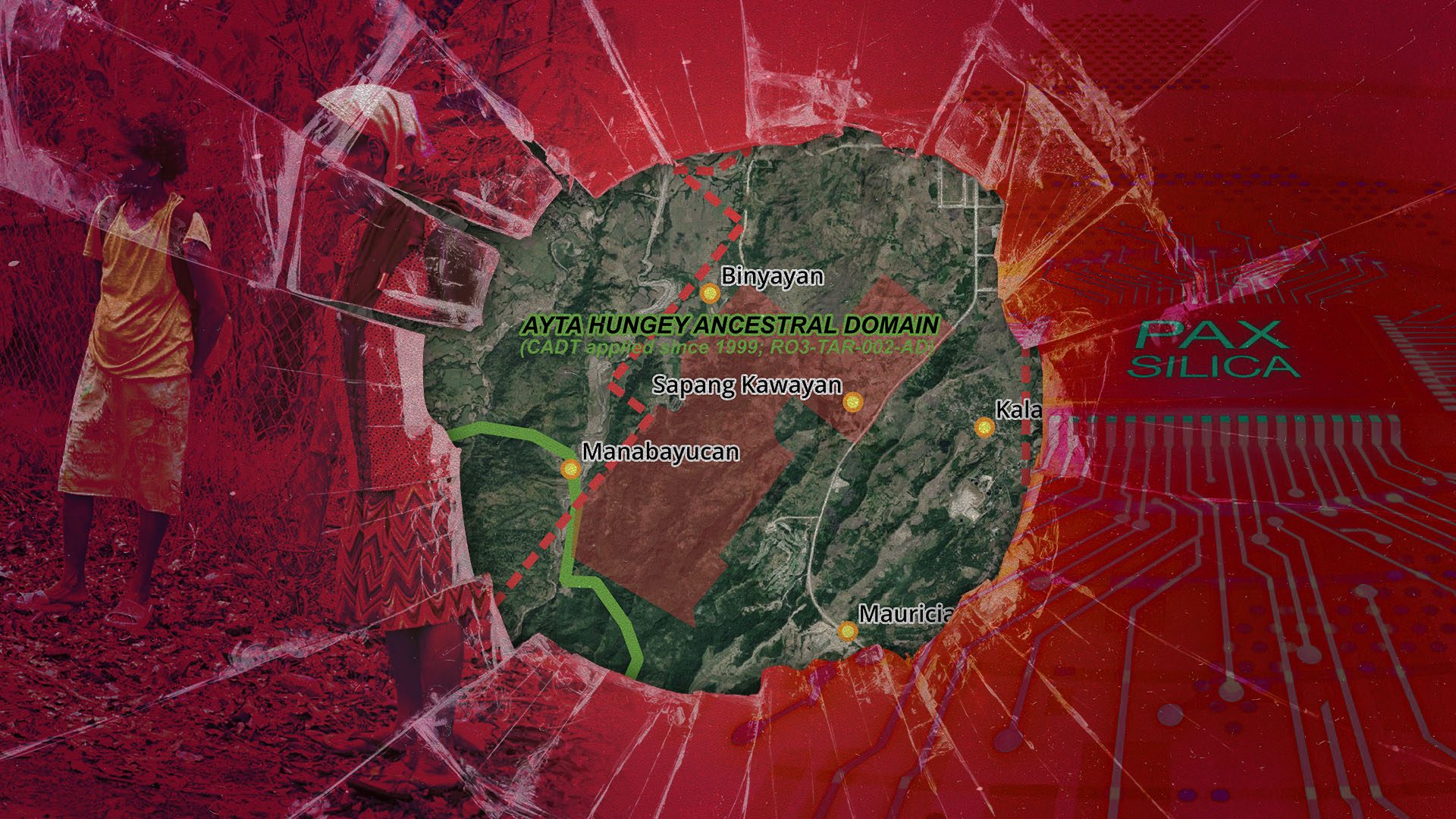
The Philippines is once again being drawn into an American imperial agenda through Pax Silica, a US-led initiative designed to secure semiconductor and critical mineral supply chains. With plans for an artificial intelligence hub in New Clark City, the government is promoting Tarlac as an emerging center of technological innovation and investment. But amid the excitement over this ambitious project, an important question remains largely unanswered: What happens to the Indigenous communities whose ancestral lands are caught within these development plans? I find it troubling that the Bases Conversion and Development Authority (BCDA) continues to assure the public that no Indigenous communities will be displaced by these developments. Such assurances overlook the longstanding ancestral land claims of the Ayta Hungey, whose relationship with this part of Tarlac extends across generations. Even if no homes are physically demolished, development can still profoundly affect Indigenous communities by restricting access to lands, resources, and places central to their livelihoods and cultural life. Consequences of bureaucratic delay At the heart of this issue is the unresolved ancestral domain claim of the Ayta Hungey. Since 1999, the community has pursued a Certificate of Ancestral Domain Title (CADT). Despite repeated submissions and more than two decades of waiting, their application remains unfinished. Meanwhile, large-scale development projects continue to advance across the surrounding landscape. This prolonged bureaucratic delay has consequences beyond administrative inconvenience. Without a formally issued CADT, government agencies can treat ancestral lands as though no legitimate Indigenous claim exists. Yet the absence of a government-issued title does not invalidate generations of occupation, stewardship, and cultural attachment to land. The Ayta Hungey were there long before New Clark City was conceived, and their ancestral relationships cannot be made invisible simply because the state has failed to complete its own recognition process. Indeed, when the government can move quickly to facilitate investment but takes decades to process Indigenous land claims, bureaucratic delay becomes implicated in dispossession. The imbalance is difficult to ignore. Land can be mobilized for infrastructure, investors, and technological development while the people who have historically occupied and cared for it remain trapped in an unfinished administrative process. The Philippines already has laws that recognize Indigenous rights. The Indigenous Peoples’ Rights Act (IPRA) acknowledges ancestral domains and Indigenous self-governance, while the Philippines supported the United Nations Declaration on the Rights of Indigenous Peoples in 2007. These commitments should carry weight when decisions are made about the future of ancestral territories, regardless of whether the administrative process of issuing a CADT has been completed. Planning without consulting communities The controversy surrounding Pax Silica also exposes persistent problems in how development is planned in the Philippines. Major projects are typically conceived by government agencies, consultants, and investors before communities have any meaningful opportunity to shape their direction. Public consultations may follow, but by then the location, scale, and purpose of development have often been determined. Participation becomes an exercise in responding to decisions rather than helping make them. For Indigenous communities, this approach is especially troubling. Those without conventional property titles can be treated as illegal settlers, even when their occupation and use of land predate the institutions now claiming authority over it. Such classifications reveal how state planning continues to privilege formal property regimes while marginalizing Indigenous histories and territorial relationships. We must also question what government agencies mean when they claim that no communities will be displaced. Displacement is not limited to the demolition of houses or the physical relocation of residents. New roads, industrial facilities, restricted development zones, and rising land values can transform access to agricultural lands, forests, water sources, pathways, and livelihood spaces. Farmers and other residents in surrounding areas may experience these changes even when their settlements remain physically intact. This is where geography and mapping become particularly important. The accompanying map identifies Ayta sitios, approved ancestral domains, the pending Ayta Hungey ancestral domain claim, New Clark City, and the proposed Pax Silica AI hub. By bringing these locations together, it raises questions that official assurances of non-displacement have yet to adequately address. Government planning maps should be examined alongside community-generated maps documenting settlements, agricultural areas, water resources, livelihood spaces, and other places that matter to Indigenous life. PERSPECTIVE. The map shows the Ayta sitios, approved Certificates of Ancestral Domain Title, the pending Ayta Hungey ancestral domain claim, New Clark City, and the proposed Pax Silica AI hub. Arnisson Andre Ortega and Counter Mapping PH What government agencies designate as available land may already be part of a complex Indigenous landscape of livelihood, memory, and belonging. Ignoring these relationships makes it easier to portray development areas as empty or underutilized spaces awaiting investment. There is also something deeply contradictory about the country’s enthusiasm for technological innovation while continuing to rely on conventional, top-down approaches to planning. We celebrate artificial intelligence and advanced infrastructure, yet the institutions responsible for development often struggle to recognize the knowledge and political agency of communities whose lands are being transformed. If innovation is genuinely a national priority, why should it stop at technology? We should also rethink how development decisions are made and who gets to make them. For the Ayta Hungey, meaningful participation requires more than being invited to consultations or informed about projects already approved. They must have a substantive role in determining the future of their ancestral territories, including the authority to question, negotiate, and influence development proposals. Their knowledge of forests, water systems, agricultural practices, and cultural landscapes should be integral to planning rather than treated as supplementary information for technical experts. Recognizing Indigenous communities as co-equals means acknowledging that they possess their own priorities, political institutions, and visions of development, which may not always coincide with those of government agencies or investors. Steps the government can take There are concrete steps that government institutions can take. The National Commission on Indigenous Peoples (NCIP) should publicly explain why the Ayta Hungey CADT application has remained unresolved since 1999 and provide the institutional support necessary to move the process forward. BCDA, for its part, should acknowledge the pending ancestral domain claim and ensure that it is properly considered in planning New Clark City and projects associated with Pax Silica. Claims that Indigenous communities will not be affected should be supported by transparent assessments that account for ancestral land claims, community land use, and potential impacts on livelihoods and resources. Ultimately, the issue is not whether the Philippines should pursue technological development. It is whether such development will reproduce the longstanding inequalities through which Indigenous peoples have been excluded from decisions about their own lands. The country’s ambitions to become a major player in global technology supply chains should not come at the expense of rights that its own laws recognize. For the Ayta Hungey, the immediate concern remains the recognition of their ancestral domain and their ability to exercise meaningful authority over its future. After more than two decades of waiting, they deserve more than another assurance that development will leave them unaffected. National development should not require Indigenous peoples to disappear from our maps. If Pax Silica is meant to represent the future of the Philippines, that future must include the Ayta Hungey as co-equals in shaping what happens to their ancestral lands. We cannot build the future by erasing the people who are already there. – Rappler.com Arnisson Andre Ortega is an associate professor of geography at Syracuse University. He leads Counter‑mapping PH, a collective of Filipino mappers advocating for marginalized communities through participatory mapping. For seven years, he has worked closely with the Aeta Hungey community in Tarlac.
[OPINION] Pax Silica and the erasure of Ayta Hungey ancestral lands
Full Article
Original Source
Read the full article at Rappler →KhanList aggregates and links to publicly available news content. We do not host full articles from third-party sources. Always verify important information with original sources.