
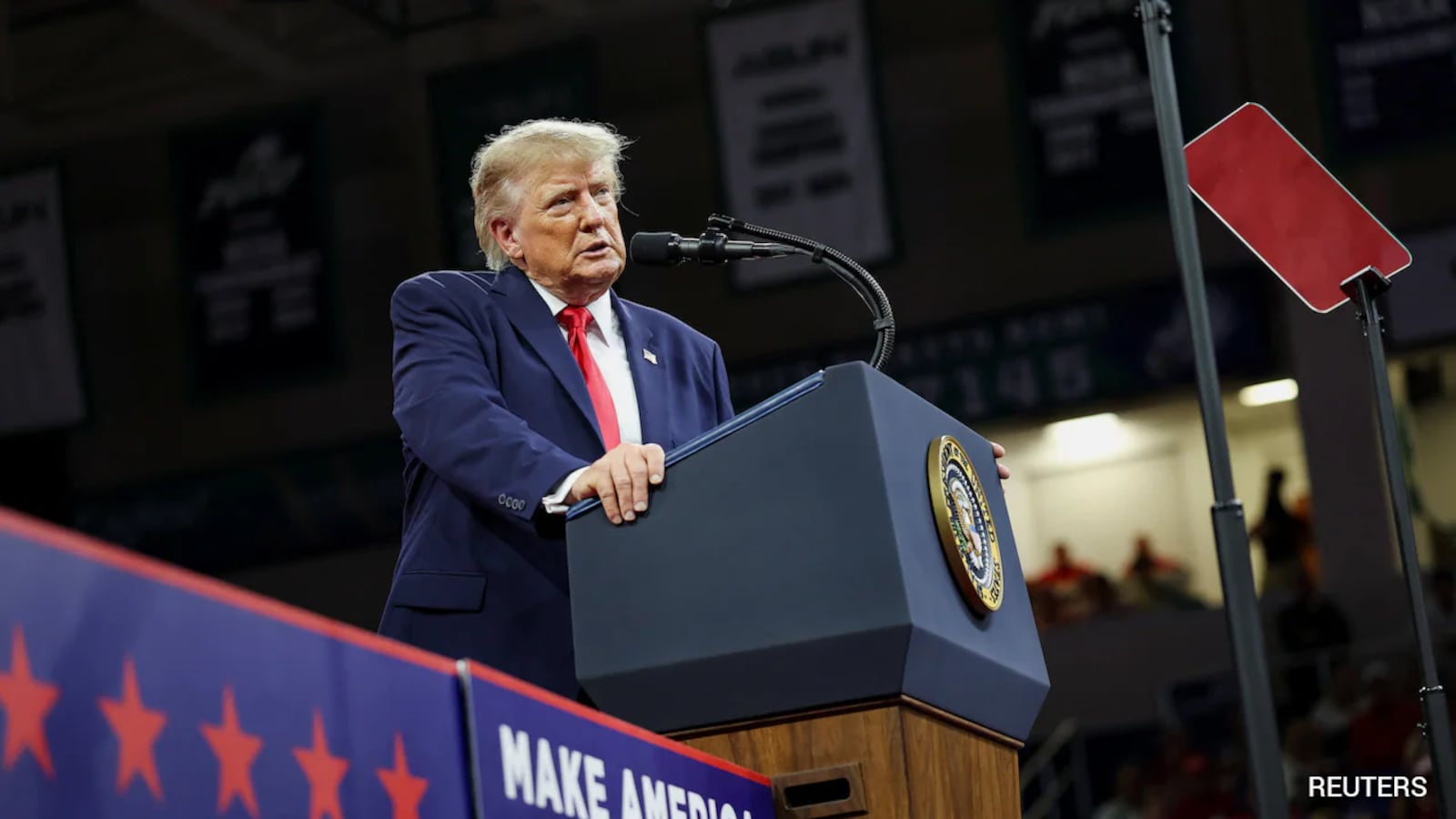
The American political system has often delivered a pendulum-like swing during midterm elections, which have tended to serve as a built-in institutional mechanism for course correction. For an incumbent administration in Washington, losing seats halfway through a presidential term is standard practice, and a setback for the White House was therefore expected. "Anti-incumbency" is not merely an Indian emotion. Yet, the scale of the Democratic "flip" in the 2026 US midterm elections extends far beyond routine political swings. What was expected to be a modest wave of opposition pushback, with Democrats perhaps winning the House and coming close in the Senate, instead transformed into a sweeping realignment across both chambers of Congress.The crowning symbol of this shift came in Texas, where a Democrat became Governor after decades, and the Democratic Senatorial candidate, James Talarico - whose campaign caught Indian attention when he made dosas at an Indian eatery to win Indian-American votes - ended a 32-year statewide drought by defeating the Republican incumbent in the US Senate race. For political observers in New Delhi watching the results unfold, this amazing Democratic flip in Texas, an entrenched "red" or Republican state, symbolised the comprehensiveness of the GOP defeat. Coupled with the Democratic party's comfortable command of both the Senate and the House of Representatives, the midterm election results signal a profound domestic rejection of the current policies of the Trump administration. Driven primarily by anxieties over inflation, trade policy friction, and daily living costs, all exacerbated by Trump's Iran War and erratic tariff policies, American voters recoiled against Trump's policies, delivering a decisive reprimand to the ruling party. Advertisement - Scroll to continue Beyond The EuphoriaHowever, from the perspective of Indian strategic interests, it is crucial to separate domestic electoral theatre from the realities of American foreign policy execution. The instinct among global onlookers is sometimes to assume that a shift in congressional majorities translates directly into a reversal of Washington's international posture. In the American constitutional architecture, that assumption simply does not hold true.While the incoming Democratic majorities in Congress gain formidable power over the purse strings, executive authority in foreign affairs remains largely intact. President Donald Trump retains broad, independent constitutional power as Commander-in-Chief to do pretty much as he pleases, including resuming the bombing of Iran, trying to topple the Cuban government, or pulling the plug on Ukraine (all possibilities he has hinted at). Although a Democratic-controlled Congress will undoubtedly introduce War Powers resolutions to try and restrict his freedom of action, and probably host high-visibility oversight hearings targeting America's overseas military entanglements, these legislative manoeuvres will merely confirm the Democrats' powerlessness in the face of the hard institutional limits imposed by the American political system. Any resolution seeking to constrain executive military action requires presidential approval, but it will encounter the President's veto. And overriding a presidential veto demands a two-thirds majority in both chambers - a threshold the Democrats do not possess despite their substantial gains.Advertisement - Scroll to continueTrump Still Runs AmericaFurthermore, the economic tools that define modern international relations, such as tariffs and sanctions, remain heavily concentrated within the executive branch. Congress could deny the President the funds needed for extensive overseas military deployments, but it cannot curb such actions as executive tariffs, sanctions, and even bombing campaigns, which lie within the President's sole discretion. In particular, the President's statutory authority to impose broad trade tariffs under national security provisions or executive emergency powers persists, regardless of who holds the gavel in the House or the Senate. For India, this means that the core economic variables shaping bilateral trade policy, from sector-specific tariffs to supply chain pressures, as well as the discretion to end the current waiver of the Graham Act and impose sanctions on India for trading with Russia, remain firmly rooted in the White House. New Delhi will still have to deal directly with the President and his cabinet appointees to negotiate trade access, manage regulatory frameworks, and resolve bilateral friction.Where the midterm outcome offers immediate psychological and practical relief for India is in the domestic socio-cultural atmospherics of the United States. The MAGA ecosystem's rhetoric often fostered an increasingly restrictive and hostile environment toward immigration, non-white populations, and foreign skilled labour, a hostility that especially seemed to target Indians. The realignment delivered by the midterm elections signals a distinct cooling of that hyper-nationalist political temperature, which would be welcome news to most Indian-Americans, who seem to have voted overwhelmingly Democratic this year.For the vast Indian diaspora, including hundreds of thousands of IT professionals, students, researchers, and entrepreneurs, a less adversarial national environment reduces anxiety around visa stability, green card backlogs, and the everyday climate of racial antagonism and "othering". The Indian-American community, which has grown into a powerful economic and civic force within the United States, stands to benefit from a public landscape that is less hostile to global talent and brown-skinned minorities.Room To BreatheBeyond executive powers like tariffs, the Democratic sweep of Congress reconfigures key legislative platforms - such as the House Foreign Affairs and Armed Services Committees - in ways that could significantly influence US-India defence and diplomatic engagement. With Democrats taking the committee chairmanships (unlike in India, where eight of our 24 Parliamentary Standing Committees are chaired by the Opposition, US Committee chairs are always held by the majority party), some interesting changes are likely. Representative Ami Bera, the longest-serving Indian-American in Congress, is in line to chair the House Foreign Affairs Subcommittee on South Asia or the Indo-Pacific, creating a knowledgeable, sympathetic interlocutor for New Delhi on Capitol Hill. This shift will elevate legislative focus on critical bilateral initiatives like the Initiative on Critical and Emerging Technology (iCET) and joint defence manufacturing, while ensuring strong Congressional support for Quad cooperation, provided the Trump Administration is still interested in promoting the Quad.At the same time, our Ministry of External Affairs (MEA) will have to face another reality. Democratic committee leadership will bring heightened scrutiny to secondary issues that are less favourable to New Delhi, with Democrats such as Pramila Jayapal raising issues relating to the human rights record of the Modi government, others expressing concern about religious freedom issues involving Muslims and Christians, and the "usual suspects" questioning India's continued purchases of Russian crude oil (several Democrats supported the passage of the Graham Act mandating 100% sanctions on India and China for such purchases). On the whole, these changes could create a foreign policy landscape where institutional strategic partnership and defence tech integration will move forward more haltingly, alongside more active and critical Congressional oversight of Administration initiatives.What Really MattersBut we will simply have to cope. Ultimately, India's strategic posture has always rested on the principle of pragmatic non-partisanship. The US-India strategic partnership is not built on individual personalities or single-party alliances; it is anchored in deep structural realities, ranging from shared security imperatives in the Indo-Pacific to robust technology and defence integration and the influential presence of the thriving Indian-American community. These verities are not going to go away.Governments in Washington change, congressional majorities flip, and political tides ebb and flow. India's diplomatic machinery this century, under both Congress and BJP governments, has successfully navigated Republican and Democratic administrations alike for decades. Regardless of who controls Capitol Hill or the West Wing, and how transactional Washington's approach has become, maintaining a resilient, multi-faceted relationship with the United States remains an imperative for Indian foreign policy. It's one that New Delhi must continue to manage with steady realism and calculated self-interest.(Shashi Tharoor has been a Member of Parliament from Thiruvananthapuram, Kerala, since 2009. He is a renowned author and a former diplomat)Disclaimer: These are the personal opinions of the author
Opinion: Opinion | Trump's Midterm Rout Eases India's Worries. But It Doesn't End Them
Full Article
Original Source
Read the full article at Ndtv →KhanList aggregates and links to publicly available news content. We do not host full articles from third-party sources. Always verify important information with original sources.