
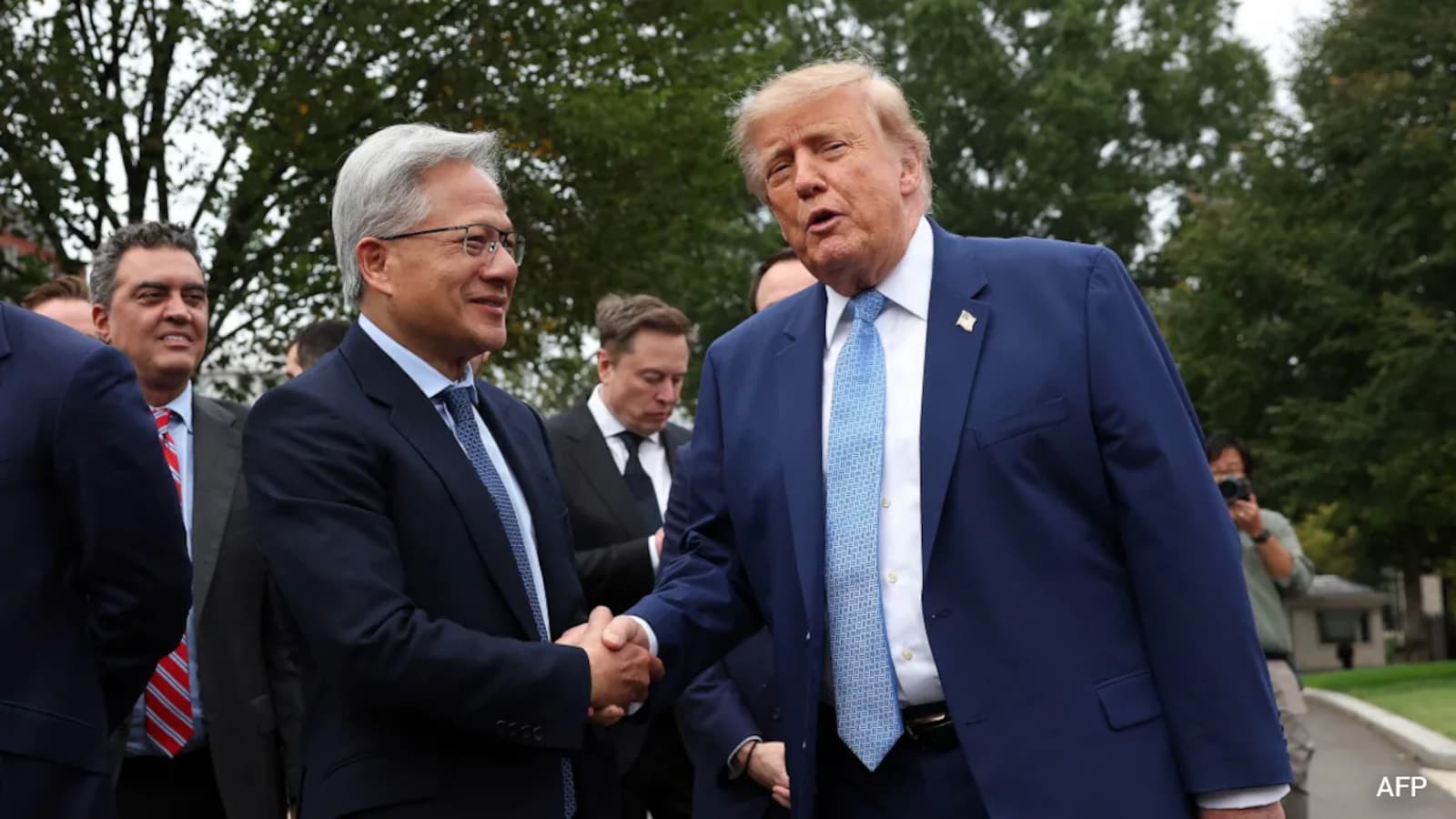
It is a pity that James Bond is British and not American. If he were, there is almost a 100% certainty that the next Bond movie, which will feature Robert Pattinson playing the charming action spy, will pair him with an attractive Chinese model out to steal high-power microchips.But then, we now have a thriller plot with a corporate U-turn that will put any climactic car chase in a Bond movie to shame. Jensen Huang is back in the seat as Chairman and CEO of Nvidia, the world's hottest artificial intelligence (AI) company, after a sex-and-spy case. Only a week ago, I mulled over how he was a potential liability. Now, he is being advertised as a prized US asset. And the person making the announcement is no less than the President of the United States. Advertisement - Scroll to continue After a week of tumult that saw stock markets yo-yo amid talk of an AI bubble, there are two hard facts staring at us. One, tech power remains the linchpin of US superpower clout, enough for a CEO under a scandalous cloud to be reinstalled over the heads of warring cabinet members and the chairman of the company itself. And two, there is now an America Inc resembling the Japanese keiretsu corporate network of yore, with close-knit companies acting like a systemic group.And The CEO is Donald TrumpTrump left little to the imagination as he gave an unusually long-winded and elaborate phone interview to CNBC anchors after personally taking ownership for the return of Taiwanese-born Jensen Huang, calling him a national asset alongside former Apple CEO Tim Cook, even as trading screens dramatically flashed Nvidia's stock zooming back as high as 35% before ending the day up at 31.5%.Advertisement - Scroll to continueThe fact that Huang returned despite being on the edge of a honey-trap relationship involving alleged Chinese spy Alice Huang and illegal supply of AI semiconductors, hides a deeper truth. I spent the weekend preceding the Nvidia CEO's return watching a documentary outlining the long history of the company he founded, and at every step, you can see his dedication to high-power semiconductors and the way he understands the labyrinthine alleys of advanced chip design. That makes him not too big to fail, but too important for America to lose, which is engrossed in a historic economic race with Beijing's dragon.With dry, ironic humour, one might say that US intelligence sleuths seem to have confirmed to the White House chief that Jensen Huang may have failed as a devoted husband in acknowledging an illicit relationship with a foreign spy, but did not wilfully let down Uncle Sam. Between Jensen and Alice Huang, there was something that, for want of a better expression, is best described as a Chinese wall, not an unholy nexus.Trump says Nvidia's mastery over high-performance chips gives the US a clear lead over China, and that is a clincher that helped the President overrule Harvey Jones, who, as temporary chairman of Nvidia after the geek wizard's exit, said that Jensen Huang will not return. Famous last words.Gossipy tongues are wagging that Trump's own business stakes in Nvidia have helped him rake in millions of dollars as the company's shares zoomed back up after the plunge that followed Huang's exit, but that would be a red herring in a tale that truly involves geopolitics and the future of the world economy. The reality is that American nationalism and Wall Street greed are in a happy waltz.But, as they say in Bollywood, the tale is not over: Picture abhi baaki hai.There's plenty to watch out for after this honeymoonish kiss-and-make-up episode. Huang's exit from Nvidia triggered fresh talk that we may be seeing the end of an AI asset bubble in the stock markets, as casino-style bets have been laid on companies whose valuations far exceed their sales figures. That scepticism is bound to return sooner or later in the backdrop of high inflation and interest rate hikes in the US.In a larger sense, Trump may be leading an America Inc high-tech keiretsu (systemic network) of companies that include AI rivals such as Amazon, Microsoft, Facebook-owner Meta, and Alphabet. But Nvidia in itself is involved in a web of investment and credit schemes in its own AI-focused keiretsu that cynics say conceals a Ponzi-like structure that may unravel at some point - much like the "dotcom bubble" of Internet companies that burst circa 2000.Nvidia is estimated to have made investments valued at close to $100 billion in companies linked to the AI system, earning the dubious description of the "central bank of AI". It also has up to $118 billion in financial guarantees and credit commitments that remind one of the tricky subprime securities that caused the Wall Street collapse of 2008. A lot depends now on how real value is generated for end customers because AI involves various kinds of execution risks: Unemployment, corporate disruptions, pricing, re-learning, cybersecurity, and rogue activities.The focus must now shift beyond semiconductor chips that go into data centres and companies that make large AI software models, such as Anthropic (which saw a roller-coaster IPO coinciding with the Nvidia crisis). Here's where business value and revenue streams need to match the kind of frenzied growth at the frontline of chips, data centres, and AI "neoclouds".Hours ahead of Huang's famous return to Nvidia, CrowdStrike, a key partner company of the chip-maker, announced a whopping $44-billion acquisition of fellow cybersecurity firm Zscaler, co-founded by Varanasi IIT-educated Jay Chaudhry, who was born at Panoh, a foothill village in Himachal Pradesh. The 68-year-old's stake is now valued at $15 billion in a showpiece tale of how fortunes change overnight in Silicon Valley. Chaudhry's personal wealth is now close to the entire market value of the BSE that drives the Sensex.Companies like CrowdStrike and the corporates who will eventually use and pay for AI capacities and services will have to substantially certify if the current valuations of giants like Nvidia and Anthropic are justified.In other words, America Inc is certainly on strong ground, but the AI saga will see some hairpin bends that will also feature more Asian characters, AI models, and companies. Watching all this is likely to keep us thrilled in 2027. Who needs a James Bond movie?(Madhavan Narayanan is a senior editor, writer, and columnist with more than 30 years of experience, having worked for Reuters, The Economic Times, Business Standard, and Hindustan Times after starting out in the Times of India Group)Disclaimer: These are the personal opinions of the author
Opinion: Opinion | Too Big To Fail, Too Connected To Fall: Why Trump Needed Jensen Huang
Full Article
Original Source
Read the full article at Ndtv →KhanList aggregates and links to publicly available news content. We do not host full articles from third-party sources. Always verify important information with original sources.