
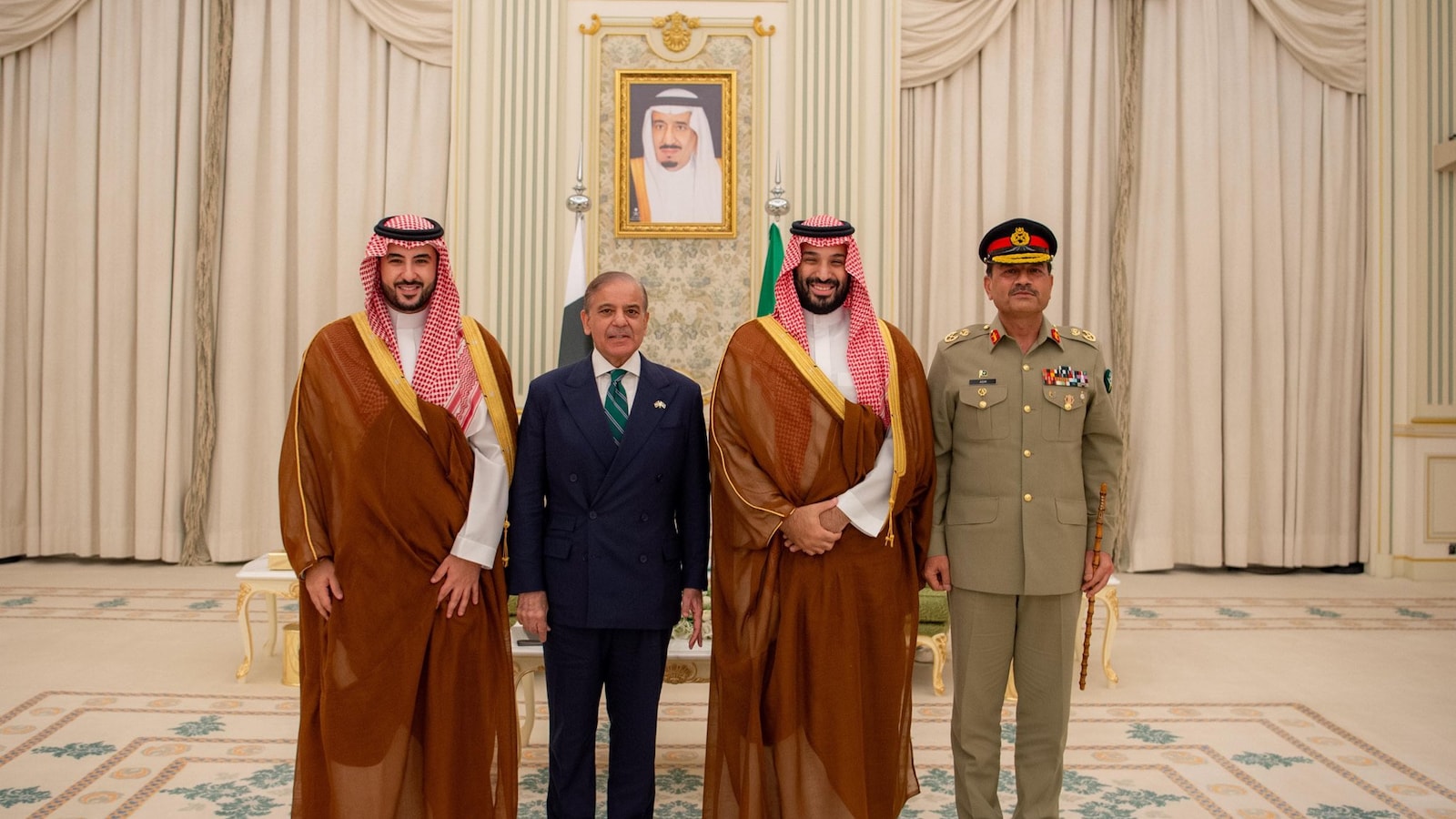
With the attack on King Khalid airport that killed more than a dozen and injured hundreds, a crisis seems to be already in the making. Add to this a series of unsurprising but vitally important events in recent days. First reports suggest that the Pakistani military is being rapidly deployed to Saudi Arabia, without the slightest intimation to Parliament, not even a nominal discussion. That's Pakistan. Second, a furious Iran is issuing warnings and threats to Pakistan - again, an expected outcome of the rapidly unfolding events. Third, Tehran is proceeding to give the Taliban access to the Chabahar port, in a deliberate move to bring Afghanistan into the picture, which is being bombed by Pakistan. And finally, rumours suggest that a Pakistani retired official is in India for a reach out to New Delhi, probably to ensure that the western border remains peaceful as Pakistan hurtles into a deadly war.Meanwhile, all pretence at a democracy in Pakistan has been unceremoniously abandoned.The Many Troubles With The Mecca PactThe Pakistani Parliament has hardly ever had the slightest power, with the legislative body having no say in the Mecca agreement either. True, that a rather apologetic-looking Prime Minister signing it should have meant an approval of some kind from Parliament. After all, he is actually the 'Prime' minister, the first among equals. But the reality has always been made and unmade by the military, which considers its own interests first, and then the country's. Advertisement - Scroll to continue But that's what is rather mysterious here. This is no good for the Pakistan military at all. It risks pulling troops into one of the most involved and bloody fights in recent years. The Houthis have demonstrated their capability in terms of drones and missiles and have no compunction in hitting civilians or anyone else. This is the rag-tag force that drove the United States into a truce last year, which seems to have led to an agreement - kept so far - not to target US ships presumably in the Red Sea, where the US hardly operates anyway. The Houthis continued their campaign against Israel, which peaked as the war began in earnest in March 2026. The group, which once operated with just some Kalashnikovs and support weapons in early 2000, evolved into a full-fledged fighting force that used a claimed 2,500-km missile to attack Ben Gurion airport, and later a "hypersonic' missile, not to mention a mix of drones and cluster munitions. Since the Houthis hardly have an industrial base, it seems pretty clear that friends and neighbours were supplying them heavily.The Saudi-Yemen War, And PakistanAnd then it turned its rage on Saudi Arabia. That's a toughie. After all, the fight between them goes back to 2015, or even earlier, when a Riyadh-led coalition backed the government of President Abdrabbuh Mansur Hadi in Yemen. That was a big mistake. Iran then stepped up its existing assistance, turning the whole saga into a wider Saudi-Iran fight for influence, a tussle that is decadal.Advertisement - Scroll to continueBut the Houthis, who follow Zaidi Shia Islam, which differs from the Twelver Shia tradition of the Iranian Shias, aren't exactly Iranian proxies. What is important to understand, therefore, is that the Houthi-Saudi fight is a subset, almost a segment of the wider war. In other words, the US itself has little to do with it, as long as the Houthis don't attack Israel too much and the Saudis don't collapse entirely. Which is probably why President Donald Trump blessed the Mecca agreement signed in August, which the Saudi Press Agency defined as "intended to strengthen collective deterrence against any act of aggression, and stipulates that any armed attack against Saudi Arabia, Turkiye, or Pakistan shall be regarded as an attack against them all". That left everyone wondering who the 'common enemy' was, and, most importantly, whether the deal included a nuclear cover by Pakistan. The latter, in turn, very quickly emphasised that the agreement was not against any one country, and hedged severely on the nuclear aspect. At various times, Gen Munir was seen visiting Riyadh, and one of his retired generals, Lt Gen Nauman Mahmood, was given a comfortable perch as the head of the Alliance.Jolted To LifeBut now, it seems the Saudis have thrown a fit. At an emergency meeting of the newly established Strategic Political and Defence Committee in Riyadh, the members of the Mecca pact decided "to move immediately to the practical implementation of the collective defence commitments".The operative part of the decision is pretty specific. The three countries agreed to "take the necessary measures to provide the agreed military forces and capabilities and ensure their rapid deployment in the Kingdom, in accordance with the approved arrangements and the national legislation of the Parties". That is, it has to still chime in with national legislation. Under Article 245 of the Constitution of Pakistan, the Armed Forces operate under the directions of the Federal Government to defend the country and assist civil power. It does not provide a unilateral or standalone mandate for the military to wage offensive foreign wars on its own authority. Any deployment, even for, say, UN peacekeeping, thus technically requires the mandate of the House.Pakistan has, meanwhile, already positioned (but not technically deployed) some 8,000 troops, JF-17 jets, drones, and HQ-9 air defence systems, all paid for by the Saudis. But though that also did not pass Parliament, it could be interpreted as being part of existing agreements, including the very first in 1967, which positioned Pakistanis for training and later defended the Kingdom against Yemeni Intrusion (1969). Don't forget that some 15,000 troops were sent there after the seizure of Mecca in 1979, with Pakistani forces fighting side by side with the Saudis. In short, it's all been done before. From that period onwards, till recently, the Saudis stood solidly with Pakistan against India, with a pragmatic prince reaching out to New Delhi with friendship and investment only in recent years. That could change rapidly, if Rawalpindi has a say. And right now, it seems it does.The DownsideBut there are other questions ahead. Turkey is already drawing lines in the sand. Its Foreign Minister, Hakan Fidan, stressing the defensive nature of the Mecca pact, said that Turkey will not deploy troops to another country's territory to launch an attack. Turkey will probably provide its extensive defence equipment, which is what Pakistan needs. A few long-range drones like the Bayraktyar Akinci, with its 7,500-km range, would be a huge plus for operations.It is technically doable. But the downside is that Iran is furious. Ominous statements have been emanating from the country in recent days. One lawmaker warned that Pakistan's entry into the war against Yemen "shows that Pakistan should no longer be considered a mediator but a regional intervenor". State media Tasnim baldly stated that if Turkey and Pakistan participate in attacks on Yemen, "they may be directly harmed through attacks on their ships, interests, and perhaps even their own territory". Well, Ankara has bowed out, leaving Rawalpindi with the mess.There's worse. Iran has reached a "preliminary understanding" to allocate land at Chabahar to the Taliban to build infrastructure for moving its goods to the sea. An Iranian parliamentarian was quoted as saying that about 10 hectares along the waterfront inside Chabahar port and more than 100 hectares in the special zone in an initial phase would be given to the Taliban, who would then invest in developing it. All in all, a very interesting coming together of various actors.In the meantime, the news is that Pakistan has sent a certain former diplomat to India to reach out to the Indian government. Expect that the US will also lean on India to 'play the game' and allow Pakistan to play its fighting role in Saudi Arabia.The key here could be Beijing. As US reports note Beijing's extensive weapons assistance to Iran, it is illustrative of the kind of quiet clout it has with Iran. Beijing may well act to restrain Tehran in its ire against Pakistan, thus once again emerging as a peacemaker, at least in public.Finally, for all those who were envious of Pakistan's 'new status' as "mediator extraordinaire", this is the reality. Rawalpindi has always bitten off more than it can chew. This time, it could, however, choke itself to death if this particular cookie crumbles halfway.(Tara Kartha is a former Director, National Security Council Secretariat)Disclaimer: These are the personal opinions of the author
Opinion: Opinion | Saudi Airport Attack, And Why Pakistan Keeps Biting Off More Than It Can Chew
Full Article
Original Source
Read the full article at Ndtv →KhanList aggregates and links to publicly available news content. We do not host full articles from third-party sources. Always verify important information with original sources.