
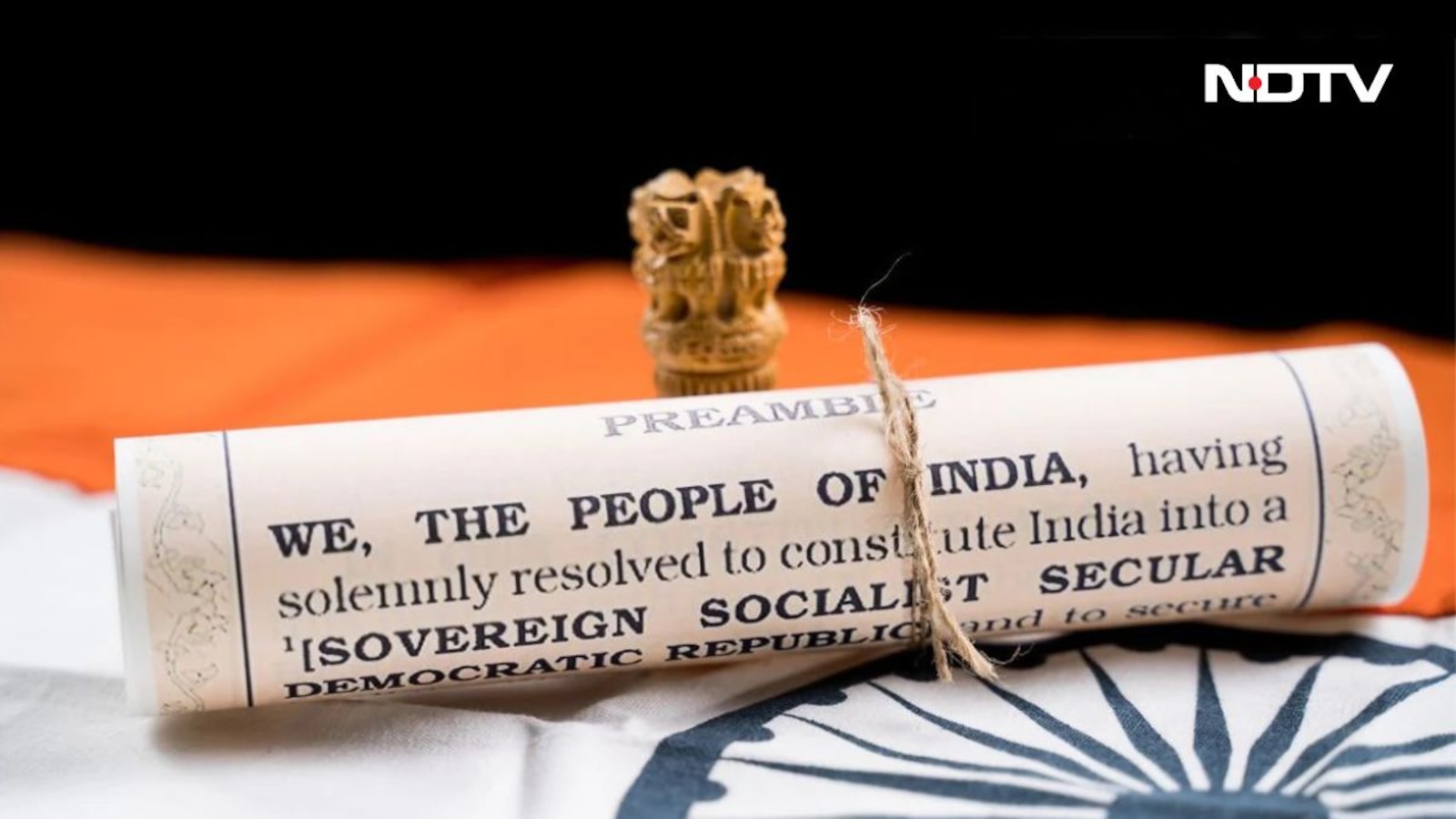
On November 26, 1949, the Constituent Assembly, an indirectly elected 299-member body, finished its daunting task and agreed on a Constitution for India that was to be formally adopted two months later, on January 26, 1950. The nationalist movement that gave our Constitution its legitimacy and sanctity had itself used many arguably non-constitutional methods in its struggle against imperial rule - non-cooperation, civil disobedience, satyagraha. Yet, it culminated in a democratic Constitution, at 145,000 words the world's longest written Constitution for any nation. It was hailed by the Oxford scholar Kenneth Wheare as 'the world's greatest experiment in democratic government'. It is now 87 years since the text of that Constitution was agreed; in that time, the average life of Constitutions adopted around the world during the same period has been 17 years.The Indian Constitution is often described as a 'living document', but such a biological metaphor undersells its original, defiant ambition. When the Constituent Assembly gathered in the shadow of the horrors of the late 1940s, in the aftermath of Partition with its massacres and forced migrations, it was not merely codifying the existing norms of a nation; it was attempting a radical, top-down transformation of a deeply illiberal society. While the classic Western liberal tradition, borne of the Enlightenment, sought to protect the individual from an overreaching state, the Indian liberal project was distinct. It sought to use the state as an instrument of liberation to rescue the individual from the suffocating hierarchies of society. Advertisement - Scroll to continue From What Had BeenThe historical descent of India from a civilisation of profound intellectual openness into a deeply rigid, illiberal social order was the result of gradual, deliberate structural processes. While ancient India's philosophical laboratories celebrated a boundary-pushing freedom of thought, this conceptual liberty was increasingly decoupled from the material organisation of daily life. The turning point occurred as the flexible, occupational groupings of the early Vedic period hardened into the hereditary, water-tight compartmentalisation of the varna and jati systems. This ossification was systematically codified by priestly elites through legalistic texts like the Manusmriti, which sanctified hierarchy, enforced strict endogamy, and criminalised social mobility.By transforming an accident of birth into an unalterable cosmic destiny, these texts institutionalised the ultimate illiberal practice: the total subjugation of the individual to the collective identity of the group. As dynastic states partnered with orthodox elements to enforce these social codes in exchange for political legitimacy, the radical, pluralistic potential of Indian philosophy was effectively insulated from social reality. The public square remained a space for debating abstract metaphysics, while the village square became a site of enforced segregation, structural violence, and systemic inequality.Advertisement - Scroll to continueA RebirthNevertheless, despite centuries of deep-seated social orthodoxy, the India of the 1940s contained a remarkable convergence of liberal possibilities that made the drafting and implementation of a progressive constitution possible. This political miracle did not emerge from a vacuum; it was the culmination of a century of internal churning. The ground had been thoroughly prepared by the radical social egalitarianism of reformers like Jyotirao Phule, the intellectual iconoclasm of the late nineteenth-century renaissance, and a massive anti-colonial struggle that had mobilised millions under the banners of civic rights, self-determination, and pluralism.By the time the Constituent Assembly met, the intellectual leadership of the nation - spanning diverse ideological spectrums from communists to Muslim Leaguers, and thinkers from BR Ambedkar to Jawaharlal Nehru - shared an unshakeable consensus that a free India could not simply replicate its past, nor could it survive as a majoritarian state. The urgent trauma of Partition, combined with the visible horrors of caste oppression, acted not as a deterrent but as a catalyst. It created a unique historical window where the elite and popular imagination alike were primed to accept a transformative, rights-based framework as the only viable contract to hold a multi-layered civilisation together.The Constitution of India fits flawlessly into the historical and philosophical trajectory of Indian freedom, particularly in the way it was legitimised in the early years post-Independence. Far from being a mere patchwork of foreign borrowings, the Constitution stands out as a sterling achievement of this Indian mould of freedom - a grand exercise in adapting the best democratic principles from around the world and anchoring them within the country's unique social realities.'Freedom' And Its Many MeaningsYet, this shared methodology of reconstruction did not produce a rigid conformity. The very concept of freedom that Vivekananda championed as Hinduism's great moment of reckoning and social awakening was later articulated by Tagore as a universalist anathema to the dark, exclusionary impulses of modern nationalism. Gandhi, meanwhile, ground that same spiritualised freedom down into a highly practical, day-to-day principle of non-violent social service. Through these diverse expressions, the Indian theory of freedom proves itself to be a dynamic, living philosophy, one where the reconstruction of ancient truths became the ultimate vehicle for achieving a modern, democratic reality.Crucially, a 'liberal constitution' in the Indian context did not mean a lazy piece of plagiarism that merely mimicked the institutional architecture of the American or British models. Instead, it represented an Indian, deeply reformist document, engineered specifically to manage the distinct frictions of a deeply unequal and diverse society.An authentic liberal constitution is defined by its commitment to complex balancing acts rather than absolute, hands-off dogmas. The text of the Indian Constitution masterfully balances individual liberty with structural equality, recognising that liberty is a cruel joke for those denied the material baseline of human dignity. It balances the preservation of distinct group identities and minority protections with the overarching imperative of a cohesive national identity. Furthermore, it rejects a fundamentalist view of laissez-faire economic 'freedom', choosing instead to balance private economic initiative with the state's moral obligation to ensure collective well-being and distributive justice.By encoding these delicate counterweights into the foundational law of the republic, India's founders proved that a Constitution is truly liberal not when it enforces a sterile, atomised individualism, but when it actively creates the legal and social conditions for an emancipated, egalitarian citizenship.This is what we celebrate on Constitution Day today - the document that made Indians of us all, free and equal citizens of a Republic that is perpetually a work in progress, but one whose possibilities are encoded in a foundation that has stood the test of time.(Shashi Tharoor has been a Member of Parliament from Thiruvananthapuram, Kerala, since 2009. He is a renowned author and a former diplomat)Disclaimer: These are the personal opinions of the author
Opinion: Opinion | How India's Constitution Was A Rebellion Against Its Own Past
Full Article
Original Source
Read the full article at Ndtv →KhanList aggregates and links to publicly available news content. We do not host full articles from third-party sources. Always verify important information with original sources.