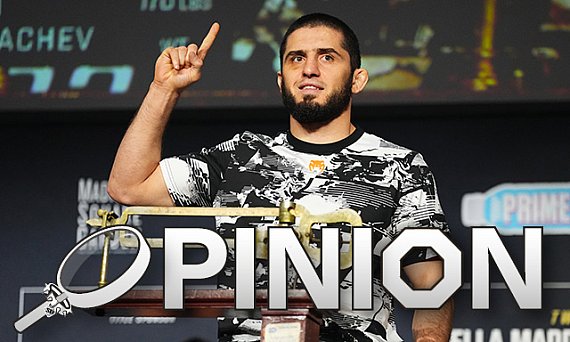
Islam Makhachev of Russia poses on the scale. | 📷: Jeff Bottari/Zuffa LLC via Getty Images Editor’s note: The views and opinions expressed below are those of the author and do not necessarily reflect the views of Sherdog.com, its affiliates and sponsors or its parent company, Evolve Media.* * * UFC 330 is creeping up on us, and it presents a couple of interesting title fights that illustrate the complexities of weight cutting from several different angles. Welterweight champion Islam Makhachev plied his trade at lightweight for the first decade of his Ultimate Fighting Championship career before climbing to 170 pounds as his metabolism slowed with age. Did he claim the belt from Jack Della Maddalena because it was a favorable matchup for him? Or will the long and lanky Ian Garry prove to be too much for the stockier champion? Even the women’s strawweight championship offers some interesting dichotomies. Many who followed champion Mackenzie Dern early in her career believed she needed to be fighting at 125 pounds. It’s hard to fault them when Dern missed weight in half of her first six career contests at 115. It turned out to be a matter of maturity and professionalism, as Dern hasn’t missed weight once since becoming a mother, a span of 13 fights. On the flip side, challenger Gillian Robertson is one of the few fighters in recent years whose career has taken off after dropping down in weight. After going 8-5 at flyweight, Robertson has managed to avoid the bullying that plagued her in her old home, going 6-1 since dropping to 115 pounds.How extreme weight cutting became part of MMA culture Since weight classes were introduced to MMA, weight cutting has always been a factor. Its impact was minimal at first, with the likes of Tito Ortiz and Pat Miletich among the first to experience the advantages that come with the practice. As time passed, more fighters picked it up until it became extremely rare for someone outside the heavyweight division not to cut weight to some extent. Hell, even heavyweight had plenty of prominent combatants cutting insane amounts of weight, most notably Brock Lesnar. Even after it got to the point where everyone was cutting weight, the practice continued to escalate until it seemed fighters were cutting as much as humanly possible, threatening their health and well-being in the process. Arguably, the most notable example is the late Anthony Johnson. For several years, the heavy-handed hitter tortured his body by cutting down to the welterweight limit. Upon deciding it was foolish to punish his body that much, Johnson eventually found his greatest success at light heavyweight — a full 35 pounds heavier than the weight he had consistently tried to make. Sure, Johnson walked around at a lighter weight when he was attempting to make welterweight, but he was still cutting to get down to 205 pounds. The UFC didn’t exactly help matters, either. The promotion continually attempted to get Cris Cyborg to cut down to 135 pounds to make a superfight between her and Ronda Rousey happen. Cyborg managed to cut to 140 pounds on a couple of occasions and documented the ordeals. It was clear Cyborg couldn’t make 135 pounds while maintaining the fighting shape required for her to be the fighter she was, and the UFC relented in trying to force her down. Of course, that also coincided with the realization that Rousey wasn’t coming back at that point, but we’ll leave that alone.Why more UFC champions are moving up in weight Even though the likes of Michael Bisping and Robbie Lawler claimed UFC gold only after committing to competing against opposition their own size, it has been more common for fighters to move up in weight to find greater success. All four of the “champ-champs” moved up in weight to claim their second belts. Among those who managed to win titles in two divisions after either losing or relinquishing their first belt, only Randy Couture and B.J. Penn dropped weight classes to claim their second titles — and they were the first two to do so. Since then, nine consecutive fighters have moved up to claim second titles, including Makhachev. It appears fighters have realized that extreme weight cutting hasn’t produced extreme results, not to mention that it likely shortens careers. Weight-cutting horror stories haven’t been nearly as prominent as they once were. I can’t say they’re in the past, as it wasn’t that long ago that Cameron Smotherman passed out at a weigh-in, but images of Aspen Ladd quivering on the scale or James Irvin looking downright skeletal have become less common. Fighters are discovering how much hydration matters on fight day. Given that fighters have the agency to determine which division best suits them, we’ll never completely rid ourselves of dangerous weight cutting. Agency is both a wonderful thing and a hell of a bugger. Of course, the reason so many fighters attempted to squeeze their frames into the smallest possible weight class is that size does matter. All those statements about “it isn’t the size of the dog” are bunk. I’ve never seen a Chihuahua beat up a Rottweiler, and I’ve never seen someone who wasn’t extremely tall play center in basketball. Weight classes exist for a reason. That doesn’t mean it’s impossible for the smaller combatant to overcome the larger one, but there’s a reason folks tend to enjoy the underdog story. There’s a reason David and Goliath is frequently cited when discussing major upsets. I accept that there are often advantages to being smaller, but they tend to be outweighed by the disadvantages.Why Ian Garry presents a different test than Makhachev faced at lightweight That’s why I’m so intrigued by Makhachev’s attempted defense against Garry. Makhachev hasn’t faced anyone with Garry’s physical makeup, with the Irishman being by far the largest opponent Makhachev has faced. It’s true that Garry isn’t known for his wrestling, but his reach creates a lot of distance for Makhachev to cover if he hopes to utilize his greatest advantage. Throw in the fact that Garry’s footwork and lateral movement are among the best in the division, and I’m not positive Makhachev’s move up in weight is going to be as successful as everyone thinks. After all, we all saw what happened to Ilia Topuria against Justin Gaethje. I will acknowledge that the best version of Makhachev today is likely at 170 pounds. Metabolism slows as one gets older, and the cut to 155 pounds would take more out of him than it used to. However, I also don’t believe today’s version of Makhachev is the best version we’ve seen. He turns 35 in a few months and has lost the size and strength advantages he enjoyed at lightweight. Even though I worry about Makhachev’s ability to dominate at 170 pounds the same way he did at 155, I think he understands the weight-cutting balance better than most. As more fighters appear to be figuring it out, here’s hoping there’s no shortage of those who do.
Opinion: Islam Makhachev's biggest UFC 330 challenge may be his new weight class
Full Article
Original Source
Read the full article at Sherdog →KhanList aggregates and links to publicly available news content. We do not host full articles from third-party sources. Always verify important information with original sources.