
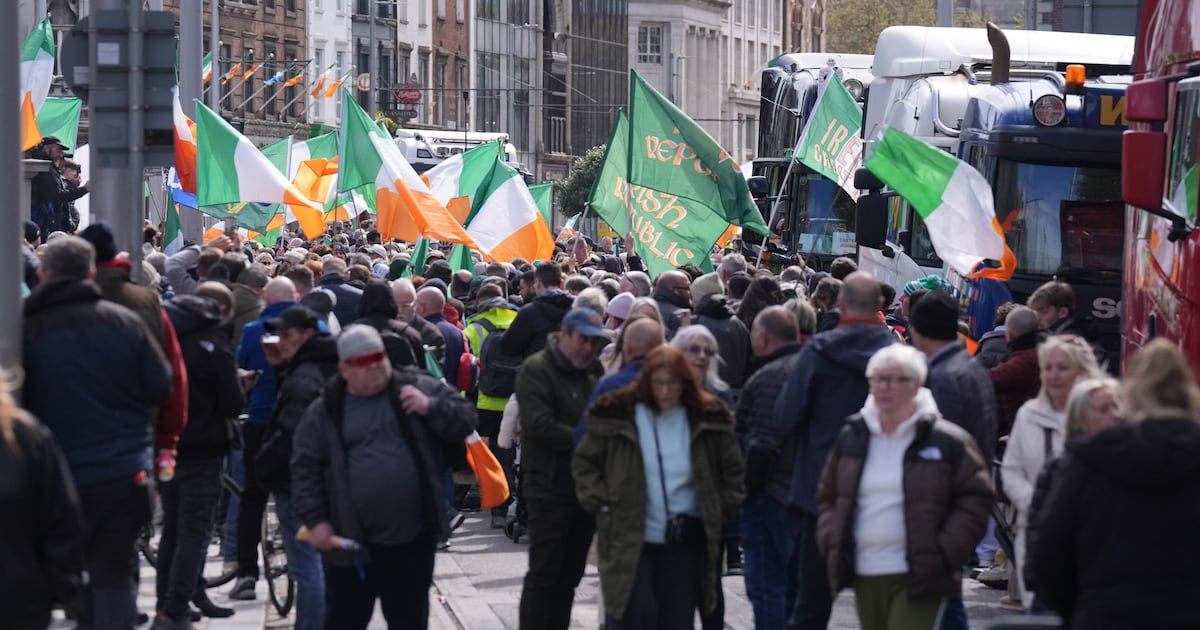
Across France, town halls are being petrol bombed while half a million people are drawn to the streets to revolt. I do not need to belabour the extent to which the French, rather famously, tend to go all-in on their protests Curiously though, in the same week, Ireland staged its largest strike since 2009 – with about 300,000 teachers, nurses and civil servants downing their tools for a single day. The strikers were looking for a pay rise, which can be thought of as a short-term solution to the structural quagmire the country finds itself in, at best.While the majority of people I meet seem to lament endlessly their dissatisfaction and even anger with the state of Ireland’s economy, at some stage the inevitable question arises: why does anger about our fast-deteriorating living conditions never amount to pressure for structural reform? The answer, I suspect, lies in how that frustration is organised. While the proclivity for protest runs through French culture deeply, Ireland has a pressure-release mechanism that ensures our anger rarely spills into the streets: we negotiate politely, we distribute out money and subsidies, and eventually, should that fail to satisfy us, we emigrate. READ MOREThis creates what we see today; a dystopian equilibrium in which people’s disillusionment is matched equally by their desire to maintain the status quo – in a system that never quite reaches the boiling point of being challenged. And as long as there is enough cash to be handed out and enough one-way flights to Sydney available to escape the problems, this will continue. So if Irish people just leave before we get too angry, why did the fuel protests in April manage to create so much disruption over fuel prices, while the wider anger with housing, public services and the cost of living rarely gets airtime outside of WhatsApp group chats? Is it because the right are able to mobilise, while the left are not?[ Europe is changing, but Ireland has yet to noticeOpens in new window ]Perhaps the lens to understand this question is not political, but economic. Because while political ideology was a useful sorting mechanism for most of the postwar period, our differences in class conflict fragment today between two groups: those who are protected by the current economic system and those who are locked out of it. And mobilising action within these groups is then decided, very simply, by whether the lack of delivery of the political class has become sufficiently intolerable – and whether the Government can respond to the resulting disquiet.The people benefiting from the status quo aren’t necessarily those who are wealthy, nor are they all on the left or right. This is somewhat due to Ireland not quite developing a clear left-right divide seen in other European countriesA public sector worker who is asking for a pay rise is very different from a young student in rental accommodation who is asking for a functioning housing market. For starters, one has an organised constituency with a recognised negotiating mechanism within the Government and a specific, numerical demand – and the other doesn’t. The interests of renters are widespread and vary enormously – including across left and right political ideologies – and what they need is much harder to deliver than a pay cheque. They need the Government to change the system entirely, including removing policies which protect existing housing prices, that a large voting base relies on. [ It seems we will tolerate any wrong so long as it is smallOpens in new window ]This creates an intriguing complexity in Irish class conflict. The people benefiting from the status quo aren’t necessarily those who are wealthy, nor are they all on the left or right. This is somewhat due to Ireland not quite developing a clear left-right divide seen in other European countries. After all, for the last century, we’ve had the same two parties – Fianna Fáil and Fine Gael – alternating and more recently coalescing – in government, with the economic model staying the same.This means that people who are losing out from the current system are not brought together under a single political project that is capable of challenging the Government. Our frustration finds ways to leak away.But this is not always the case, as we saw in April in the fuel protests. Disruption can happen – and especially when people can identify a collective demand; a demand which is directly connected to their lives, and that can reasonably force a Government response.The fuel protests have often been described as a worrying demonstration of power by far-right political operators that were acting outside of the established system; that the right were willing to disrupt the daily life of the hard-working people that the left purportedly represents. But again, this political lens isn’t as useful as an economic lens. [ Europe does not need Patrick Collison to ‘fix’ itOpens in new window ]The protests were organised around real and material problems, and it just so happened that in the political vacuum in which these problems are barely acknowledged by Ireland’s political class, right-wing operators were the only available conduits to translate the hauliers’ grievances into political pressure. To show just how little the left-right axis had to do with the protests, a poll at the time showed that 56 per cent of Irish people supported these protests. It is hard to reconcile this with the narrative that it was a fringe operation outside of the political mainstream. However, the left-right framing gives the political class a very convenient way to dismiss their protests.Isn’t it easier, after all, to condemn the dangerous politics of those who want recognition of their problems, rather than to explain to the same voters why that problem has become so big in the first place? Or why the politicians have, decade after decade, proven themselves entirely incapable of doing anything about it? The vacuum that gave air to the right was created by the left’s habitual inability to organise people around specific demands, despite it being able to explain structural inequality so precisely. This gap between “talking about” and “doing” is often driven by the breadth of the left’s constituents: small businesses, the youth, renters, public sector workers, the educated elite – people that don’t necessarily have identical immediate needs that can be used to create immediate pressure.The political failure around protests can therefore be explained by the left being unable to take Irish economic dysfunction and turn it into a larger project of reform. Said another way, the left has failed to impose any cost on the government for its decades-long inaction, whereas the right has. The right makes it clear that the State can be forced to act – but only if disruption becomes more expensive than inaction. And unless the left learns to impose that same cost, the Irish structural failures will continue to be managed and negotiated away by one-day strikes rather than creating the urgently-needed reform.
Opinion: Ireland’s left has failed to penalise government for decades of inaction but the right has
Full Article
Original Source
Read the full article at Irishtimes →KhanList aggregates and links to publicly available news content. We do not host full articles from third-party sources. Always verify important information with original sources.