
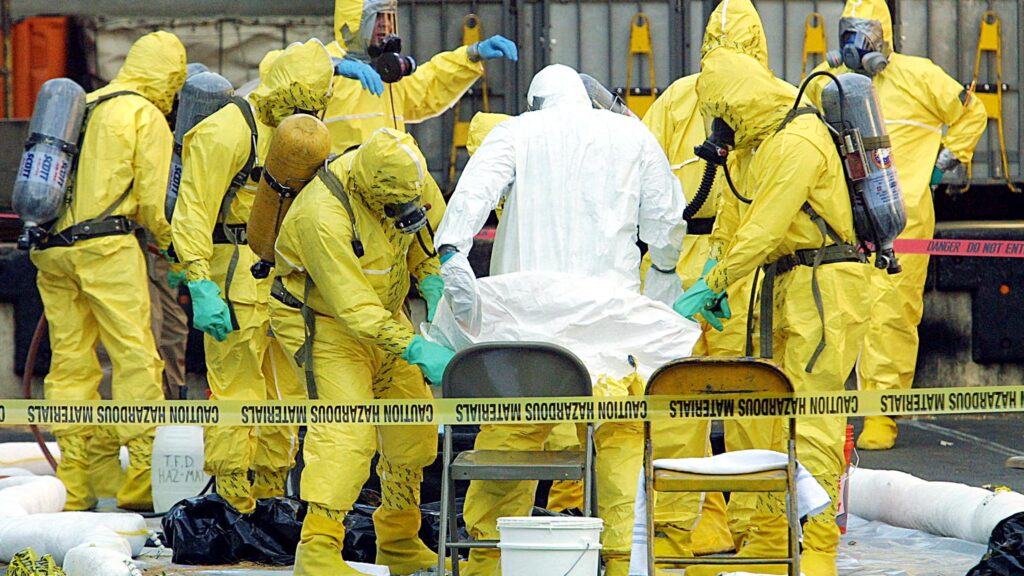
Twenty-five years ago, as the country still reeled from Sept. 11, the first of two batches of anthrax-laden envelopes were mailed from New Jersey to news media and congressional offices. All told, the letters caused 22 cases of anthrax disease, leading to five deaths; prompted considerable fear in the U.S.; and cost billions of dollars in response and recovery. Remembering how public health responded to the anthrax letters can help inform how we might meet the challenge of something similar today, whether intentional or inadvertent, and whether human or artificially generated. The 2001 anthrax attacks showed how a handful of letters could produce an enormous impact. Everyone gets mail, and the marvel of the postal system’s reach and distribution was intentionally used as an anthrax dissemination machine. One of those powder-containing envelopes was delivered to American Media Incorporated (AMI) in Florida, where a photo editor for The Sun tabloid became severely ill, leading an astute clinician to suspect anthrax based on what he saw in a spinal tap specimen. When the CDC was alerted the next day through its newly established Laboratory Response Network, my colleagues and I began our work. Initially, the investigation focused on possible natural exposures as the source. However, when a second AMI employee was confirmed with anthrax, only weeks following the Sept. 11 attacks, bioterrorism became front and center. This left us a little stunned wondering how large and coordinated the attack might be. The CDC then stood up an Emergency Operations Center (EOC) in one of its auditoriums, sent multiple teams to the field, and I began serving as the lead of the Epidemiology and Surveillance Team at the EOC. After our investigation, my colleagues and I published a paper describing the anthrax cases from contaminated mail. The clinical picture was unusual: Half of the cases were limited skin infection, while the rest were highly fatal inhalational disease. Molecular testing, something relatively novel at the time, was used to show that isolates recovered from patients, from four powder-containing envelopes, and from environmental samples were indistinguishable, indicating a common source. The investigation also identified important differences between the two major mailings: Illnesses associated with the Sept. 18 mailing were more often cutaneous and associated with media workplaces (what we informally called “crunchy” anthrax since it was clumped), while the Oct. 9 mailing was associated with more inhalational disease and illness among postal workers along the mail-processing pathway (what we called “fine powder” anthrax, which was more easily aerosolized). The findings showed that the consequences of an intentional biological release went far beyond the intended targets and that the characteristics of the agent, its formulation, the route of dissemination, and the population exposed likely had an important impact on the clinical and epidemiologic picture. Early on, the difference between the Sept. 18 and Oct. 9 mailings in some ways looked like a crude experiment, where different formulations of anthrax were being tested to see their different outcomes. This made us concerned that a larger release was being planned, but that never happened. In fact, no further intentional releases of anthrax have been reported since then, although many “white powder” episodes have tested the public health and law enforcement communities. Perhaps the most consequential finding was that knowledge available before the attacks did not adequately predict how exposure would occur. Much of the prior literature suggested that the risk of resuspension or re-aerosolization of deposited anthrax spores was low, and our existing guidance at the time largely focused prophylaxis and decontamination on persons and locations directly exposed when an envelope was opened. However, the serious disease and deaths among postal workers caused us to rethink our view of infection as well as our public health response as new evidence accumulated. Ultimately, an estimated 32,000 people began antimicrobial prophylaxis. Fortunately, no additional cases were identified among people at suspected exposure sites who started prophylactic drugs. Through the investigation, we recognized a broader lesson: In a deliberate biological event, initial cases can be misleading, assumptions based on previous experience may prove inadequate, and investigators need to look beyond the intended targets to everyone potentially exposed along the path of dissemination. Today, the technologies available for detecting biological threats are substantially more capable. In addition, mail is screened (and there’s less of it), mail sorters are engineered differently, and the select-agent rules that followed the event make it more difficult for people to misuse their access to anthrax. But the infrastructure to respond to natural and intentional infectious diseases is vulnerable, due to cuts to multiple civilian and military biodefense programs. A recent Center for Strategic and International Studies report stated, “Americans face greater risks from biological threats today than at any time this century—and these risks are growing rapidly.” This heightened risk is driven in part by the increasing capability of artificial intelligence to facilitate development of, and possibly generate, biothreat pathogens, leading the Bipartisan Commission on Biodefense to conclude, “AI fundamentally transforms the biological threat landscape.” Those first days after the initial anthrax case, our muscle memory focused us on the important work of traditional shoe-leather epidemiology. However, the pace and scale of the emerging impact were far beyond our usual outbreak response. Now, 25 years after we hastily set up our first EOC at CDC, three lessons come to mind. First, detection must lead rapidly to interpretation and action. In the current administration, which has undermined independent, evidence-based decision making and biothreat planning, I am concerned that actions following a real intentional biothreat signal might be delayed and not coordinated with increasingly distant state and local governments. Second, preparedness must assume that the initial way of thinking may be wrong. Maintaining a response culture that manages uncertainty and is open to science-driven evaluation is critical to rapid rethinking of infection risks and interventions. However, the current leadership at Health and Human Services has demonstrated an intolerance for internal dissenting dialogue — a significant impediment to rapid course correction. And third, preparedness is a capability that must be continually maintained. Sophisticated technology cannot substitute for experienced people, functioning networks, practiced relationships, and institutions capable of making defensible decisions under uncertainty. With the CDC’s covered civilian staff now running at around 28% lower than in 2024 and with losses of subject matter experts and scientific leadership, the nation’s public health first responders need reinforcements. However, hiring of CDC scientific staff and budget support for high-consequence pathogen programs are woefully slow and insufficient. We’ve come a long way since the fall of 2001, but we find ourselves with recent widening gaps in public health readiness and mitigation. Now, with recent and large outbreaks of hantavirus, Ebola, cyclospora, measles, and others, the specter of an intentional threat like anthrax should motivate all of us to get the focus back on biothreat preparedness, cross-sector coordination, and science-driven assessment and response to emerging infections. Twenty-five years after anthrax was sent through the U.S. mail, we should remember that the first signal will rarely tell us everything we need to know. The strength of the response will depend not simply on whether we can detect the threat, but on whether we still have the people, institutions, relationships, and scientific culture needed to understand it and act. Daniel B. Jernigan, M.D., M.P.H., is a contributing scholar at Johns Hopkins Bloomberg School of Public Health and previously served 31 years at CDC. During the national investigation of bioterrorism-related anthrax in 2001-2002, he participated as the lead for the Epidemiology and Surveillance Team of CDC’s Emergency Operations Center.
Opinion: I worked on the CDC investigation of the anthrax letters. 25 years later, are we ready for the next biothreat?
Full Article
Original Source
Read the full article at Statnews →KhanList aggregates and links to publicly available news content. We do not host full articles from third-party sources. Always verify important information with original sources.