
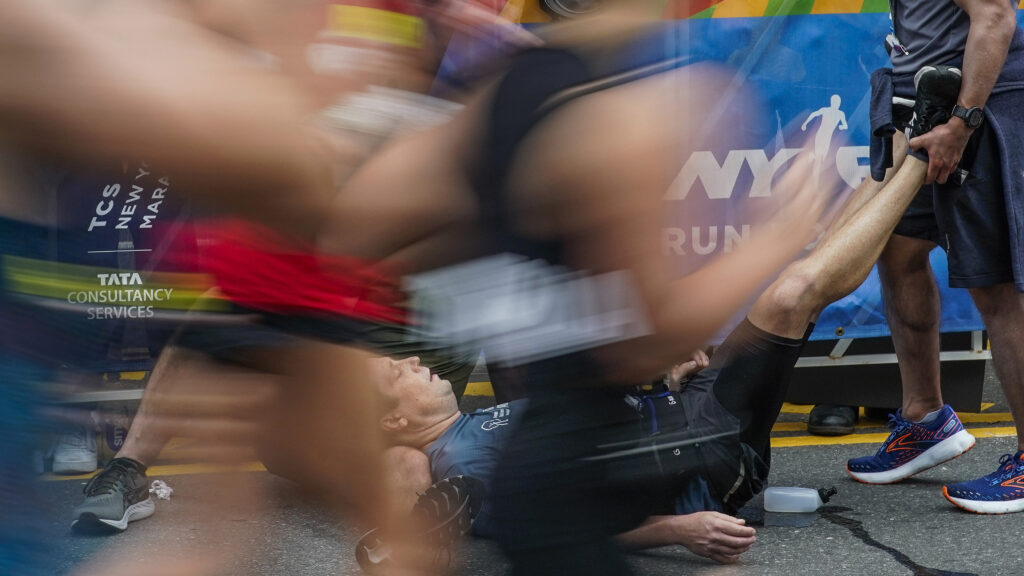
Though I have treated thousands of patients since, Nov. 6, 2022 — the day of a record hot New York City Marathon — still weighs on me. Around the three-and-a-half-hour mark of the race, the finish-line medical tent filled. Inside, I was volunteering as a medical provider and an amateur runner, assigned to a row of cots in the moderate-severity zone. The unseasonably climbing temperatures were taking a visible toll on athletes of all levels. A volunteer wheeled into my zone a middle-aged man — I’ll call him John — who had collapsed at the finish line. I asked him his name; he answered without hesitation. “Can you tell me where we are, John?” I asked. His eyes roved the tent’s plastic ceiling. “Nick’s house,” he said. His skin was flushed. John’s oral temperature read 107 degrees. He had been mistriaged. I grabbed a senior physician from the critical care area: “We need to upgrade this patient immediately. Heat stroke.” We quickly moved John, cut off his soaked singlet, and began cooling him with our last bags of ice. The tent’s only cold-water immersion tub was already occupied by a young woman I recognized from club running in Central Park. Likewise overheated, she was deliriously swatting at the attending physician. To worsen matters, the tent’s only electrolyte analyzer was backlogged and every vital-signs monitor was in use. We rationed monitors based on who would benefit most. In the middle of Manhattan, flanked by some of the nation’s best hospitals, we were practicing resource-limited field medicine. Thankfully, no one died that day. Credit is owed to thousands of volunteers who sacrificed 12 hours of their Sunday, some sprinting to bodegas for more ice. But goodwill is not a safety system. Even now, each time I am an event physician, I think about John — his mistriage, the dearth of supplies, the mere minutes that could have cost his life. The question that bothers me most: Why weren’t we adequately prepared? It is tempting to dismiss stories like this as niche, but as endurance event popularity and global temperatures rise, these scenes are increasingly predictable. That same year at the hot, humid Brooklyn Half Marathon, 16 participants were taken to the hospital. Yes, these events are voluntary, and runners, one could argue, ought to understand their individual risk. Heat acclimation, pacing, and hydration are participant responsibility. I don’t disagree. But when an event swells to the size of a city — the New York City Marathon had nearly 60,000 finishers last year — climate risk is no longer solely a personal matter. It is a public health matter with the ability to strain local systems. Of note, several races already are adapting to rising temperatures: adding warning flags, moving start times earlier, shifting dates, canceling outright. Decades ago, Grandma’s Marathon, held in Minnesota every June, actually quantified and shared the impact of their strategies to reduce runner morbidity. After it added a half-marathon option and an earlier start time, aid tent utilization dropped. Twin Cities Marathon reported similar information, though without detailed analysis of risk reduction methods. At the elite level, the International Olympic Committee formed a working group on heat risk ahead of Tokyo 2020, where heat illness accounted for 96% of marathon and race walk medical tent admissions. Those games became the first in Summer Olympic history to publish invaluable epidemiologic data such as diagnoses, core temperatures, and minutes-to-cool, which continue to inform Olympic planning. This March, due to heat risk, the Los Angeles Marathon controversially allowed runners to collect marathon finisher’s medals at the 18-mile mark. Nearly 1,000 runners took this option, and the race charted 652 incidents of injury or illness. We know LA Marathon’s numbers only because they shared them. Many don’t — and incidence data alone models neither climate-related medical sequelae nor the efficacy of mitigation measures. Consequently, we are left with questions rather than lessons learned. Were these illnesses and injuries because of the 18-mile option, or despite it? How were aid needs affected? Shortly after the LA Marathon, the contiguous United States experienced its hottest summer ever recorded. Several states hosting large fall marathons have high chances of above-average temperatures, including New York, Pennsylvania, and California. On top of long-term climate change, this year’s El Niño (recently deemed “super status”) may exacerbate extreme heat and humidity. Though these predictions exist weeks ahead of events, their impact on preparedness is nebulous. The answer to “Why weren’t we adequately prepared?”may be simple: The data that could have prepared us was not adequately used. Goodwill is not a safety system — but evidence could be. To run safe, large-scale events in a warming climate, organizers should use a shared evidence base that allows them to predict race-specific resource needs and evaluate safety interventions. Every major race generates a veritable treasure trove of data — chip times, pace decay, did-not-finish rates — all tied to tens of thousands of runners’ basic demographic information, all cross-referenceable with real-time, publicly available climate conditions. Critically, medical data are missing. Medical operations at many major races are contracted to third parties, and there is no shared standard for what gets recorded, how, or by whom. Even municipal special-event permits rarely explicitly require medical data collection as a condition of approval. At one event, a contractor may run a sophisticated, proprietary digital system. Another may rely on paper forms and one veteran’s instincts. What could be a living, cumulative evidence base — one that gets smarter every race — is instead fragmented and opaque, if it exists at all. Furthermore, smaller, less-resourced events — which comprise the majority of U.S. races — are left without objective best practices from leading events. It doesn’t have to work this way. If, with participant permission, the New York City Marathon analyzed and reported de-identified tent encounter data against variables such as climate, its organizers could predict, rather than guess, event resource needs. Other races would learn what to capture and how to protocolize it. If all World Marathon Majors —popular global races including the NYC Marathon with over 300,000 runners collectively last year — followed suit, the standard for data-driven planning in the entire sport would shift. Potentially lifesaving and cost-saving decisions to shorten courses, redistribute staff, streamline, or expand resources could come from quantified inputs, in conjunction with prior experience. Somewhere in that data is the next John, along with the ice, monitor, and tub that should be ready to receive him. As a physician, I am afraid of losing a patient to a condition we know how to prevent. As a runner, I don’t want to lose a friend. The finish line should mark the end of a race, not a life. Vibhu Krishna, M.D., M.P.H., is a senior resident physician in the Division of Occupational, Environmental & Climate Medicine at UCSF. She is an avid runner with a background in emergency medicine, event medicine, and public health consulting.
Opinion: I treated heat stroke at the NYC Marathon. Marathons need to prepare for a climate-changed world
Full Article
Original Source
Read the full article at Statnews →KhanList aggregates and links to publicly available news content. We do not host full articles from third-party sources. Always verify important information with original sources.