
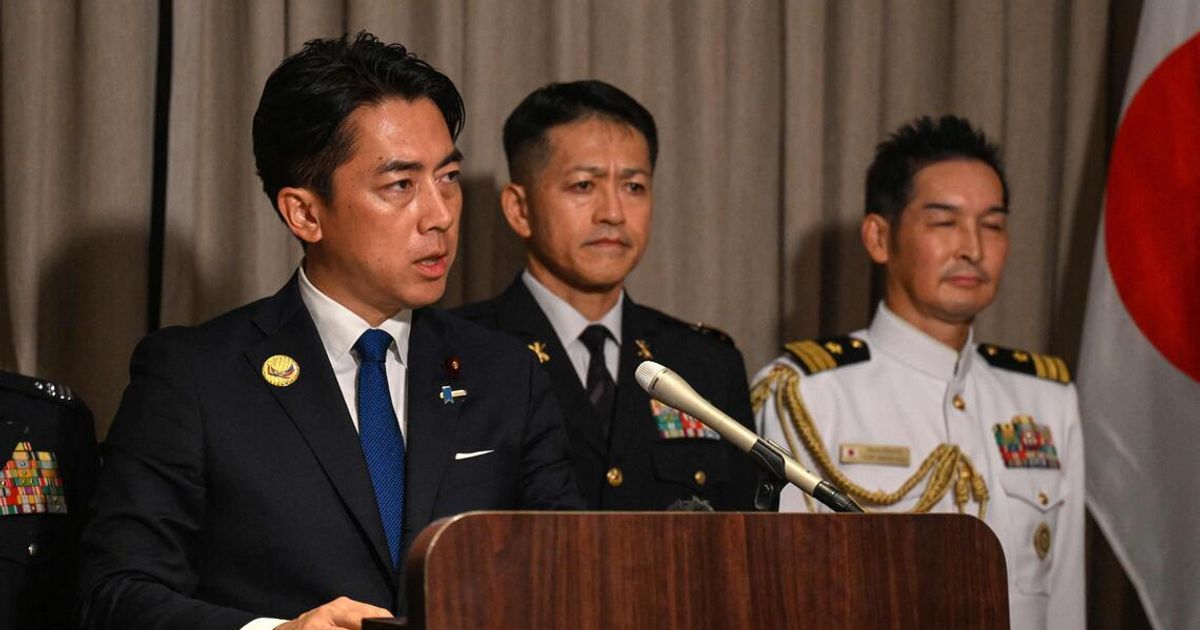
– A landmark pact between Washington and Tokyo to assemble frontline air-to-air missiles on Japanese soil marks a decisive shift in Indo-Pacific defence, drawing swift condemnation from a leery Beijing and raising the stakes over any conflict over Taiwan.Japanese Defence Minister Shinjiro Koizumi and US Secretary of War Pete Hegseth reached the agreement in the Philippines on Oct 28, on the sidelines of the ASEAN Defence Ministers’ Meeting-Plus in Cebu, which comes as part of the “Operation Supercharge” push to accelerate weapons co-development and co-production.Japan will become the first country outside the United States to host a Final Assembly and Check-Out (FACO) facility for the AIM-120 Advanced Medium-Range Air-to-Air Missile (AMRAAM). They also agreed to boost technical sharing to expand output of the Standard Missile-3 (SM-3) Block IIA, a jointly developed naval interceptor designed to destroy incoming ballistic missiles.“This represents a groundbreaking agreement that will contribute not only to the reliable acquisition of defence equipment needed by both Japan and the US, but also to the strengthening of Japan’s defence industrial base,” Koizumi said on Oct 28.The move immediately drew fire from Beijing, which perceives it as a direct challenge to its anti-intervention stance. China routinely accuses Japan of “new militarism” – a charge that Japan denies – while bilateral ties are already frozen over Prime Minister Sanae Takaichi’s suggestion that the Self-Defense Forces (SDF) could be mobilised if a Taiwan contingency poses an existential crisis for Japan.On Oct 29, Chinese Foreign Ministry spokesman Guo Jiakun told a regular news conference: “Since taking office, the current Japanese administration has repeatedly violated international law and domestic regulations under the pretext of responding to threats. The international community must remain highly vigilant and resolutely contain such actions.”Chen Yang, a research fellow at Beijing’s Charhar Institute, told The Straits Times that the missile assembly agreement suggests Tokyo’s evolving role within the US-Japan security alliance beyond mere logistical support and military equipment purchases.Rather, it is taking on a more proactive node in US-led advanced weapons production, and augmenting its operational reach in the East China Sea and Taiwan Strait, he said.“This creates favourable conditions for Japan to expand its production and export of military equipment in the future,” he said. “What truly warrants caution is the potential for Japan and the US to continuously strengthen their capacity for military intervention under the guise of ‘regional security’, thereby creating new disruptions to peace and stability in the Taiwan Strait.”Over in Tokyo, Institute of Geoeconomics director Kazuto Suzuki firmly rejected such a view.Despite Chinese narratives, he told ST that the facility’s primary purpose was to “manufacture the missiles Japan needs and to align production with Japan’s procurement requirements; it is not intended as a deterrent”.“Japan has already made it clear that it possesses stand-off capabilities, and while the AMRAAM is not a stand-off weapon, it is positioned as part of an air defence system,” Suzuki said, adding that Japan can help clear US delivery backlogs.The radar-guided AMRAAM is the primary beyond-visual-range air-to-air weapon for the US and its allies, fired from fighter jets including the F-15 and F-35. Pilots can lock onto and destroy adversary jets or cruise missiles even before seeing them with the naked eye.It also arms ground-based National Advanced Surface-to-Air Missile System (NASAMS) batteries, which are vital for shielding key infrastructure.Strategic relief for Taiwan?While the FACO’s location, timeline and Japanese partner remain undisclosed, analysts say the pact reflects a turn towards “industrial deterrence”, or the ability to outproduce and out-sustain a potential adversary.“Lessons from Ukraine and the Middle East are a reminder that wars can become industrial wars of attrition,” Heng Yee Kuang, who heads the Security Studies Unit at The University of Tokyo, told ST.The AMRAAM facility addresses deeper “magazine depth” by maintaining larger reserves of ammunition to endure high-tempo combat. But given US production capacity at its limits with a significant backlog accumulating, Heng warned that “friend-shoring is not a magic wand to resolve US defence industrial bottlenecks instantly”.That said, the facility is part of Washington’s broader push to strengthen production by shifting critical supply chains to its security allies.On Oct 27, just one day before the Cebu meeting, the Pentagon said Poland would host the first European maintenance, repair, and overhaul facility for Patriot Advanced Capability-3 (PAC-3) interceptor missiles. The Polish hub will inspect and recertify ready-to-use missiles locally, thus significantly shortening turnaround times as missile stockpiles are fast being depleted since Russia’s full-scale invasion of Ukraine began in 2022.Separately, while Japan’s Mitsubishi Heavy Industries has been licensed to build PAC-3 missiles since 2008, this had been for the SDF. Following an easing of weapon export rules in 2023, Tokyo completed its first-ever export of finished PAC-3 missiles to the US in November 2025 to help replenish American stockpiles.For Taiwan, whose air defences rely on AMRAAM-equipped fighters and NASAMS batteries, the agreement might offer some strategic relief. By establishing an assembly line for AMRAAMs in Japan, the US is effectively forward-deploying reserves to the front lines of a potential conflict in East Asia – even if Japan’s current arms export rules bar direct lethal transfers to Taipei. A regional production hub would significantly shorten the distance needed to resupply US forces operating around the island.Yet defence strategists in Taipei are tempering expectations. In an analysis published Nov 9, Taiwan’s Institute for National Defence and Security Research noted that the FACO plant merely assembles and tests imported components rather than manufacturing missiles from scratch, and hence does not give Japan full industrial independence.“A FACO facility does not equate to a complete, independently operating manufacturing capability,” the report said, noting that Japan will still face delays if upstream US suppliers struggle to produce rocket motors and microchips. “Although setting up factories in Japan may shorten some supply distances, in wartime, the safety of facilities, energy interruptions, cross-border transportation, and storage must still be considered,” it added, noting that there was not enough evidence to conclude that operational sustainability has improved.Still, the AMRAAM agreement arrives just as Tokyo prepares to revise its three core national security documents in December: the National Security Strategy, the National Defense Strategy, and the Defense Buildup Program.The updated National Defense Strategy is expected to mention the need to strengthen “war-fighting sustainability”, a phrase that has stirred some controversy because the language evokes military combat.But Japanese observers argue that Tokyo cannot deter aggression without guaranteed stockpiles, repair infrastructure, and industrial endurance.“Japan does not harbour ambitions to become a military player; rather, it views its actions as necessary for its own defence,” Institute of Geoeconomics’ Suzuki said.Additional reporting by Chew Hui Min in Taipei
‘Operation Supercharge’: A plan to assemble US AMRAAM missiles in Japan draws China’s pushback
Full Article
Original Source
Read the full article at Straitstimes →KhanList aggregates and links to publicly available news content. We do not host full articles from third-party sources. Always verify important information with original sources.