
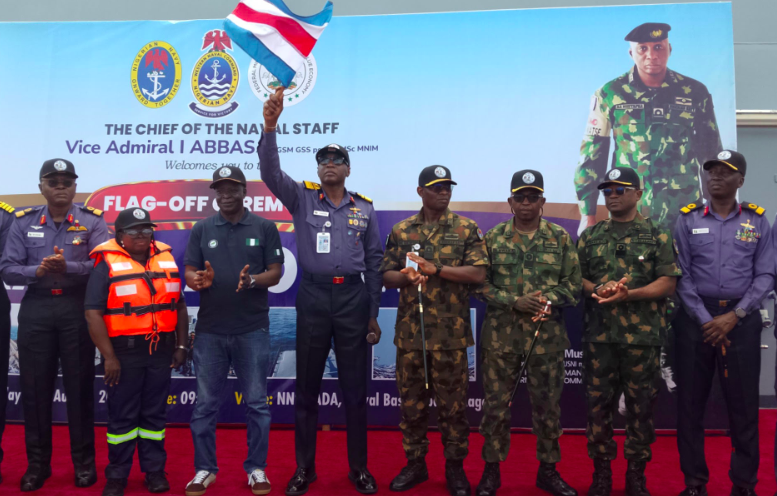
To tackle illegal, unreported and unregulated fishing and protect Nigeria’s marine resources, the Nigerian Navy recently launched Operation Abo Eja, a joint patrol crackdown with the Federal Department of Fisheries and Aquaculture. By the time the operation ended, three fishing trawlers had been intercepted and about 30 crew members arrested over suspected fisheries violations. The arrests came at a time when Nigeria imports more than 70 per cent of its fish requirements, making the protection of local fish stocks critical to food security, coastal livelihoods and the country’s blue economy ambitions. Chiemelie Ezeobi reports Nigeria’s fish crisis is no longer just about what happens in the markets. It begins much farther offshore, where illegal fishing is steadily taking a bite out of the country’s fish stocks, depriving legitimate fishermen of catches, denying government revenue and putting further pressure on a country that already imports more than 70 per cent of its fish requirements. ‘Measuring’ the Deficit, Damage Nigeria’s annual fish demand is estimated at about 3.6 million tonnes, against local production of roughly 1.1 million tonnes, leaving a deficit of about 2.5 million tonnes. At the same time, estimates of what the country loses to illegal, unreported and unregulated (IUU) fishing range from more than $30 million annually in a United Nations assessment to about $70 million, according to the Fisheries Cooperative Federation of Nigeria. But the loss is not measured only in dollars. This is because illegal fishing removes fish faster than stocks can replenish themselves, threatens breeding populations, damages marine habitats and can result in the capture of species that fishermen are not permitted to target. Marine pollution and plastic waste compound the problem by damaging the same aquatic environment on which the fisheries industry depends. Operation Abo Eja It was against this backdrop that the Nigerian Navy, working with the Federal Department of Fisheries and Aquaculture (FDFA), took the fight to sea through OperationAbo Eja, a joint fisheries protection patrol designed to strengthen surveillance, enforce fisheries regulations and protect Nigeria’s marine resources. The operation, whose name means “Fisheries Protection” in Yoruba language, was launched aboard Nigerian Navy Ship KADA in Lagos last week as part of a broader effort involving the Navy, the Federal Department of Fisheries and Aquaculture (FDFA) and the Fisheries Committee for the West Central Gulf of Guinea (FCWC). Operation Abo Eja brought together naval ships, helicopters, Special Boat Service personnel and maritime surveillance assets, coordinated through the Western Naval Command Mission Control Centre. Fisheries officials provided the technical expertise required to identify violations of fisheries regulations. At the flag-off ceremony, the Flag Officer Commanding, Western Naval Command, Rear Admiral Abubakar Mustapha, who represented the Chief of the Naval Staff, Vice Admiral Idi Abbas, said the operation represented a deliberate attempt to combine the Navy’s maritime enforcement capabilities with the regulatory responsibilities of fisheries authorities. “Operation Abo Eja marks a significant milestone in our collective determination to safeguard Nigeria’s marine resources, protect the means of livelihood of our coastal communities, and strengthen interagency cooperation in the fight against illegal, unreported, and unregulated fishing,” he said, adding that the collaboration with the FDFA “would ensure comprehensive surveillance, rapid response, and coordinated enforcement of fishery regulation across our maritime domain”. But he stressed that arrests alone were not the ultimate objective. “Our objective is clear- to recalibrate our strategies, tactics, techniques, and procedures in order to detect, deter, disrupt, and deny illegal, unregulated, and unreported fishing, as well as other criminal activities in Nigeria’s maritime domain.” Protecting Nigeria’s Fish Stocks For the Navy, the issue is increasingly tied to Nigeria’s food security and blue economy ambitions. Rear Admiral Mustapha, who acknowledged the difficulty of putting a precise figure on the losses because of inconsistencies in fisheries data, however stressed that “fishery resources are a critical component of Nigeria’s global economy aspiration. Nigeria has abundant fishery resources but the activities of poachers or illegal, unreported and unregulated fishing has actually affected our fishery stock to a large extent, to the extent that Nigeria imports over 70 per cent of our fishery needs”. Thus he opined that the answer lies in bringing security and regulation together. “So the partnership between the Nigerian Navy and the Federal Department of Fisheries and Aquaculture is a step in the right direction,” he said. “In fact, the days of illegal fishers and poachers are numbered because the intersection of security which the Navy brings and regulation which the Federal Department of Fisheries brings to the table would translate to the denial of these criminal activities and which will also translate to more revenue and more food security in terms of fishery proteins to this country.” Successes at Sea The essence of that partnership was tested almost immediately. After two days at sea, the patrol returned with evidence of the scale of the challenge- three fishing trawlers were intercepted over suspected IUU fishing activities, with their crew members taken into custody for further investigation. Reports on the operation put the number of arrested crew at 30, while the FDFA’s breakdown identified three Chinese, two Ghanaians and 28 Nigerians among those arrested. However, the violations were not limited to the act of fishing itself. According to the FDFA, one vessel was found operating with a 36mm mesh size, contrary to the prescribed standard for its category, while discrepancies were also detected in its Automatic Identification System (AIS) data. Two other vessels were allegedly found fishing within five nautical miles of the shoreline with their AIS switched off while another had two AIS, which they were switching alternatively. After the arrests, the vessels were escorted to the Lagos Defence Jetty for further investigation and processing in accordance with the law. For the Navy, the arrests demonstrated the practical value of putting naval enforcement capacity and fisheries expertise on the same patrol. Attention to Marine Pollution The operation also brought attention to a threat that exists alongside illegal fishing: marine pollution. According to the Director of Monitoring, Control and Surveillance at the FDFA, Usman Garba, the department was working with other agencies to tackle marine pollution, particularly plastic waste. The problem is significant because the destruction of fish stocks cannot be separated from the destruction of the environment in which they breed and grow. Garba warned that plastic waste was killing aquatic life rather than simply driving fish away from Nigerian waters. He also called for stronger sanctions against offenders, arguing that weaknesses in fisheries laws could allow violators to continue exploiting the country’s marine resources. Push for Sustained for Regional Cooperation What this operation has brought into sharper focus is that the fight against illegal fishing cannot stop at Nigeria’s territorial waters because fish stocks are migratory. Thus, because the Gulf of Guinea has overlapping maritime boundaries involving countries such as Ghana, Togo, Cameroon, Equatorial Guinea and São Tomé and Príncipe, this makes regional cooperation essential, as illegal fishing in one country’s waters can ultimately affect another. According to Rear Admiral Mustapha, this is imperative “because fisheries are migratory in nature, if they go and steal fish, it affects us because they come down to us during their breeding season”, adding that Nigeria was already exploring ways of addressing the challenge through regional cooperation. “We have discussed with the federal government fisheries that can be addressed under regional cooperation. We will talk to our partners that the more we sustainably protect these resources, all the countries in the Gulf or around us would benefit better,” he said. Given that Operation Abo Eja was itself part of a wider Regional Simultaneous Fisheries Patrol coordinated by the Fisheries Committee for the West Central Gulf of Guinea (FCWC), with a corresponding exercise conducted in Ghana, the FOC said the participation of Nigerian personnel in the Ghana operation was evidence that the regional approach was beginning to take shape. “Part of this exercise is also being conducted in Ghana. Some of our participants are there. So it shows that regional cooperation against illegal, unreported, unregulated fishing is actually gaining traction.” The development is important because the success of Operation Abo Eja cannot be measured only by the three vessels intercepted or the crew members arrested. Its broader value lies in strengthening the cooperation needed to track an activity that moves across maritime boundaries. Way Forward With the successes recorded during the operation, the challenge now is to sustain the surveillance and enforcement measures Operation Abo Eja has brought into sharper focus. Essentially, fisheries protection cannot depend on occasional patrols; regular monitoring, intelligence gathering and coordinated action will be needed to keep illegal operators at bay. Also, better fisheries data is also essential because reliable data would help authorities better track fish stocks, identify pressure points and measure the impact of illegal fishing. Stronger sanctions, sustained regional cooperation, emplacing fishing off season to protect fingerlings, and continued efforts to tackle marine pollution, particularly plastic waste, are equally important. Ultimately, the success of Abo Eja will depend not only on the arrests made, but on whether its renewed approach to surveillance, enforcement and cooperation can be sustained.
Operation Abo Eja: Strengthening Surveillance, Enforcing Regulations and Protecting Nigeria’s Fisheries
Full Article
Original Source
Read the full article at Thisdaylive →KhanList aggregates and links to publicly available news content. We do not host full articles from third-party sources. Always verify important information with original sources.