
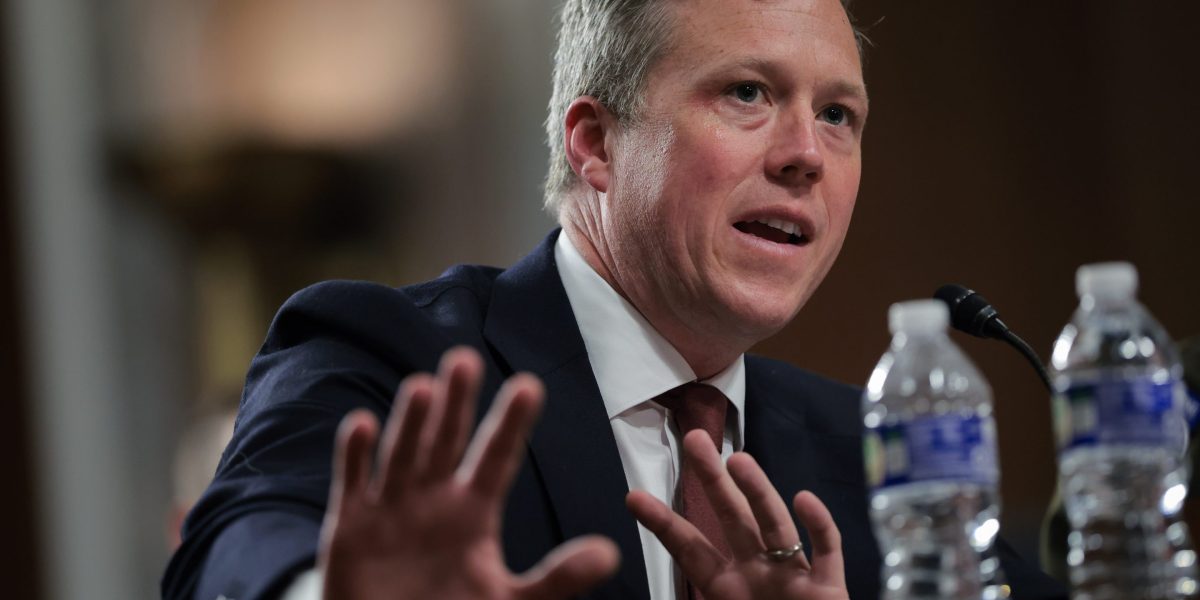
OpenAI’s hiring of a recently departed Pentagon official points to the frontier lab’s growing interests in defense and expanding roster of former military officials in its ranks. OpenAI has hired former U.S. Army Secretary Dan Driscoll to the bespoke role of senior counselor for national security modernization, the company announced on Monday. The new job comes two months after Driscoll left the Trump administration after reportedly clashing with Defense Secretary Pete Hegseth. In the role, Driscoll will advise OpenAI’s public and private sector partners on how to modernize policy and strategy in support of improving national security with AI, according to OpenAI. The focus of his work will be on how AI can be used responsibly to improve security among the U.S. and its allies. Gwanhoo Lee, the chair of the Department of Information Technology and Analytics at American University’s Kogod School of Business, said that by tapping Driscoll, OpenAI is continuing in its strategy of pouring resources into the defense sector, where it sees high demand for AI systems to bolster national security. “This hire is a continuation of their trend to see the opportunity in hiring significant government officials to strengthen their relationship with the government and strengthen their business in dealing with the government agencies,” Lee told Fortune. In June 2024, OpenAI appointed retired U.S. Army General Paul Nakasone, former National Security Agency director, to its board of directors. Later that year, it partnered with American defense firm Anduril to integrate OpenAI’s systems with Anduril’s database of unmanned drone threats. Driscoll did not respond to Fortune’s request for comment. Why OpenAI hired Driscoll Within the federal government, Driscoll pushed modernization efforts such as low-cost battlefield drones, cutting red tape for defense contractors for drone development, and switching the Pentagon to commercial software—a departure from its practice of purchasing custom-built software specifically for the military. He also became an unlikely negotiator in working to end the war between Russia and Ukraine by making several trips across Europe to broker talks between Ukrainian and European officials. He also made a secret trip to the Middle East to meet with Russian officials. “The U.S. has an extraordinary opportunity to work with other countries to spread the adoption of democratic AI” following Driscoll’s hire, Altman said in a statement in the press release. “This technology will help them keep pace by cutting through paperwork, making sense of more information, and getting the right answer to the right person faster,” Driscoll said. “I’m joining OpenAI to help the United States and our allies put this technology to work responsibly, for the people who keep us safe.” The former Army secretary stepped down from his role in the Pentagon in September after just 18 months on the job following widely reported tensions between him and Hegseth—particularly disagreements over promotions and the scale of the Pentagon’s modernization efforts. Driscoll’s exit followed a series of departures from other senior military officials, including the ousting of Gen. Randy George, the agency’s top uniformed official, in April and the resignation of Gen. Christopher Donahue, a champion of unmanned drone-use in Ukraine, in June. Before his time in the Trump administration, Driscoll was involved in several investment and advisory firms, working as the chief operating officer at venture capital firm Flex Capital and partner at private equity firm 100watt. He served in the U.S. military from 2007 to 2011, and was deployed to Baghdad, Iran, in 2009. Concerns about OpenAI’s relationship with the Pentagon Driscoll’s new private-sector role is likely to raise questions about a “revolving door problem” of the company’s access to government officials, according to Lee. He noted that potential conflicts of interest could impact the government’s procurement process, or how it decides with private entities from which to buy goods and services. “If AI companies can take high-level officers from the Pentagon or any other important government agencies right after they’ve left their organizations, in terms of procurement process, I don’t know how fair the government procurement process will be when AI companies have significant individuals from that organization,” Lee said. As countries depend more on AI systems for both defense of national security and forms of offensive cyberattacks, investing in both the most effective and cost-effective technologies have become crucial for maintaining national safety and infrastructure, Lee explained, but priorities for securing private sector contracts can become muddied if deals are based too closely on preexisting social ties. “If that procurement is based upon relationships rather than merits and strengths of technology, that puts us at risk,” he added. “As AI companies take on national security risks, we need clearer rules on oversight and conflict interest, so I think there is some governance concern.” OpenAI said all parties are aware of post-employment restrictions and will comply. While OpenAI’s work with Driscoll will extend beyond its relationship with the Department of Defense, OpenAI’s previous deals with the Pentagon have raised concerns about safety and privacy from tech policy experts. The company won a $200 million contract from the Department of Defense in June 2025 to design AI tools for the agency to address national security challenges. The relationship between OpenAI and the Trump administration grew closer in February, when OpenAI signed a new deal with the Pentagon to deploy its AI models in the agency’s secure networks. Earlier that month, Hegseth issued an ultimatum to OpenAI rival Anthropic CEO Dario Amodei, demanding the company allow unrestricted use of its AI, which has safety guardrails against the use of the technology for mass domestic surveillance and autonomous weaponry—but Anthropic refused to remove the restrictions. Trump then asked federal agencies to stop using Anthropic’s products, and Hegseth designated the company a national security “supply chain risk,” the first time the U.S. has ever used the designation for an American company. OpenAI’s subsequent deal with the Pentagon still set limits on how the government can use its technology, but allowed for the deployment of its AI models inside the Pentagon’s secure networks under an “all lawful use” clause, offering broader usage of the technology within legal confines. Experts warned the deal left space for legal loopholes—like whether large-scale analysis of Americans’ data, which is legal, is different from mass surveillance. “Right now, under U.S. law, it’s lawful for government authorities to buy up commercially available information from data brokers and other third parties,” Samir Jain, vice president of policy at the Center for Democracy & Technology, told Fortune earlier this year. “If you buy up massive amounts of data and allow AI to analyze it, you may end up, in effect, engaging in mass surveillance of Americans through that process. It’s not currently restricted by law or prohibited by law.” In a blog post updated in March, OpenAI noted language it added to the deal with the Department of Defense, including that in accordance with the Fourth Amendment of the Constitution, the National Security Act of 1947, and other applicable laws, its AI system would not be intentionally used for domestic surveillance. It also noted the Pentagon understands limitations to prohibit deliberate tracking of U.S. persons or nationals, including through the procurement or use of personal information from commercial third parties.
OpenAI’s hiring of former Army Secretary just 2 months after Pentagon resignation is part of a ‘trend’ of it pivoting resources to defense projects
Full Article
Original Source
Read the full article at Fortune →KhanList aggregates and links to publicly available news content. We do not host full articles from third-party sources. Always verify important information with original sources.