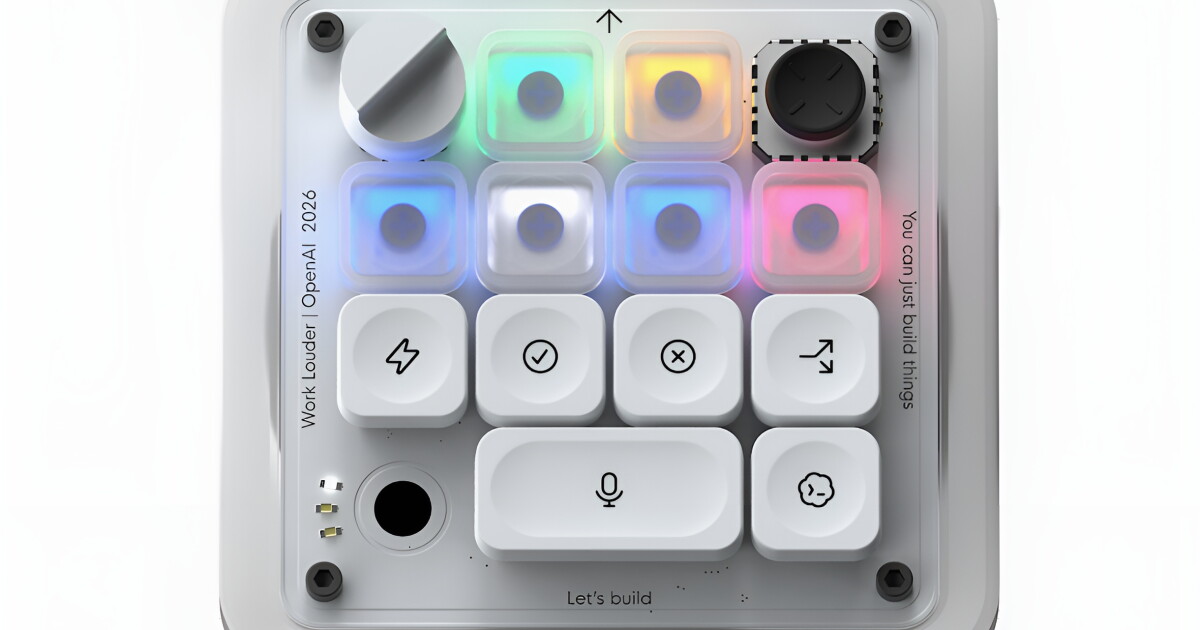
OpenAI, the AI lab that brought us ChatGPT, which simultaneously evoked awe, fear, and fascination when it first launched in 2023, has released its first-ever hardware product, a $230 mini-keyboard that’s designed to enhance the workflow of users of Codex, the company’s specialized AI coding agent.Called the Codex Micro, the device was created in collaboration with specialist keyboard maker Work Louder and is sold through OpenAI’s Supply Co. store. OpenAI describes it as a “command center for agentic work,” although “keyboard” is slightly generous, as with only 13 mechanical switches, the device is really a programmable macro pad designed to sit beside a normal keyboard.OpenAI built the device specifically for Codex users who increasingly find themselves supervising several AI agents and coding tasks at once. The pad features 13 mechanical keys, including six translucent Agent Keys that can each be linked to a different Codex conversation. Pressing one of the agent keys immediately opens the corresponding chat. Each key uses live RGB lighting to show whether its assigned agent is idle, working, waiting for input, finished, or has encountered an error. This allows users to check the progress of several tasks at a glance instead of repeatedly opening different chats to see whether Codex has completed them.The other six Command Keys come labeled and preconfigured for frequently used actions such as starting a new chat, approving or rejecting a request, activating push-to-talk, and sending a prompt. Users can remap them to other Codex functions and replace the keycaps with matching icons from the additional set included with the device. Hitting the push-to-talk button activates and uses the microphone connected to the user’s computer, as the Codex Micro doesn’t come with a microphone. A small joystick is includedOpenAI The device also features a small joystick, likely the 13th key, that can trigger reusable Codex Skills and common workflows such as debugging an error, reviewing a pull request, or refactoring code. Perhaps the Codex Micro’s most interesting feature is a rotary dial that lets the user adjust the agent’s reasoning level depending on the difficulty of the task. Together, the controls turn what would normally involve several clicks and chat switches into single physical actions, making it easier to keep multiple agents moving without constantly interrupting the main coding workflow.The hardware connects through Bluetooth or USB-C and supports Mac and Windows. The body combines CNC-machined polycarbonate and aluminum with PBT and polycarbonate keycaps. Buyers can choose clicky or silent mechanical switches. The Codex Micro is not really new hardware. Peel off the branding, and it's Work Louder’s existing Creator Micro 2 with the same 13 mechanical switches, rotary encoder, planar joystick, and touch sensor, simply remapped for OpenAI. The keyboard is priced at $230OpenAI For a long time, OpenAI had teased a mysterious, screen-free device that it was developing with former Apple design chief Jony Ive, with many expecting that to be the company's first hardware product. However, that plan seems to have hit a snag, as days before the Codex Micro appeared, Apple sued OpenAI, accusing it of stealing trade secrets to build its hardware and of poaching ex-Apple staff for confidential product details.Regardless, Codex Micro may actually be a befitting first hardware product, as Codex has grown into one of OpenAI’s biggest bets. The company announced in June that Codex had surpassed 5 million weekly active users, growing 6x since February. The hardware sold out in less than 24 hours after launch.Source: OpenAI
OpenAI launches Codex Micro hardware for AI coding
Full Article
Original Source
Read the full article at Newatlas →KhanList aggregates and links to publicly available news content. We do not host full articles from third-party sources. Always verify important information with original sources.