
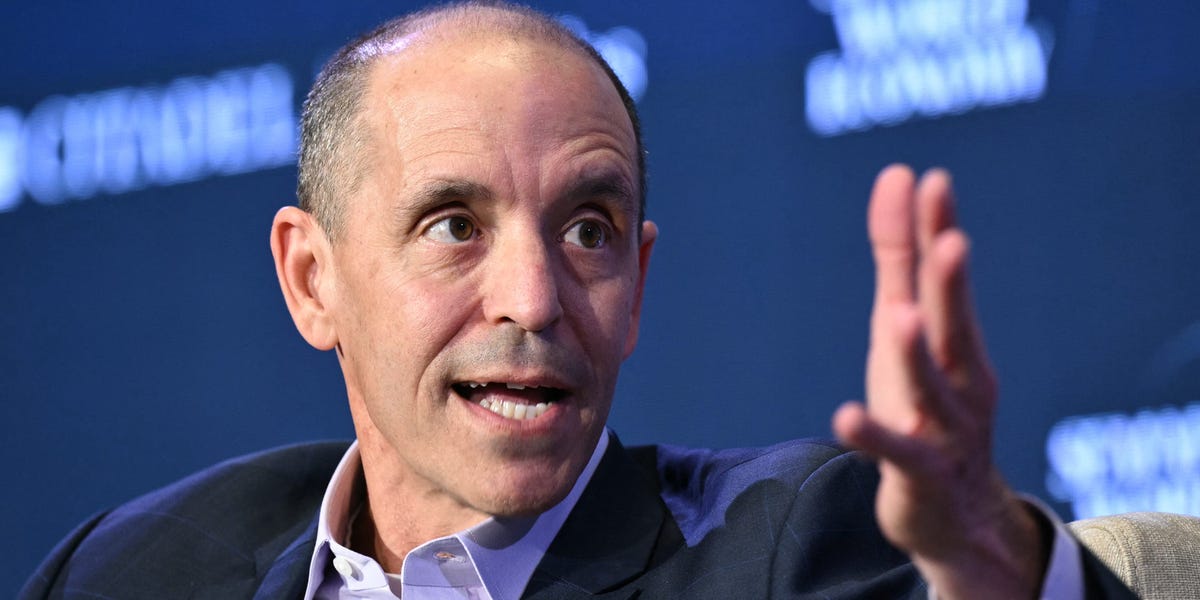
Chris Lehane, OpenAI Chief Global Affairs Officer, speaks during the 2026 Semafor World Economy conference in Washington, DC. Mandel NGAN / AFP via Getty Images OpenAI's top lobbyist is privately telling prospective 2028 candidates that artificial intelligence will define their bids for the White House.In a memo circulated among some contenders and obtained by POLITICO — which, like Business Insider, is part of the Axel Springer Global Reporters Network — Chris Lehane argues that candidates need a governing philosophy for AI, not just talking points about key issues dominating the campaign. He warns that Democrats, in particular, could find themselves on the wrong side of the debate if they oppose the infrastructure needed to build the technology.A fight over data centers could have consequences far beyond local projects, Lehane warns. If the US loses its AI lead to China, he writes, "This could well be the 2028 version of the 2002 vote to go to war in Iraq."The memo, which has not previously been reported, is an attempt by the AI giant to shape how White House hopefuls think and talk about the technology as both parties begin preparing for the next presidential race. It was sent to about half a dozen prospective candidates alongside a few members of Congress and prominent political operatives, according to a person with knowledge of the memo granted anonymity to discuss private conversations.OpenAI declined to comment.Lehane, a veteran Democratic political operative who was press secretary to then-Vice President Al Gore, argues that candidates should offer voters a middle course between unchecked AI development and putting control of the technology in the hands of a "self-appointed elite.""The candidate who can articulate a compelling third path between those who would letAI advance without speed limits, and those who would keep control over the technology in the hands of a self-appointed elite, will have an opportunity to define a new contract for this new era."He compares the current era to the New Deal of 1932, saying the next president will have an opportunity to reimagine "the relationship between people and a transformative new force in their lives." Lehane thinks that AI is already showing up in the 2026 election with unpopular data centers serving as a proxy for affordability concerns that extend beyond the infrastructure build-out. He also sees the rapid technological progress as a driver of anxiety among an electorate who feel as though the social contract has been "fractured."But according to Lehane, the landscape will be different in 2028 as its capabilities continue to advance and Americans become more familiar with the technology.In the memo, he encourages candidates to show voters how they will keep humans at the helm of consequential decisions. He also urges them to address what the tax code should look like in the AI era, how children should be protected, whether AI can make life more affordable and whether the US can maintain its technological lead over China."A world in which America leads will look very different from one in which the Chinese Communist Party sets the pace," Lehane writes. "That doesn't mean every data center is a good project or that communities should accept higher electricity costs. It means policymakers must solve those problems rather than treating infrastructure itself as the problem."With the shadow primary already underway and the race only expected to intensify in the weeks after the midterm elections, both parties will be forced to grapple with what their approach to AI is, and each party's eventual standard-bearer will help set the tone."The successful candidates won't promise to stop the future or simply trust everything will work out," Lehane writes. "They'll show Americans how to shape that future and benefit from it."This story originally appeared on POLITICO and is courtesy of the Axel Springer Global Reporters Network, which harnesses the resources of the company's newsrooms to publish ambitious scoops, investigations, interviews, opinion pieces, and analysis. It allows journalists — including those from POLITICO, Business Insider, WELT, BILD, Onet, and Fakt — to collaborate on major stories for an international audience of hundreds of millions across platforms. Read next Business Insider tells the innovative stories you want to know Business Insider tells the innovative stories you want to know Business Insider tells the innovative stories you want to know Business Insider tells the innovative stories you want to know OpenAI
OpenAI is already pitching 2028 hopefuls on how to talk about AI
Full Article
Original Source
Read the full article at Businessinsider →KhanList aggregates and links to publicly available news content. We do not host full articles from third-party sources. Always verify important information with original sources.