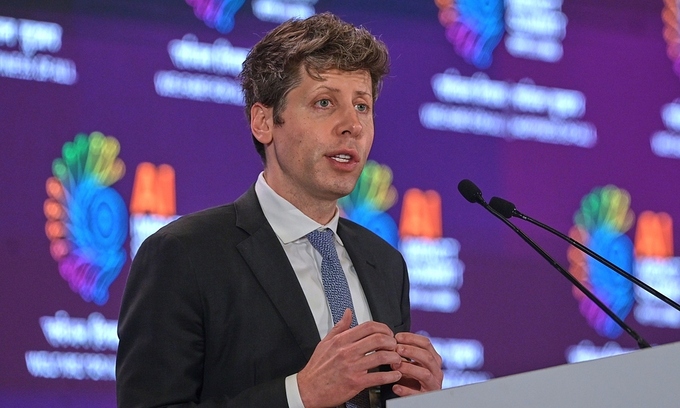
OpenAI CEO Sam Altman has suggested that two years of college may be enough, arguing that traditional four-year degrees could be too long in an increasingly AI-driven world. Altman himself spent two years at Stanford University before dropping out in 2005 to co-found Loopt, a location-based social networking app that became one of the first companies to join Y Combinator."Two years was like the exact right amount of college to do," Altman said at the recent Internapalooza summit, a networking event hosted by investor Cory Levy for students and interns at technology companies.Altman’s remarks were posted by Z Fellows, a startup accelerator and fellowship founded by Cory Levy, on its YouTube channel. OpenAI’s CEO Sam Altman speaks at the AI Summit in New Delhi, India, Feb. 19, 2026. Photo by AP "I think I learned a lot, and it would have been like vastly diminishing returns," Altman said, referring to his decision not to complete a four-year degree.He added that he had "sort of thought that maybe the way the world has evolved, college just shouldn't be as long as it is."Altman acknowledged that college still offers benefits beyond formal education, including opportunities to meet people, live independently and work on projects."But I also think four years would have not been that great," he said. He also noted that he knew many people who never attended college but had nevertheless "done great."Altman has previously expressed admiration for young people who leave college to pursue startups. At OpenAI’s DevDay in October 2025, he said he was envious of college dropouts today because of the breadth of opportunities and the number of things they can build.At the Internapalooza event, he linked that view more directly to the rise of artificial intelligence. AI tools that can assist with coding, research and other aspects of product development have lowered the resources needed to develop an early-stage business, he said."You can sort of get a long way in life and career just by doing stuff," Altman said. "And I think this is much more true now than ever before. You can make a whole startup kind of by yourself in a room with a lot of AI tokens, but not much else."His broader point was that students, recent graduates and young entrepreneurs do not necessarily need to wait for an established company, investor or institution to validate their ambitions before starting to build.Altman also advised young people not to spend too much time trying to be taken seriously."If you were trying to do enterprise sales to a big, stodgy, old company, then it kind of does," he said. "And after trying and failing to get taken seriously in that specific way for a while, I was like, ‘I'm just going to hire a 50-year-old.’"Less demand for college degrees Altman’s comments reflect a broader debate in the technology industry over the value of traditional college degrees and the skills employers increasingly prioritize.Google co-founder Sergey Brin said in January that the company had hired "tons" of people without bachelor’s degrees, highlighting a shift in Silicon Valley toward placing greater emphasis on skills and problem-solving abilities than formal academic credentials, according to Fortune.Nvidia CEO Jensen Huang similarly argued in 2024 that the rise of generative AI was making programming less essential, suggesting that young people could focus on other fields rather than learning to code.One of the most prominent advocates of alternatives to traditional college is Peter Thiel, a co-founder of PayPal. His Thiel Fellowship offers $250,000 over two years to people aged 22 or younger who leave or skip university to work full-time on their own projects.
OpenAI founder and CEO Sam Altman suggests college should last 2 years instead of 4
Full Article
Original Source
Read the full article at E →KhanList aggregates and links to publicly available news content. We do not host full articles from third-party sources. Always verify important information with original sources.