
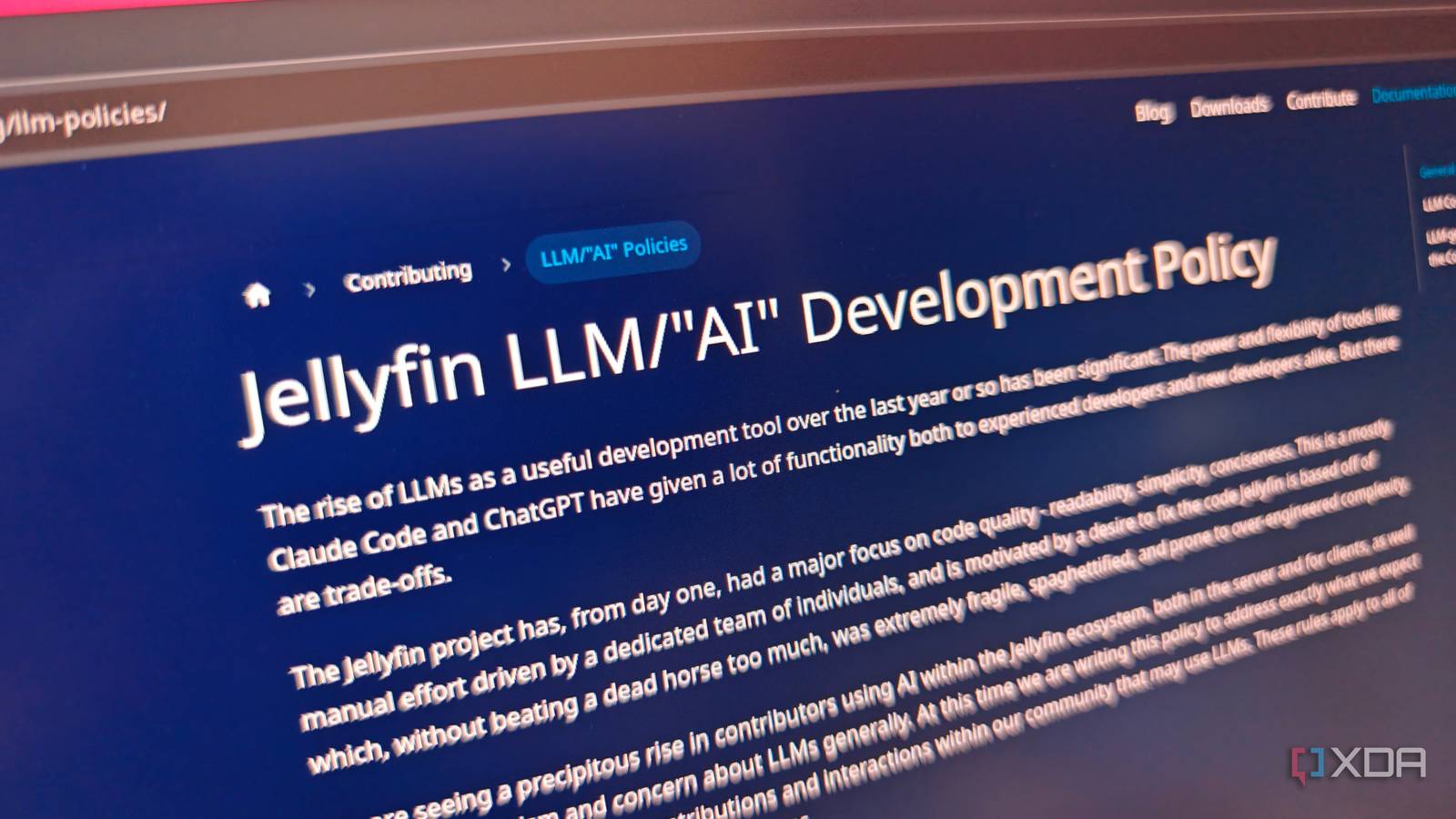
Published Aug 24, 2026, 7:00 PM EDT Richard is the PC Hardware Lead at XDA and has been covering the technology industry for almost two decades. He's been building PCs since young, and when not creating content, you can often find him inside a chassis somewhere. Artificial intelligence has been around in one form or another for decades, but it's quickly growing in scope with the rise of the language models (LLMs). These tools are trained on massive amounts of text to understand, summarize, and generate human-like language. LLMs power hosted tools such as ChatGPT and Claude, while some models are released with downloadable weights that can be run locally (with the right hardware). They're great when used appropriately, but they can cause issues for software development. Everyone's a developer Until they have to explain their submitted code One issue with LLMs is they can write extensive code frameworks. You can ask a chatbot to build a website with a full login and authentication system, integration with payment gateways, and account management. It can produce what appears to be a deployable application in minutes. It's actually impressive just how well they're able to interpret prompts and work on projects like this, allowing almost anyone to build something that really improves their daily lives. Self-hosting is a great place for this to take place. I did just that with our trash collection schedule. Instead of having to remember which bin needs to be taken to the roadside, I got an LLM to create me a dashboard showing the schedule. It scrapes the local authority's website to ensure our locally hosted schedule matches what's listed on the official site. This is particularly useful for holidays, such as Christmas, where scheduled dates can change. But I didn't stop there, as the original prompt tasked the LLM to create an API for Home Assistant. The local agent handled it well enough. There were only a few small issues I saw when glancing at the code before deploying it, requiring a quick fix, but aside from that, it was pretty solid. The API works well enough, and I was able to add Home Assistant dashboard cards and notifications. Now, my phone receives a reminder Sunday evening to put the trash out, showing which bin is to be collected, and the notification is only sent if my phone is detected to be inside the home. It was fairly surprising to me to see just how reliable the LLM can be to work on a code project. I knew the technology was there, but this was the first time I simply asked it to do something, and it carried it out with no trouble. But this is where things can start to go wrong for community-powered open-source software. It's one thing for me to ask an LLM to make me something to look it over and make sure it all works, but it's something else for someone with no coding knowledge to do so. Handling AI-assisted code submissions Developers are rolling out new policies Speaking of Home Assistant, the Open Home Foundation has had trouble with AI development, so much so that the team behind the curtain even wrote up a comprehensive AI policy. "We don't mind if you use AI tools to help you write. However, do not have tools post unreviewed content on your behalf. Keep responses to the minimum needed to communicate your intent. We may hide any comments that we believe are unreviewed AI output." It's a similar approach other developers have taken with hosted projects. If AI is to be used, it's vital the code it generates is checked and understood by the submitter, as it will be treated as though it's their own work. Jellyfin, one of the most popular media streaming packages, also struggles with AI submissions and communication. As per the official guidelines on using LLMs, the developers and community volunteers on the repository expect the author's opinion and not something generated by a chatbot, even if what it provides is useful in locating and squashing software bugs. "It takes like 10 seconds for you to copy paste an LLM response, but the maintainer has to put much more efforts to respond, to investigate, and to validate if LLM is hallucinating." This is something that has been shared by others within the space. It's easy for LLMs to produce code and even discover potential issues, but it's down to a human to interpret this and check whether the code is valid and if the issue persists. If one is to simply use an LLM with a single prompt and submit file changes without checking, this causes more work on the side of the maintainers. It's not just open-source either Even Google, the technology behemoth, experiences problems with AI-generated submissions. It's almost naive to believe LLM-generated code will simply be glanced at and approved for inclusion for the next release. Google itself uses LLM agents to aid with developing Chrome and discovering bugs and vulnerabilities, but then developers spend time reviewing patches before moving forward, and that's only after other agents have cross-checked what another agent created. It's a fine balance between using AI to aid development processes and ensuring the quality of code making its way into the main project branch remains high. There wasn't much in the form of preparation for project maintainers and developers to put in place measures to help combat the onslaught of "AI slop" that seems to be making its way across the online realm. Chatbots like ChatGPT took the world by storm, and now everyone is using them for various tasks, including coding. Open source is changing Adjusting to the new status quo (and lots of AI) To land a job at Google, Microsoft, or some other technology company as a developer, you need some credentials and experience to show for it. No one will sit you down in front of a terminal and open up access to their valuable systems if you don't know your stuff. The same went for open source, as writing code was the challenging part. As an end user, seeing an issue with software was one thing. Spotting something that's off is relatively trivial, but writing the fix to address it is a whole different kettle of fish. Now, everyone can write code, and it's not always clear if the code itself is human-made or generated with an LLM, if done right. It's difficult to picture just how much time goes into monitoring pull requests, and when the maintainers and developers need to sieve through legit submissions amongst a seemingly endless sea of AI-generated "slop," it can quickly become overwhelming. The issue for open-source is the higher rate of submissions doesn't equate to faster development. A simple bug fix could be transformed into a multi-file layer with everything working as intended, but it's completely overkill for what really needed a simple one-line change. The maintainer doesn't just check the code line by line, but they also have to understand the rationale behind the changes. An AI isn't always rationale in that this example saw the agent create a solution that was notably more complex than it really needed to be. To the AI, it fixed the issue. To the project maintainer, it caused a mess. It's an uphill battle Only a small number of contributors to a project handle the review workload. Even with a fully staffed review process, this would take considerable work, but when it falls on a few individuals who may have full-time jobs and other responsibilities, it can almost put someone off from helping work on something they value most on the software front. AI isn't really to blame for maintainers having too much code to review. What it has done is expose an asymmetry that was already there. Generating code is becoming extraordinarily cheap, while understanding, reviewing, testing, and maintaining it still takes human time and expertise.
Open-source maintainers are drowning in AI-generated garbage, and it's getting worse
Full Article
Original Source
Read the full article at Xda-developers →KhanList aggregates and links to publicly available news content. We do not host full articles from third-party sources. Always verify important information with original sources.