
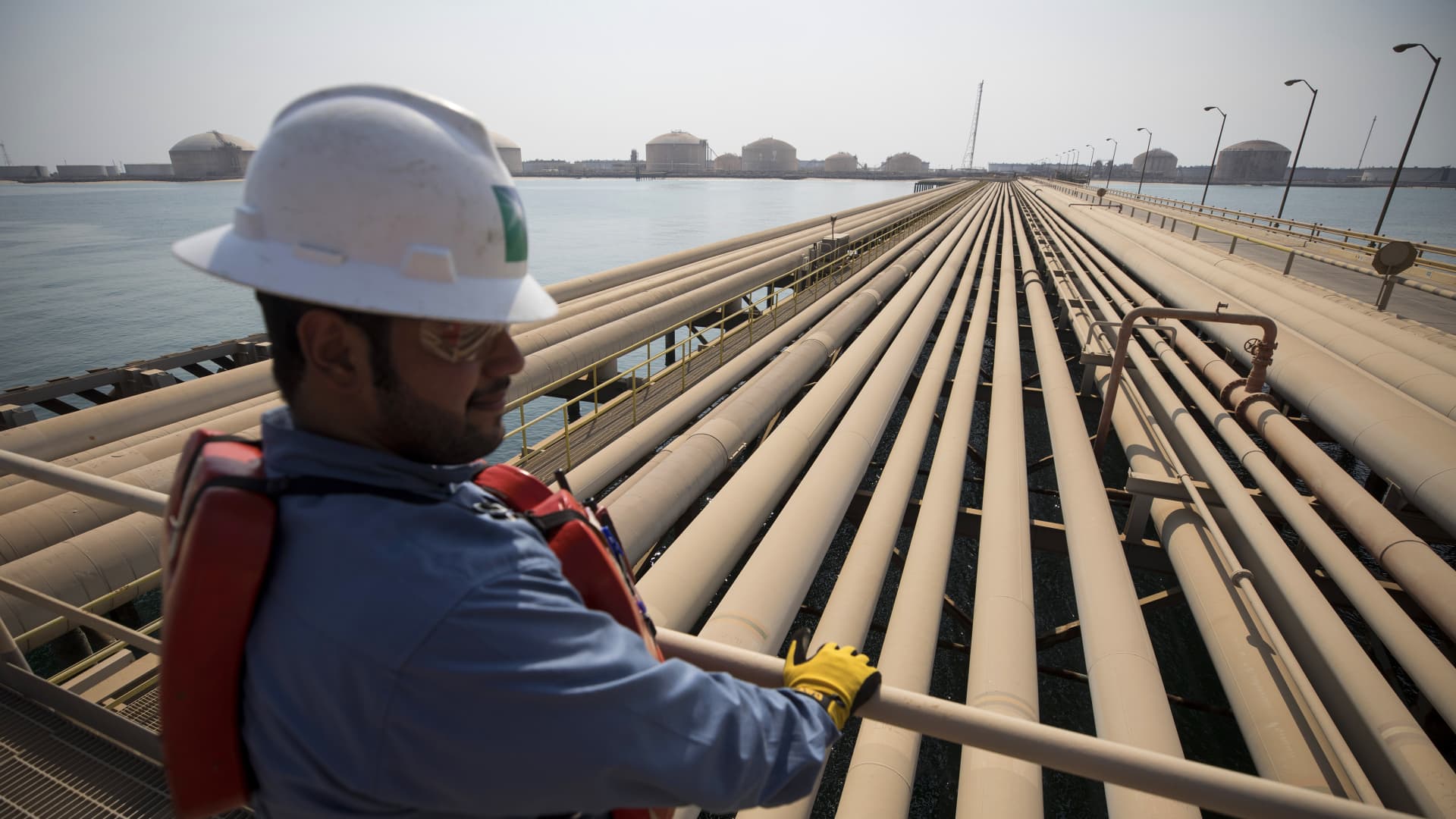
An employee looks out over oil transport pipelines on the Arabian Sea in Saudi Aramco's Ras Tanura oil refinery and oil terminal in Ras Tanura, Saudi Arabia.Simon Dawson | Bloomberg | Getty ImagesOPEC+ is set to keep oil output targets unchanged for the first three months of 2027 at its meeting on Sunday, people familiar with the discussion said, as the war in Iran disrupts Gulf exports and members argue over how much they can produce.The war and disagreements over production capacity threaten another difficult year for OPEC+, as rival producer the United States continues to gain market share and exploits divisions within the group.OPEC+ had planned to set new output targets for 2027 and commissioned its first-ever review of members' production capacity to help set the targets at Sunday's meeting. But the exercise became difficult after Iraq and Kazakhstan challenged the capacity assessments as too low, OPEC+ sources familiar with the discussions said.The group has since leaned towards keeping output targets unchanged in the first quarter of 2027 and has reached an agreement in principle, the people said on Friday.A series of virtual meetings is set to start at 1300 GMT on Sunday, two people said. OPEC+ includes the Organization of the Petroleum Exporting Countries and allies, including Russia.Oil analyst firm Rapidan Energy Group also expects no changes to production targets, citing uncertainty over the duration of the U.S.-Iran war and its effect on crude output and exports.Oil prices have rallied above $100 per barrel due to the war and disruptions this year but have eased in recent weeks due to rising Gulf exports and renewed expectations of a crude surplus in 2027.Rystad Energy sees a global oil surplus reaching 5 million barrels per day next year, equivalent to roughly 5% of worldwide demand, even if Gulf supplies recover only partially.Sunday's meeting comes months after the United Arab Emirates left OPEC and OPEC+ to pump more oil after years of arguing that its quota was too low. Angola quit OPEC at the start of 2024, and Iraq has warned it may leave if its quota is not raised.On Friday, Brent crude futures fell $1.13, or 1.2%, to close at $95.44 a barrel. It hit its highest since Nov. 9 earlier in the session, but stayed shy of the $100 mark.U.S. West Texas Intermediate crude futures traded at $83.08 a barrel, down 60 cents, or 0.7%, from Wednesday's close. There was no Thursday settlement for WTI because of the U.S. Thanksgiving holiday.Brent gained about 3% on the week, while WTI lost 0.9%.
OPEC+ set to keep oil output unchanged as Iran war, capacity rifts persist
Full Article
Original Source
Read the full article at Cnbc →KhanList aggregates and links to publicly available news content. We do not host full articles from third-party sources. Always verify important information with original sources.