
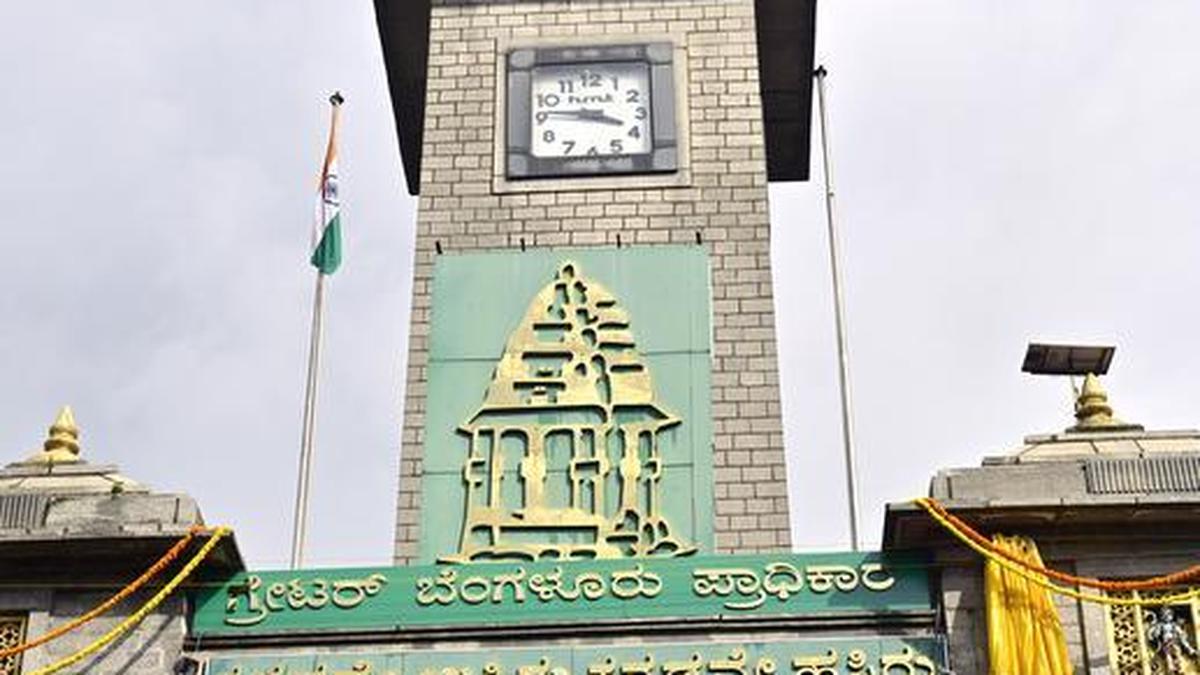
Greater Bengaluru Authority (GBA) board was installed in the head office of the erstwhile BBMP, in Bengaluru on September 3, 2025. The GBA was established with five city corporations with the number of wards increasing from 198 to 369. | Photo Credit: MURALI KUMAR K In this six-part series, The Hindu’s reporters evaluate the restructuring of urban governance in the city with the Greater Bengaluru Authority and five corporations, a year after the reform.The Greater Bengaluru Authority (GBA), which completed a year after replacing the Bruhat Bengaluru Mahanagara Palike (BBMP) with five city corporations, increased the number of wards from 198 to 369. But while 171 new wards were added to the civic map, there has been no corresponding expansion of facilities such as primary health centres (PHCs), Indira Canteens or even ward offices, the local touchpoints through which the five-corporation system was expected to bring civic services closer to residents.The restructuring was also envisaged to address micro-level issues through decentralisation of the administration. But city corporations are still mostly working with a workforce deployed for the old 198-ward setup and not upgraded to the 369 wards yet. Moreover, the vacancy rate is around 40%. This essentially means, the intended benefits of the new governance structure is yet to reach citizens.Residents have pointed to continuing gaps in areas such as solid waste management, funding, and execution. With elections long overdue and councillors and ward committees yet to be in place, many feel the new administrative structure can deliver its full promise of bringing governance closer to citizens only when there is a stronger local accountability mechanism. According to GBA sources, top-level coordination and frequent meetings have particularly helped expedite long-delayed civic works and infrastructure projects. However, problems faced by people on a daily basis, such as garbage blackspots, waste collection, potholes, and citizen services persist.The new corporations had high hopes for three major sources: advertisement revenue, premium FAR, and B-Khata to A-Khata conversion. However, the new setup will step into another year with revenue capacities largely unchanged.The corporations are grappling with shortage of staff, offices and funds, while key institutions meant to drive the city’s development and planning, such as the Economic Development Agency and the Bengaluru Metropolitan Planning Committee (BMPC), are far from becoming functional. Published - September 05, 2026 01:34 pm IST
One year on, how has the Greater Bengaluru Authority fared?
Full Article
Original Source
Read the full article at Thehindu →KhanList aggregates and links to publicly available news content. We do not host full articles from third-party sources. Always verify important information with original sources.