
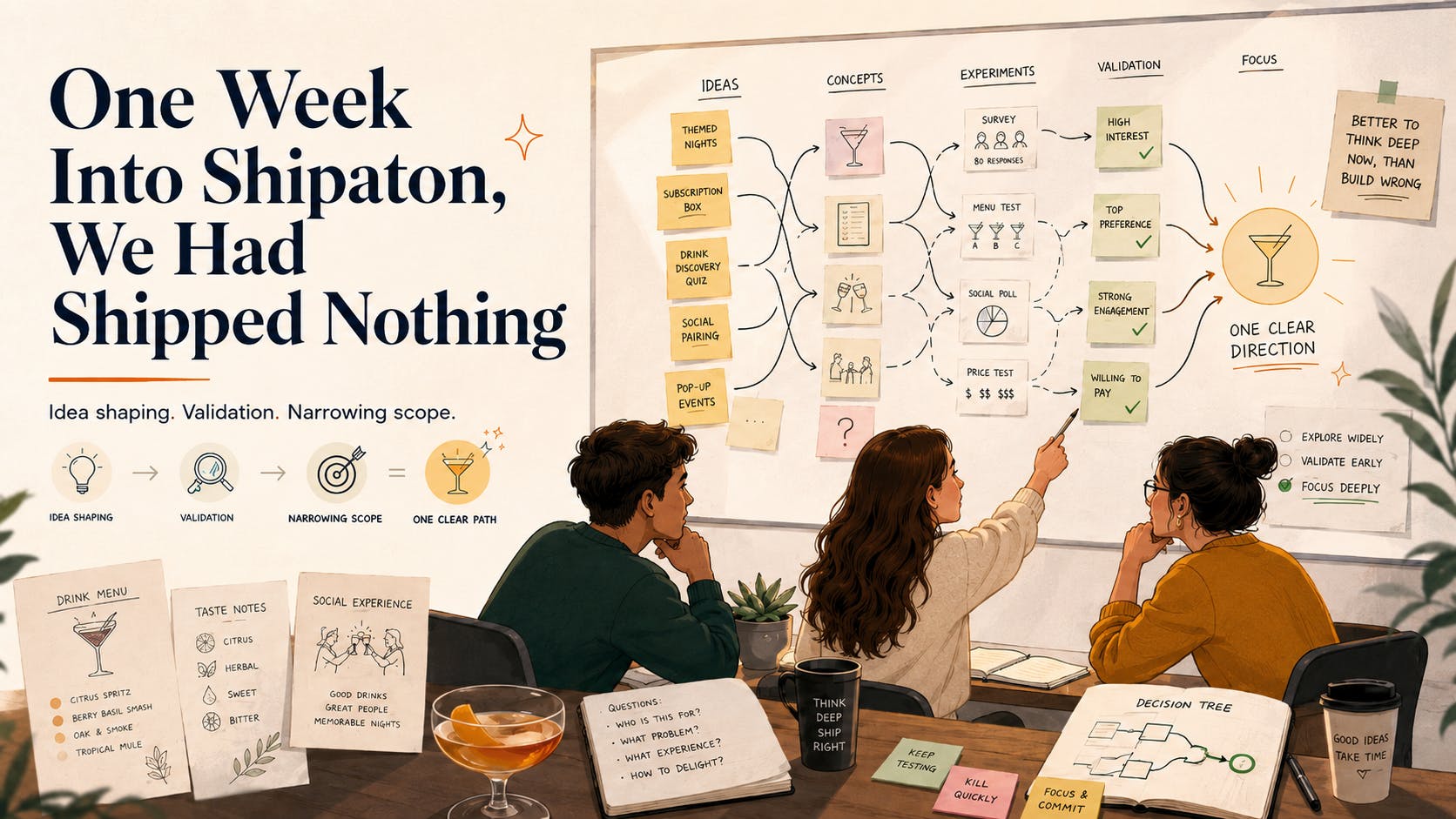
One week into Shipaton, and technically, we shipped nothing.No App Store launch. No polished MVP. No dramatic “built this in 48 hours” post. But we did spend the week doing something we think matters just as much at this stage: figuring out what is actually worth building.We’re working on Vibetail, an AI-powered experience around drinks, taste, and real-world social moments.The original idea sounded simple. Then we started talking to people.And, as usual, a simple idea became five possible products.The More We Researched, the More Questions We HadThis week, we talked to potential users and people on the business side. We looked at how people currently discover drinks, what makes an AI interaction feel genuinely fun instead of gimmicky, and where a product like Vibetail might fit into a real-world experience.We expected market research to narrow the idea immediately. It didn’t.Instead, we found promising signals in several directions.Some people responded most strongly to the personal and playful side of the experience.On the business side, we saw a different opportunity: AI could potentially make an existing offline experience more interactive and easier to navigate. Both sounded reasonable.That created the real Week One question: Who are we building for, and what problem are we solving first?Positive Feedback Is Not the Same as ValidationOne thing we’ve been thinking about a lot is what “validation” actually means.It’s easy to ask someone:Would you use this?And get a yes.It’s also easy to show someone an AI demo, watch them smile, and decide you’ve found product-market fit.We’re trying to be more careful than that.Instead, we started asking questions like:What part of the experience do people actually care about?Would they use it again?Does it solve something, or is it just entertaining once?Who benefits enough to eventually pay?What assumptions can we test without building the entire product?That changed the way we approached the week. Rather than immediately building every feature we could imagine, we kept trying to identify the smallest useful loop worth validating first.Every Good Idea Made the MVP WorseThe dangerous part was that none of our ideas were obviously bad.We thought about personalization. We thought about saving past experiences.We thought about social features.We thought about ways the product could work inside physical venues.We thought about distribution and monetization.Every addition had a perfectly reasonable argument behind it. And together, they made an excellent product roadmap for something we absolutely could not ship quickly.That was probably our biggest lesson this week: The hardest features to cut are not the bad ones. They’re the good ones that don’t need to exist yet.At one point, one of my cofounders even showed us a completely different AI product idea with a much simpler user flow. For a moment, we seriously asked whether we should change direction.The alternative looked cleaner. Easier to explain. Easier to build.But that discussion led us to a better question:Are we looking for the simplest idea, or the idea with the most interesting assumptions to validate?A new idea always looks unusually elegant before you’ve discovered all of its problems. So rather than restarting again, we decided to focus on reducing the biggest unknowns in the product we already care about.Week One Was an Idea-Shaping SprintBy the end of the week, our product became smaller.That’s probably our biggest accomplishment.We cut several things from the first version.We narrowed the user journey.We identified a few assumptions we can test directly.And we now have a much clearer definition of what the MVP needs to prove. I’m intentionally not sharing every detail yet — partly because some of the most interesting pieces are exactly what we’re testing next.But our current questions are much more concrete than they were seven days ago:Do people understand the experience immediately?Does it feel useful enough beyond the initial AI novelty?Does putting it into a real-world context make the experience stronger?And most importantly: Do people want to come back?Those are questions we can build experiments around.So… Did We Waste a Week?If shipping means releasing a finished product, then yes:Week One shipping count: 0.But I don’t think early-stage progress should only be measured in lines of code. Code can make an idea look real long before the assumptions behind it are real. You can build onboarding for users who don’t want to sign up. You can build advanced AI behavior before knowing whether anyone cares about the basic interaction. You can spend days polishing a feature that should have been removed after a 20-minute conversation.So our biggest takeaway from Week One is pretty simple: Shipping fast matters. But learning what to ship matters first.We probably did think too much.But hopefully, we now know much more about what deserves to be built.Week Two: less existential product discussion.More shipping.
One Week Into Shipaton, We Had Shipped Nothing
Full Article
Original Source
Read the full article at Hackernoon →KhanList aggregates and links to publicly available news content. We do not host full articles from third-party sources. Always verify important information with original sources.