
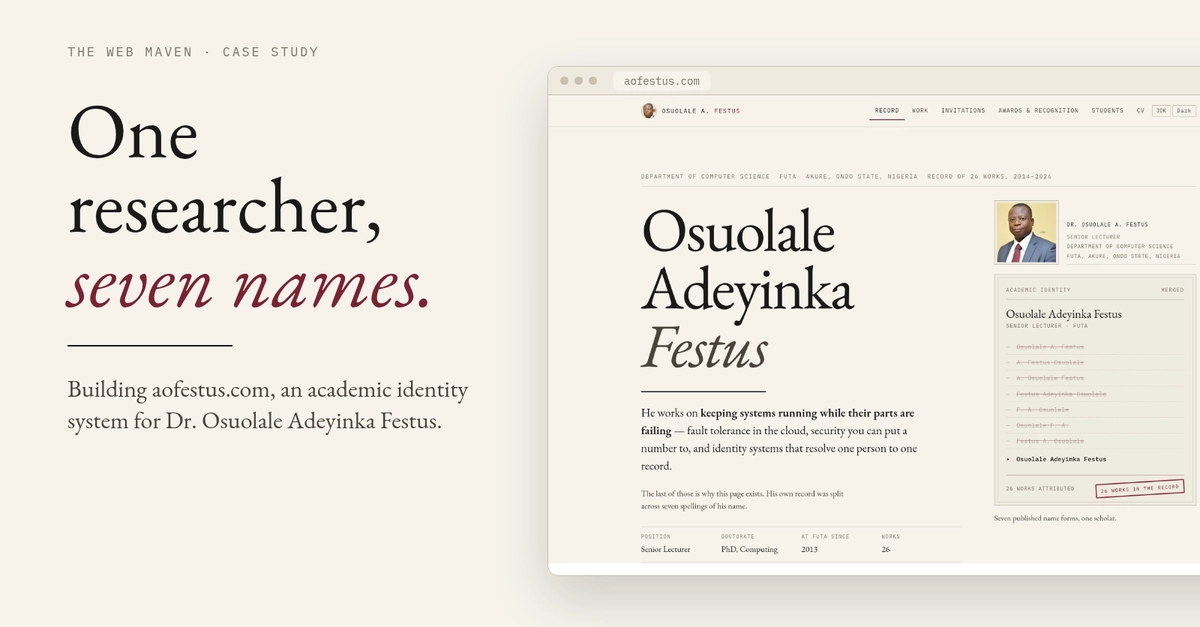
Check the live site The real problem wasn’t “no website” Dr. Osuolale Adeyinka Festus is a Senior Lecturer in Computer Science at FUTA. On paper, the brief was simple: build him an academic website. Then I looked at his publication record and found the actual problem. His work was spread across scholarly databases under seven different spellings of his name. Initials swapped, middle names dropped, surnames shortened. To a person, that’s a small annoyance. To a search engine or a citation index, those are seven different people. The result is a research record that looks smaller and more scattered than it really is. So the brief changed. It went from “build a personal website” to: Make one academic identity easy to understand for people and for machines, without inventing anything. Research before design Before any layout work, I went through the public records and mapped every name variant back to a single canonical identity. One rule held throughout: every claim about a real person needs a source. If I couldn’t verify something, it stayed out or got flagged for him to confirm. Nothing got filled in with copy that just sounded right. That rule shaped the content model, the publication data and the interface. Showing the problem instead of explaining it I didn’t want to bury this in a paragraph, so the site visualises it. You can watch the seven name forms resolve into one identity. The co-author graph uses the same alias mapping, so known variants never show up as strangers. The site also handles the everyday jobs an academic profile should do: Publication record of 26 works, with search and filtering BibTeX export for anyone citing his work Research timeline showing how his themes changed over the years Printable CV generated from the same source data, so it never drifts out of date Invitation composer for event organisers (more below) Supervision, awards and recognition where the record supports them About the invitation composer A normal contact form collects a message and leaves the sender to guess what a good invitation needs. The composer walks organisers through building a complete request and shows them what’s still missing. It never commits him to dates, fees or availability. The site helps people reach him. It doesn’t decide things for him. Light by design No CMS and no database. The site is data-driven and static: Updating it means editing the data, rebuilding, validating and shipping. The build checks canonical URLs, the sitemap and robots file, structured data, image alt text and broken references before anything goes live. It’s fast because there’s very little to load. On the PageSpeed Insights mobile test (14 Oct 2026), it scored 98 performance, 96 accessibility, 100 best practices and 100 SEO. It also supports keyboard navigation and reduced motion, and keeps working offline after the first visit. Readable by machines People increasingly find researchers through search engines, Google Scholar and AI tools. So every page includes canonical URLs, schema.org structured data and scholarly citation metadata. The goal is one authoritative source that other systems can point back to. To be clear, metadata doesn’t guarantee rankings or fix third-party databases on its own. It gives those systems the right signal, and the results get measured over time. What I took away Model the real problem. The missing website was the symptom. The scattered record was the cause. Make the evidence visible. A clear source and honest gaps beat polished copy you can’t back up. Maintainability beats feature count. A small build with one source of truth will outlast a heavy platform. The result aofestus.com is live on its own domain. At the in-person handover on 23 September 2026, Dr. Festus was pleased with the work and asked me to stay in touch. Next up: tracking indexing and search performance so the impact can be shown with data. Do you have a scattered research record, or know an academic who does? Let’s talk →
One Researcher, Seven Names: Building aofestus.com
Full Article
Original Source
Read the full article at Dev →KhanList aggregates and links to publicly available news content. We do not host full articles from third-party sources. Always verify important information with original sources.