
The Industry Prediction markets that cozied up to Don Jr. are now attempting to court Democrats who should be investigating them. By Enter your email to receive alerts for this author. Sign in or create an account to better manage your email preferences. Unsubscribe from email alerts Are you sure you want to unsubscribe from email alerts for Alex Kirshner? Nov 16, 20265:43 PM Photo illustration by Slate. Photos by Getty Images Plus. Sign up for the Slatest to get the most insightful analysis, criticism, and advice out there, delivered to your inbox daily. Since January 2025, a random month when nothing of importance happened in American politics, Donald Trump Jr. has had a sweet gig. Despite Don Jr.’s investment firm having a nine-figure stake in Polymarket, one of the two big prediction markets, the presidential son has also been collecting payment from Polymarket’s main rival, Kalshi. It’s unclear why Don Jr. was allowed to play both sides of the prediction market fence. Most likely it was because of his vaunted business acumen. But last week, at another totally random time in American politics, it became impractical for Don Jr. to keep working for Kalshi while his firm had a roughly $500 million stake in Polymarket. Kalshi and Don Jr. ended his advisory relationship and said it was mutual. “Both parties understood that advising two competitors in a growing sector was complicating things,” Kalshi said in a statement first reported by Reuters. Kalshi pointed to Trump Jr.’s firm increasing its already-huge stake in Polymarket. Indeed, Kalshi paying a member of the president’s family has gotten pretty complicated. For the first time since the company got into the “paying Trump’s family” business nearly two years ago, it is now at risk of facing consequences from the federal government for the various roles it has played in the corruption scandals of Trump 2.0. If Democratic members of Congress are as serious as some of them say about using their new House and Senate majorities to investigate graft, there is no easier layup than to start with the prediction markets. There are two genres of prediction market corruption that Democrats might consider doing something about. The first area is a crackdown on trading markets that create the most obvious corruption opportunities in the world. When you make a trading market out of as many things as you can think of, you create legions of insiders who know things other traders don’t. Some of these insiders turn out to be massive crooks, like the soldier who allegedly used classified information to bet on the U.S. capture of Nicolás Maduro and would’ve tipped off anyone who was paying attention. That market was on Polymarket. Kalshi bills itself as the more respectable of the two platforms, and in many ways it really is: It does not have an offshore exchange like Polymarket, and it does not offer contracts, for the most part, on things that would obviously get people killed if they were to pay out. No missile strike markets here! But to claim that Kalshi is free from insider trading would be impossible. Neither the platform nor its light-touch regulator, the Commodity Futures Trading Commission, has the bandwidth (or perhaps the interest) to investigate and punish the full variety of questionable trading on the exchange. The CFTC is the other piece of this corruption puzzle. Trump’s family has made and staked a lot of money on the growth of prediction markets. At the same time, Trump has installed a CFTC head, Republican Michael S. Selig, who has helped create the best possible business environment for prediction markets. The clearest example of this work has been in sports betting, which Kalshi and Polymarket are slowly devouring, with the help of a federal government that tries to steamroll their opposition for them. The prediction markets pitch themselves as truth machines that separate signal from noise on important societal issues. But about 80 percent of the volume on Kalshi and Polymarket was sports betting as of July, repackaged to feel like stock trading. The Supreme Court gave authority over sports betting laws to each state in 2018, but that was before Kalshi and Polymarket were founded and intertwined themselves with the Trump family. In October 2025, Trump nominated the new CFTC chairman, Selig, who has repeatedly argued in court that his agency (which is now stridently pro–prediction market) has the authority to effectively legalize sports betting in every state, as long as it’s happening on Kalshi under the guise of “trading.” (The CFTC filed its latest lawsuit along this line last week against Arkansas.) There’s a big, fat menu of policy options available to congressional Democrats: For one thing, they can move forward with legislation to ban sports prediction markets, which are an obvious subversion of states’ rights to make their own rules about sports betting. (At the moment, only four states have managed to take Kalshi and Polymarket sports markets offline.) A handful of Democratic and Republican members of Congress introduced House and Senate bills this spring and summer that would ban the markets nationwide. These bills haven’t gone anywhere without the backing of Republican leadership. Trump would probably veto that legislation, which would hurt companies that enrich his family, but the Democratic Congress might like to consider making him do that (or making Republican senators fight it on his behalf). The removal of sports markets would be a blow to Kalshi and Polymarket, which rely on them for large percentages of their trading volume. But there’s so much more that various members of Congress have already proposed: Democrats could push to ban government officials from using these platforms at all. Democratic senators introduced a bill in March. What about banning officials at certain levels of government from trading on Kalshi and Polymarket at all? There’s a Democratic bill for that. Outrightly prohibiting markets on war, assassination, and sensitive government decisions? There’s another one. Maybe Democrats could also consider a bill that would prevent prediction markets from directly paying or offering equity to politicians’ immediate family members. The Donald Trump Jr. Act, maybe? The president’s family has climbed into a bed of money with an industry that wants to turn everything in the world into sports betting. At the exact same time, Trump’s regulatory underlings are browbeating any state—even a Republican state—that thinks to itself, Hmm, didn’t we have the right to decide on sports betting for ourselves? Corruption is both a cause and effect of prediction markets’ growth, and red states aren’t spared. These all seem like reasonable things to talk about in congressional hearings. The legislative branch has shown only glancing interest, under Republican leadership, in doing anything about this very Trumped-up industry. The House Oversight Committee, under Rep. James Comer, released a “staff memorandum” on Friday, a neat thing to do a week after the midterms. Comer is pretty good at making a public spectacle of oversight (see: his efforts to shift Epstein files discussion from Donald Trump to the Clintons) but has had very little to say about prediction markets. If Democrats want to do anything about this vector of corruption that happens to be tied up with their biggest political enemy, they should probably do it now. The prediction markets do not have a lot of Capitol Hill allies at the moment, but they have not been sitting on their hands waiting for a shift in congressional power either. The industry, with Kalshi leading the way, has been prepping for Woke 2.0 for some time now: The Coalition for Prediction Markets hired a former Democratic Congressional Campaign Committee chair as CEO in January, then brought in a former Biden administration and DCCC official as head of government relations. Kalshi hired Democratic strategist Stephanie Cutter in April and made sure the first paragraph of the press release noted her “experience advising top Democrats, including President Barack Obama.” The company brought on another Obama guy, Eric Schultz, in the weeks immediately before the midterms. Polymarket has included Democrats in a recent raft of political giving. You might say the sector has been, if I may, hedging. What is going to happen next, I think, will be something like this: The prediction markets are going to try to de-MAGA-fy their brands while continuing to offer as wide a sweep of financial markets as possible. Old Democratic campaign hands will be part of a reputation-cleansing campaign, which will be aimed at convincing members of Congress and the public that prediction markets have a higher purpose beyond enriching Donald Trump’s family and subsuming states’ rights to make their own laws about gambling. The new Democratic majorities will need to decide whether they want to help them. Democrats Donald Trump Gambling 2026 Midterms
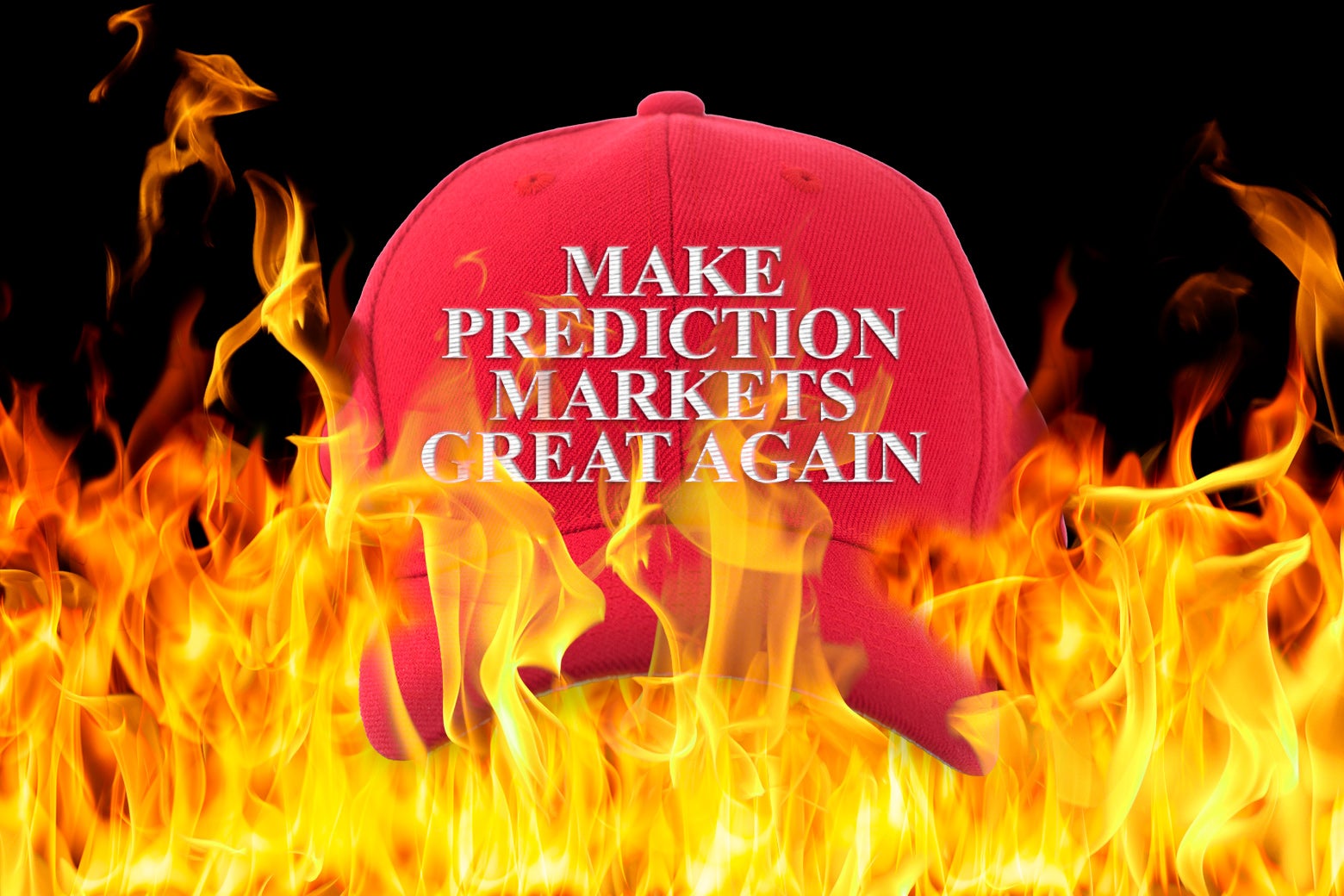
One of Trump’s Favorite Industries Is Trying to Burn Its MAGA Hat
Full Article
Original Source
Read the full article at Slate →KhanList aggregates and links to publicly available news content. We do not host full articles from third-party sources. Always verify important information with original sources.