
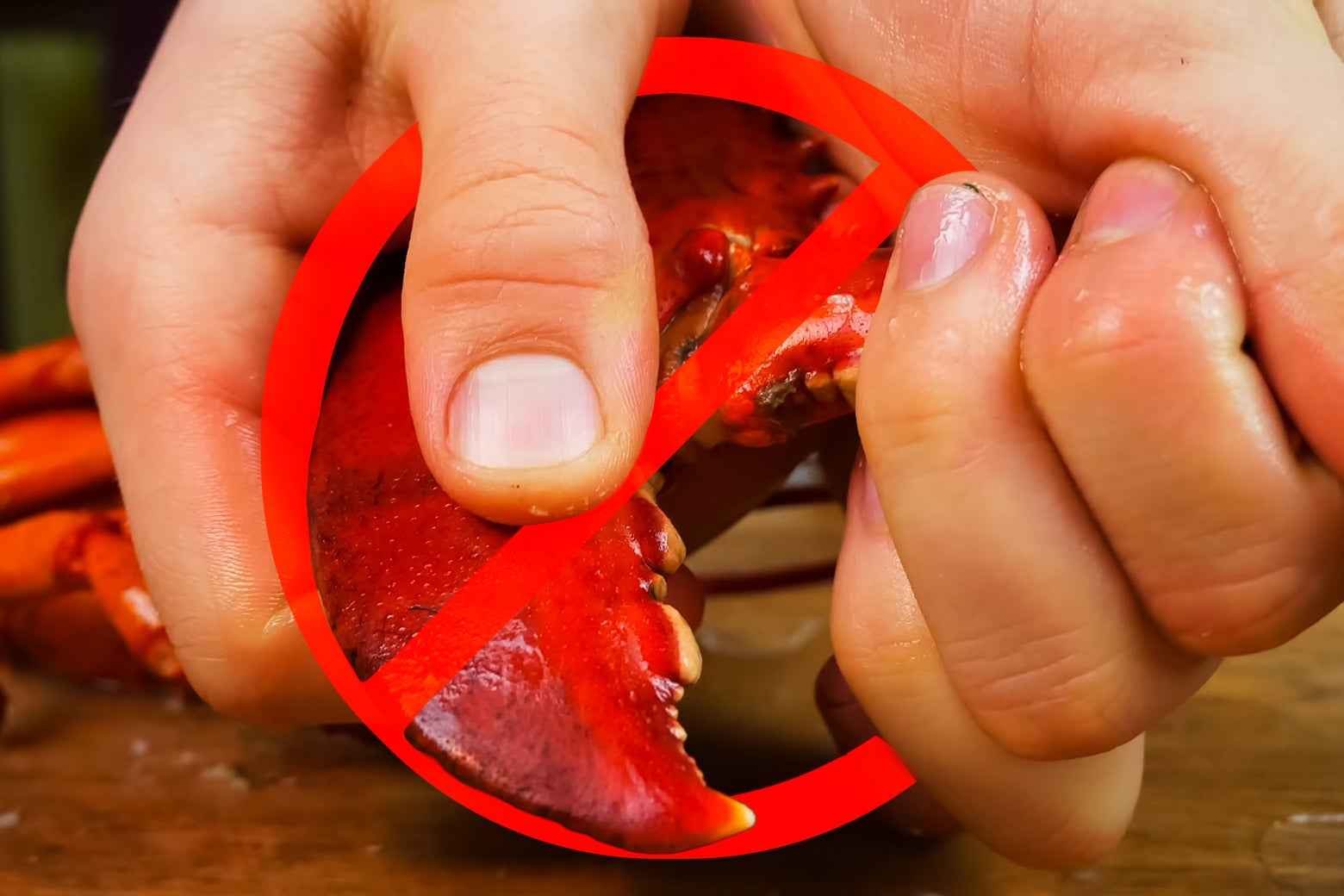
Food The End of Cracking the Crab Yourself Restaurants rarely leave the work of crustacean-eating in our hands anymore—is it time to claw the messy ritual back? Photo illustration by Slate. Photo by Getty Images Plus. Sign up for the Slatest to get the most insightful analysis, criticism, and advice out there, delivered to your inbox daily. On a recent outing to the opulent, subterranean cocktail lounge Kitty’s Cosmopolitan Club in Chicago, four friends eagerly agreed to order the Dungeness crab “cocktail,” among other posh snacks, to wash down with silky gin martinis stirred tableside. The crab arrived shelled, piled jarringly into a fluted scallop shell. The meat itself was delicious, buttery-sweet, exhaling gentle heat and bright citrus. But the lack of effort to excavate it troubled me, as did the use of a bivalve shell to present crustacean meat. Was this just a daring bit of intraspecies accessorizing, or maybe a practical or real-estate decision? After all, who wants the messy, time-consuming business of cracking crab claws while sipping a long-necked martini? (I do!) The next morning, the nose-to-tail British restaurant St. John issued an eerily prescient plea on Instagram disguised as an ad for its whole-crab lunch. “Do not think of the crab as a task,” read the caption, beneath a grinning CEO Trevor Gulliver with a claw in each hand. “It is an engagement to be taken with patience and pleasure. The joys of the claws, the white meat and the brown meat, with a glass of white wine to aid the digestion and appreciation. Simply enjoy the time it takes.” For a long time, shell-on crustaceans were common in restaurants, from dressed-down to special occasion, coastal to landlocked. The Marie Antoinette–esque extravagance has always been there (see the never-say-die seafood tower). But there was a time not long ago when mom-and-pops and casual sit-down restaurants displayed fresh lobsters and crabs in tanks, cheerfully arming patrons with shell-cracking tools and plastic bibs. In the 2010s, fast-casual crab-boil restaurants proliferated nationwide, buoyed by the irresistible virality of buttery whole crabs and corn being dumped from Old-Bay–spiced bags onto communal platters. Social-media candy or not, it platformed a genuinely appealing idea: that coming together to tear, suck, and pluck coveted sweet crabmeat from its shell might not only be fun but also a fine equalizer for our increasingly brittle egos—that is until COVID snuffed many of them out. Nowadays, unless you live in the bayou or Low Country with a grandma who throws backyard crab boils or you can afford a $200-per-pound spindly pile of king crab at a posh steakhouse, your exposure to this messy brand of hands-on eating has largely dried up. As shell-on hedonism slowly gives way to prepicked, preseasoned piles in pretty tins or borrowed bivalve shells, do we still value the time and untidy labor of shelling crabs? Are we forgoing our few remaining connections to the creatures we eat in the name of convenience? “The West’s addiction and kink for convenience here has sort of surpassed the labor that is so inherent to eating and cooking and food in general,” New York–based food writer Anikah Shaokat told me. “Crab is, like, the one thing that still has the ability to have people interact with what they’re eating. If we continue to get so sensitive to that slight chaos and messiness, then we are going to completely detach ourselves from our food.” Bones? What Bones? Americans are well used to disconnection from our food sources, most egregiously when it comes to animal protein. Look no further than our obsession with boneless meat, which has been around since mechanical deboning plants appeared in the 1960s. The diet-crazed ’80s brought the first U.S. plant dedicated to boneless chicken breast, after which we learned to love neutered slabs of white meat, nuggets, patties, and tenders. The latest marketing scourge, boneless chicken “wings” (made from breast meat!), took on special absurdity in the past few years when a slew of lawsuits exposed that even our legal system backs total anatomical incorrectness where poultry is concerned. (I can’t wait till they take up faux crab legs, now making the viral rounds on FoodTok.) No wonder many restaurants consider tiny bones and shell shards a liability. We make exceptions for the sloppiness of (real, preferably spicy) chicken wings and cartoonishly oversized racks of ribs, which seem to better suit a certain—ahem, masculine—brand of overconsumption. And while they may be messy, they’re also far easier to eat. “With crab, you have to fail a little and look like an idiot,” Shaokat said. “Americans, especially, do not want that.” Shaokat was born and raised in Chittagong, Bangladesh. Her parents still live there; her father has a “crab guy,” for crying out loud! When blue crabs are in season, he secures a crate that he cooks in oil with chilies and spices then heaps on the table alongside bowls of rice for sopping. What follows is a deliciously messy, ritualistic dismantling and dispatching of many crab corpses, undertaken by men, women, and children of all ages, seated elbow to elbow. “No tools,” Shaokat said. “Tools are for the weak.” (Except her teeth, with apologies to her dentist.) In other words, this kind of eating lives in Shaokat’s very bones; it’s generationally and geographically expected. Spending my early childhood in Massachusetts, I quickly learned the uniquely smug pride that comes with tackling shell-on Maine lobsters. “No spiny lobstah crap!” Dad would cry, of the supposedly lesser Caribbean variety, his Boston accent strengthening with each syllable. I still recall the shock of watching Maryland blue crabs turning orangey-red as they cooked, the wince-inducing fear of cracking through my first slender, toothed claw before the payoff: slipping out a pointy finger of sweet flesh and dabbing it in melted butter. Now I live in landlocked Chicago, where the extent of my local fish consumption consists mostly of purchasing plastic-wrapped, frozen fillets of lake walleye and whitefish around their brief seasons. And what do my fellow seafood-deprived Chicagoans think of attacking a shelled ocean creature while donning a bib? “Give me an already-cracked pile of crab any day,” said Amanda Gaeta, a Chicagoan and former hospitality marketer, who should probably hasten to Kitty’s immediately. “I know it may taste better if it’s kept in the shell and I do the cracking myself. I just always feel awkward doing it and that I’ll make a mess. Like a bad-first-date-food feeling, if that makes sense—and I love crab.” Backyard vs. White Tablecloth There’s an argument to be had that this messy, uncomfortable business is best tackled at backyard barbecues on newspaper-lined picnic tables. Tamara “Sweetie” Manigault, a line cook at the Publican in Chicago, thought as much when she developed a compromise recipe for crab-boil fries that’s now a bestseller on the happy-hour menu. Manigault grew up in Jacksonville, Florida, where the backyard crab boil is a summertime tradition. In her addictive adaptation, sweet lump blue crab and hard-cooked fries are tossed with spicy garlicky butter and lemony gremolata in a plastic bag, which Manigault herself brings to each table, then shakes and pours into a big, shallow bowl. “The inspiration behind it was, I want to give people a crab boil who don’t want to deal with the messiness of it and the smell on their hands and the stuff on their clothes,” Manigault told me. “It takes time to enjoy a seafood boil. This is like a mini crab boil in a bag.” Crab cracking is far from dead in the Windy City, of course, though most experiences run pricey—unsurprising not least because of our Midwestern location. Yet even places whose hallowed halls were built on whole crabs, like San Francisco’s House of An restaurant group, are seeing customer interest in tackling it wane. Vietnamese immigrant Diana An opened the iconic restaurant Thanh Long in 1971 with her signature garlic-roasted Dungeness crab. As it did back then, it still comes to the table as four pre-quartered legs, hidden beneath the fan-shaped Dungeness shell, to the tune of some 450 crabs sold per week. “Growing up there and working at the restaurant, I knew crab only as a whole-crab experience,” third-generation operator Monique An told me. She now oversees sibling restaurant Crustacean’s San Francisco and Northern California locations. “There’s joy in getting the perfect crack and getting out that perfect moist bite for dipping; there’s the ASMR of crunching into it and licking the juices. There’s satisfying pleasure in doing a little bit of work for your meal.” Soon after the family debuted the Beverly Hills location of younger sibling Crustacean in the late 1990s, customers started requesting their whole garlic crab shelled for the first time. “They’d say, ‘It’s delicious but we don’t want to have to work and break it,’ ” An said. They added a partially cracked version and a shelled one to both Crustacean locations. Now, about a third of the 350 weekly garlic crab orders at Crustacean San Francisco are shelled. The rest are equally split between partially cracked and whole. When asked what might be driving the shelled movement, An replied, “the time and the mess.” It’s not just people at a business dinner loath to get dirty or look silly; crab cracking is an undue burden to some with physical limitations or of advanced age, she noted. Being an excellent ambassador, she said there’s a time and place for both. “But when else do you get a chance to use your hands and fingers in a nice beautiful restaurant, enjoying it with wine and cocktails?” Make It Theater! When indeed? Some 550 miles north, Portland, Oregon, is Dungeness country too. Sean Hoard, partner at Pal’s restaurant on the waterfront, is the sort who considers eating this crab a “spiritual experience.” (He also calls Maryland blue crabs “cute, whatever,” totally unprovoked.) Realizing it wouldn’t hurt to inject some drama into the proceedings, he threw an unconventional feast at the restaurant on Jan. 31, at the height of crabbing season. “Hail Crustacean!” ($66.66) starred whole crabs with Malaysian-inspired flavors seared in a huge wok over an open flame on the back deck, precracked and heaped on pushed-together communal tables with coconut rice. “We were sort of going for this pagan-ritual theme, very dark, tons of candles, playing metal,” Hoard said. He tapped Aaron Rieseberg, the bassist in Portland doom-metal band YOB, to build a playlist to unleash the inner animal in each participant. “Ozzie, Rainbow, Scorpions, Iron Maiden, a lot of classics,” Rieseberg said. “Mostly an upbeat vibe with a few crushers.” (Pun intended.) Rieseberg is an Oregon native who grew up going to crab and crawfish feeds in his grandparents’ backyard. He hadn’t been to one in probably 20 years, since his grandfather, and the tradition, died. He attended the sold-out Hail Crustacean with 40-odd fellow diners. “It was kind of a party vibe,” Rieseberg said. “Really warm, really good service. We made buddies with people sitting next to us. They kept bringing these huge plates of chili crabs; it felt like bottomless crab.” As for cracking it, Rieseberg said it was like riding a bike. “I knew where to dig, I didn’t waste any. It was a big mess and so much fun. I kept thinking, ‘How is this first time I’ve been to crab feed at a restaurant?’ ” At one point, a couple started making out right there at the table, he recalled. Was it the wine or the candles? Or perhaps giving themselves over to a bit of public hedonism, as its chili-soaked juices coated their phoneless fingers and ran down their chins? We’re all still animals, after all. Get the best of news and politics Sign up for Slate's evening newsletter. Food Summer Travel Ocean Restaurants
One of Summer’s Greatest Food Delights Also Takes a Lot of Work. That’s Starting to Change, and Not Everyone’s Happy About It.
Full Article
Original Source
Read the full article at Slate →KhanList aggregates and links to publicly available news content. We do not host full articles from third-party sources. Always verify important information with original sources.