
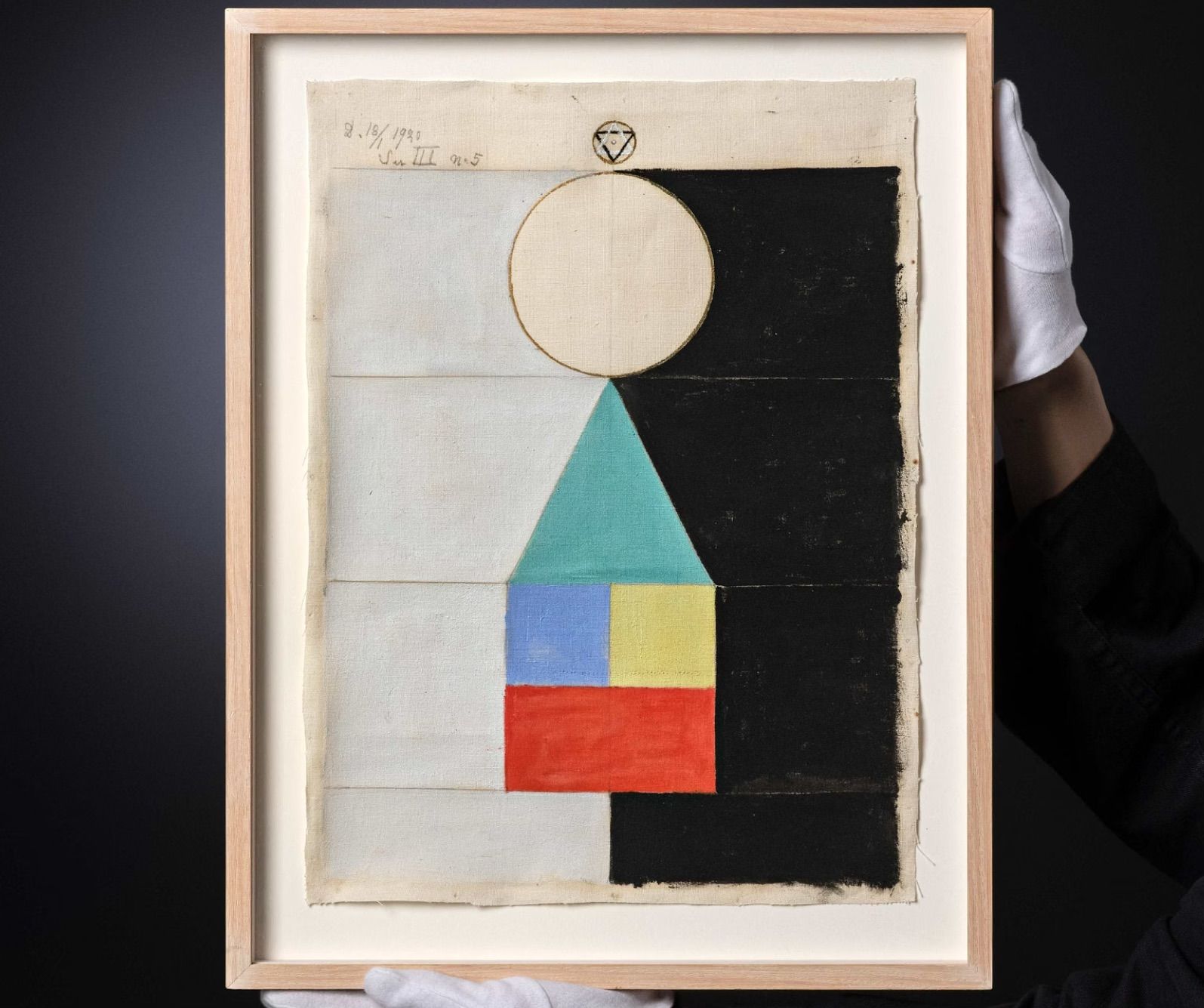
After “Ser III No. 5,” painted in 1920, sold for nearly 16 times its pre-sale estimate, critics charged that af Klint wanted to keep her “holy body of work” together in a temple, not spread across private collections November 20, 2026 4:23 p.m. Ser III No. 5 sold for nearly 16 times its pre-sale estimate. Bukowskis On Thursday, a rare abstract painting by Swedish artist Hilma af Klint sold for a staggering $12.7 million at auction, raking in nearly 16 times its estimated worth. Painted in 1920, Ser III No. 5 is the first of af Klint’s abstract works to go to auction in over three decades, according to a statement from Bukowskis, the Stockholm-based auction house. But some critics say the sale defies the artist’s original intent. Ser III No. 5 epitomizes af Klint’s late-career abstractions, exploring the idea of balance through its black-and-white background broken by a series of colorful, stacked geometric shapes. The painting works on “an intimate scale, steeped in af Klint’s mystical visual language,” Min Chen writes for ArtNet. “She calls her work a message for humanity. There’s the balance of materialism but also spirituality,” Rachel Villari, author of Hilma af Klint’s Atom and The Tree of Knowledge, explains to NPR’s Rob Schmitz. “She was doing it as a way to convey a message for a future generation, [and] I believe we are that generation now” Af Klint created her first abstract work in 1906 and over the course of her career amassed more than 1,200—but almost none have ever sold. Unlike many of her modern art contemporaries, af Klint refused to show off her works beyond her intimate circle. For af Klint, her work was a way of connecting with a higher power; instead of hanging in a museum or private collection, she hoped her paintings would one day fill the walls of a temple. “For Hilma, this is a holy body of work,” Erik af Klint, the artist’s great grand-nephew and the board chair of the Hilma af Klint Foundation, tells Hyperallergic’s Rhea Nayyar. Hilma af Klint, Ser III No. 5, 1920 Bukowskis Throughout her life, af Klint’s work was limited to a small, “spiritually interested audiences,” per the foundation’s website. Upon her death in 1944, af Klint, who never married or had children, bequeathed her collection to her nephew under the condition the public wouldn’t see them for at least 20 years. “The world, she believed, wasn’t ready for them,” Smithsonian’s Ellen Wexler wrote in May. For decades, her works languished in relative obscurity until a 2018 Guggenheim exhibition propelled her into the public eye. Art historians deemed her to be the world’s first abstract artist, reclaiming the title from Wassily Kandinsky, and the 2022 biopic Hilma brought her story to the big screen. But, even as interest in af Klint’s life and work rose, collectors couldn’t get their hands on any of her abstract pieces. The foundation still owns almost all of her pieces and guards them tightly. “Her spirituality and her mysticism are so appealing to people, but she’s been out of reach for so long,” Louise Wrede, head of Bukowskis’ art department, tells the Wall Street Journal’s Kelly Crow. Erik af Klint, in particular, has resisted calls to share, monetize or sell the work, Hyperallergic reports, believing the art should be available as a complete body of work to those seeking a spiritual experience. Ser III No. 5 is one of the few exceptions. In 1992, an entity related to the foundation tried to sell four of Klint’s works to little avail, the Journal reports. In 1995, an unnamed collector purchased two, including Ser III No. 5, which his heirs recently decided to list for auction. Still, the final sticker price likely came as a surprise. Its high-end estimate was $800,000. Af Klint’s previous auction record, set in 2019, was a mere $165,825 for a 1931 watercolor titled The Power of the Spleen. Hilma af Klint in her studio in Stockholm, c. 1885 Public domain via Wikimedia Commons Villari tells NPR that af Klint’s resurgence in the artworld—coupled with the inaccessibility of her pieces—likely contributed to the pumped up price: “That makes it even more desirable to people who can afford to buy her work because what would you want more than the impossible painting that you’re not supposed to have or can’t have?” Af Klint first began painting abstracts as a spiritual project. While in art school, she and four other young, female artists formed a group called “the Five,” devoted to spiritual beings they called the High Ones, per Bukowskis. Her first abstract series, The Paintings for the Temple, comprised 193 paintings dated from 1906 to 1913, each a fragment of an ideal spiritual temple. Did you know? A collaborative project Experts suggest af Klint wasn’t the only artist behind The Paintings for the Temple. She often worked closely with the other members of the the Five, including Anna Cassel, who is thought to have been painted some of the projects’ pieces. Soon, she was introduced to Rudolf Steiner, an Austrian guru who founded the anthroposophy movement, which centers around the idea that the human consciousness can perceive spiritual worlds. In 1920, she began her next project, 85 geometric works including Ser III No. 5 meant to interpret the anthroposophy creed. Villari tells NPR that it is hard to understand af Klint’s pieces, including Ser III No. 5 on their own. “I believe that her work should be kept together as a whole, and that they should be shown sequentially,” she says. “I know, from my own research, that looking at her work from beginning to end, you can see that it’s a progression of this message that they’re conveying.” You Might Also Like Get the latest stories in your inbox every weekday. More about: Art Art Crimes Art History Auctions Modern Art Painting Women's History
One of Hilma af Klint's Amazingly Rare Abstract Paintings Sold for a Record $12.7 Million at Auction. But Should It Have Been on Sale at All?
Full Article
Original Source
Read the full article at Smithsonianmag →KhanList aggregates and links to publicly available news content. We do not host full articles from third-party sources. Always verify important information with original sources.