
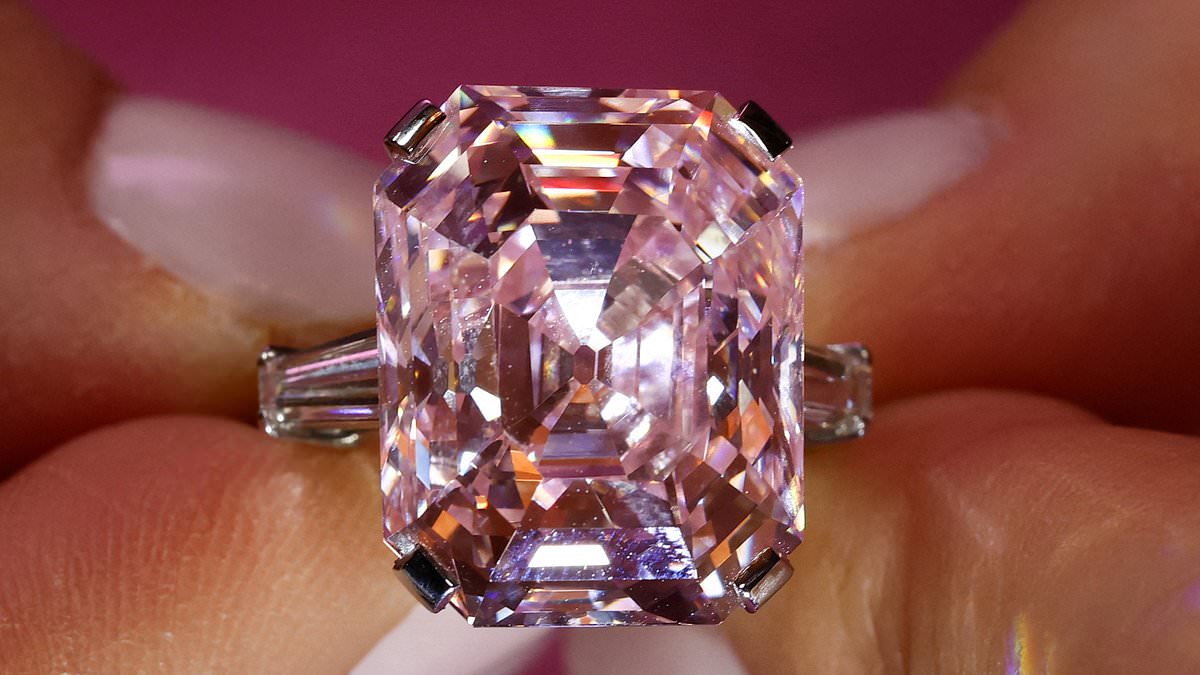
One of the rarest gems on Earth has sold at auction for a staggering 12.1 million Swiss francs ($14.6million). The emerald-cut 'Bulgari Pink' is a Type IIa diamond – a very rare type representing fewer than 2 per cent of gem-quality diamonds. These diamonds contain virtually no measurable nitrogen or boron impurities, and are highly sought-after. Ahead of the sale, Max Fawcett, Christie's global head of jewellery, trumpeted the stone as 'the Mona Lisa of pink diamonds'. Dr Wuyi Wang, Senior Vice President of Research and Identification at the Gemological Institute of America (GIA), said: 'Pink diamonds are rare, but one of this size and quality is very rare among gemstones. 'Most of the natural pink diamonds examined by GIA are less than a single carat. 'The Bulgari Pink is 24.00–carats, with a Fancy Intense Pink color and VVS2 clarity.' One of the rarest gems on Earth has sold at auction for a staggering 12.1 million Swiss francs ($14.6 million) The emerald–cut 'Bulgari Pink' is a Type IIa diamond – a very rare type representing fewer than two per cent of gem–quality diamondsChristie's, who hosted the auction at the Four Seasons Hotel des Bergues in Geneva on November 10, explains that the rough diamond was acquired in India's famous Golconda mines in the 1950s, before being transformed by Bulgari. 'At the time Bulgari, the Roman jeweller, was emerging as a destination for some of the world's most discerning collectors and patrons, making it a natural choice for a diamond of such rarity,' it explained in a statement. 'The 1950s coincided with Rome's emergence as the centre of post–war glamour. With major Hollywood productions filming at Cinecittà Studios, international stars gathered in the city, creating what became known as "Hollywood on the Tiber”. 'Bulgari's boutique at Via Condotti became a social and cultural meeting point, welcoming many of the world's most renowned celebrities, including Elizabeth Taylor and Richard Burton, Audrey Hepburn and Mel Ferrer, to name two Hollywood couples.'The diamond is classified as 'Fancy Intense Pink', which is a coveted colour grade. Dr Wang explained: 'Its color is caused by nitrogen vacancy centers, a truly special feature of natural pink diamonds. The diamond is classified as 'Fancy Intense Pink', which is a coveted colour grade The diamond had been expected to fetch 10–15 million francs ($12–18 million), and eventually sold right in the middle of the expected range Diamonds: The 4 C's Carat: The weight of a diamond. One carat is equal to 200 milligramsColour: Evaluates how colourless, near–colourless, or yellow–brown tinted a diamond is on a scale of D–ZClarity: Evaluates a diamond's freedom from internal and external flawsCut: Evaluates the diamond's craftsmanship and quality of light behaviour 'Its emerald cut, with broad, open facets reveals rather than conceals the diamond's internal characteristics, making this a captivating example of nature's ability to create something extraordinary.' The diamond had been expected to fetch 10-15 million francs ($12-18 million), and eventually sold right in the middle of the expected range.The news comes shortly after a rare half-pink diamond weighing a whopping 37.4 carats was discovered in Botswana.The diamond is one inch long and has a 'sharp' boundary between the dusky pink and colourless sections.Jewels this colour are incredibly rare because temperature and pressure conditions have to be just right for them to form.Experts believe it could be one of the most important pink diamonds in history.Oded Mansori, co-founder of diamond-cutting firm HB Antwerp, said: 'This stone has the potential to become one of the most important pink diamonds ever polished.'Its intensely rich coloration is a testament to the geological uniqueness of the Karowe Mine.'And our deep understanding of the manufacturing process will allow us to capture its vibrant color to the fullest extent possible.'HOW DO SCIENTISTS 'GROW' DIAMONDS IN A LABORATORY? Diamonds fetch their lofty price tags because they form over millions of years under high pressures and temperatures deep within the Earth's crust.But a number of companies are now growing the gems in laboratories across the world, threatening to shake up the diamond industry.A small 'seed' diamond acts as a scaffolding for the process.Scientists first place this seed into a vacuum chamber to remove impurities from the air. Lab-made gems are threatening to upset the diamond industry, with several companies worldwide now growing the stones for jewellery. In this image Pure Grown Diamonds CEO Lisa Bissell unveils a lab-cultivated diamond in New York in 2015They then funnel hydrogen and methane gas heat to 3,000°C (5,400°F) into the chamber to create a highly charged gas known as plasma. The gases rapidly break apart, releasing carbon atoms from the methane that collected on the diamond 'seed'.These atoms naturally copy the crystal structure of organic diamond, which is also made up of carbon atoms.Each artificial stone grows at a rate of around 0.0002 inches (0.006mm) an hour.
One of Earth's rarest gems sells for $14.6 million: 24-carat 'Bulgari Pink' is hailed as the 'Mona Lisa of pink diamonds'
Full Article
Original Source
Read the full article at Dailymail →KhanList aggregates and links to publicly available news content. We do not host full articles from third-party sources. Always verify important information with original sources.