
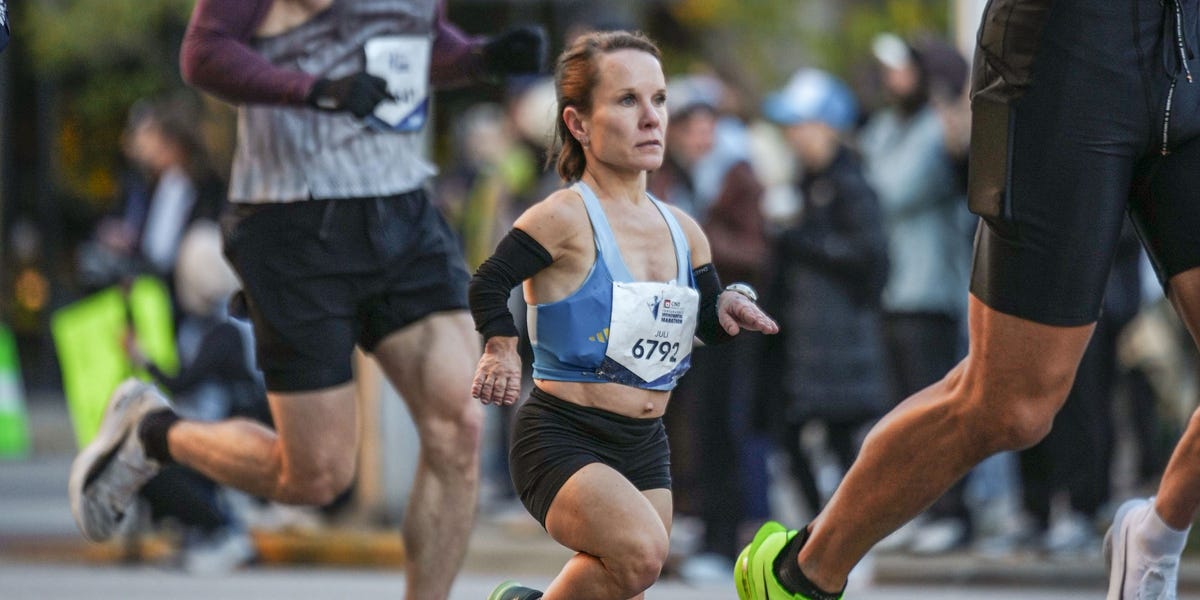
During a marathon, Juli Windsor admits she doesn’t always get to take in the scenery.“Most runners can see what's coming ahead, and they can see beyond the shoulders and all the heads,” she said. “For me, my view is hundreds of butts. It’s not the most inspirational view.”It’s one difference that Windsor, who is 3-foot-9, has learned to navigate as a runner with dwarfism. But that hasn't stopped her from beating many of those butts in races.At the Indianapolis Marathon on November 7, Windsor, 39, ran 3:42:00 to finish in the top third of her 35–39 age group, averaging an 8:28 mile pace. The time was a PR by seven minutes and is provisionally a new American record for the T40 para category (a division for athletes with short stature).Windsor was born with an extremely rare form of dwarfism called acromesomelic dysplasia. “Last I heard, I’m one of a million,” said Windsor, who works as a physician assistant in developmental pediatrics.Windsor’s run in Indianapolis is more impressive considering that this is part two of her marathoning career. After taking a decade off to raise her two kids in 2014, Windsor has come back even stronger, knocking off more than an hour from her pre-hiatus personal best.“I just think the human body is just such an amazing thing,” she said. “And that when asked something difficult of it, what you’re capable of doing can sometimes be really surprising.”Finding her strideAs a middle schooler, Windsor joined the track team to hang out with her friends and went in with low expectations. But that changed when she beat another runner in an 800-meter race. It was motivating, and Windsor eventually realized that although she couldn’t dust her peers in a sprint, she had exceptional grit and endurance. “I might not be able to outrun them, but I could outlast them,” she remembers.In her twenties, Windsor set her sights on the marathon—and one marathon in particular. She wanted to become the first person with dwarfism to run the prestigious Boston Marathon. In 2013, her dream almost came true, but as she neared the finish line on Boylston Street, she was forced to stop. Terrorists had detonated bombs at the finish. Windsor was unharmed, but her dream would have to wait.The next year, Windsor became the first person with dwarfism to complete the historic race, running 4:43:26. That would be her last marathon for a decade, as Windsor raised two kids and focused on her family.In 2025, she felt pulled back to the distance. She signed up for the Spinx Marathon in Greenville, South Carolina, where she ran 4:09:51—more than 30 minutes faster than her personal best from Boston.MarathonFotoNot long after, Windsor started working with coach Esther Atkins, a former professional marathoner who coaches with McKirdy Trained. Atkins saw potential in Windsor and had a hunch she could run a lot faster. While unsure at first, Windsor was assuaged when she nabbed another massive personal best, running 3:49:42 at the 2026 Boston Marathon in April.Atkins, who works with about 40 athletes, is impressed by how coachable Windsor is. “She’s always open to trying something different, and very eager to push the boundaries of what she has done before or what she has believed she was capable of,” Atkins said.“I’m not used to people expecting more of me than I expect of myself; usually it’s the other way around,” Windsor said. “And that’s how I know I have an exceptional coach. She sees the possibilities and isn’t stumped by my unique challenges.”On her own termsAs a runner with dwarfism, Windsor is presented with obstacles that most runners don’t face. Her cadence, for example, is much higher than the average runner. While 180 steps per minute is a commonly cited target among runners, Windsor averaged 207 steps per minute at Indianapolis, and because her stride length is much shorter, she covers less ground per step. (For reference, Windsor is about the height of an average 6-year-old.)Windsor also has to navigate crowds carefully—she doesn’t always show up in the peripheral vision of competitors. She generally runs on the right side of the road to improve her visibility and avoid getting tripped up or surprising people as she passes. At larger races, like Boston or Indy, she is able to start a few minutes ahead of the masses to let the race string out.Courtesy Juli WindsorWindsor celebrates with other runners at the finish of the 2026 Indianapolis Marathon.And then there are shoes. Windsor wears a kids’ size 13, but it’s hard to find athletic shoes in her size that aren’t Velcro or light-up. She generally sizes up to a size 1 for running shoes and uses custom orthotics. But such small sizes don’t have the bells and whistles of normal running shoes. And super shoes that small don’t exist.So far, Windsor has liked Asics the best. “I don’t think I fully appreciated the difference of having a good quality shoe until I tried [an Asics shoe] on,” she said. “And even just having a gel cushion was like, ‘Is this how everybody else feels? This is what I've been missing out on.’”Windsor ran Indianapolis in the GT-2000, although they’re still a little pared down compared to a mass-market adult shoe. “I really wish there were better options and better technology, because I've had to just work with what my options are,” she said.Until recently, Windsor wasn’t able to find a GPS watch that fit her wrists. Last summer, she discovered that Garmin made a 42mm watch, which finally allowed her to run without a phone and gave her insights like cadence and stride length. She partially credits the data for her recent improvement.Eyes down the roadLooking ahead, Windsor has two goals. The first is to qualify for Boston in her age group. Windsor has already nabbed a BQ in the adaptive athlete field, but she’s targeting the able-bodied BQ. She turns 40 next spring, which will bump her to the 40–44 age group. She’ll need to run under 3:35:00—about 7 minutes faster than her personal best—to achieve the standard.Her other goal is to create more opportunities for runners in her Paralympic category. Currently, World ParaAthletics doesn’t sanction running events in the short stature division. USATF recently began to include the marathon in the T40 category, a record which Windsor owns. But the record book isn’t what drives her.“It's less about competition, more about just setting some sort of a standard, and that records are meant to be broken …” she said. “I would love for to open up opportunities for people to at least be curious and give it a try.”Next up for Windsor? The Tokyo Marathon on March 7—one week before her 40th birthday.Find Your Next Running PlaylistTheo Kahler is the senior news editor at Runner’s World. He’s a former all-conference collegiate runner at Winthrop University, and he received his master’s degree in liberal arts studies from Wake Forest University, where he was a member of one of the top distance-running teams in the NCAA. Kahler has reported on the ground at major events such as the Paris Olympics, U.S. Olympic Trials, New York City Marathon, and Boston Marathon. He’s run 14:20 in the 5K, 1:05:37 in the half marathon, and finished 40th at the 2025 New York City Marathon. He enjoys spotting tracks from the sky on airplanes. (Look for colorful ovals around football fields.)
‘One of a Million’: She’s 3-Foot-9, Just Ran a 3:42 Marathon, and Is Chasing a Boston Qualifier
Full Article
Original Source
Read the full article at Runnersworld →KhanList aggregates and links to publicly available news content. We do not host full articles from third-party sources. Always verify important information with original sources.