
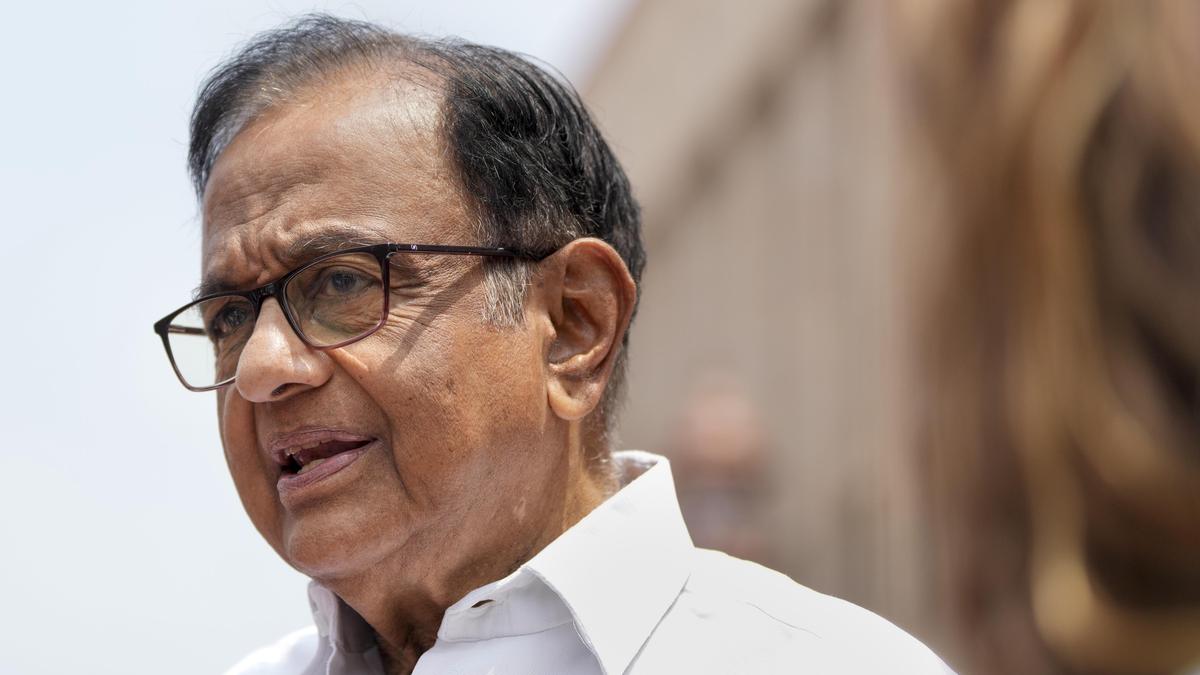
Former Union minister P. Chidambaram on Monday (August 24, 2026) strongly opposed the proposed move to hold simultaneous elections to the Lok Sabha and State assemblies before a joint committee of Parliament, decrying the initiative as "monstrous" and "unconstitutional." The former Home and Finance Minister also said that the proposal to hold nationwide polls under "One Nation, One Election" is a "mindless" exercise.Sources said Mr. Chidambaram submitted his opinion while appearing before the joint committee of Parliament on the Constitution (129th Amendment) Bill, 2024, and the Union Territories Laws (Amendment) Bill, 2024, which aim to synchronise Lok Sabha and State assembly polls.The committee is headed by BJP member P.P. Chaudhary.The senior Congress leader contended that the bills on simultaneous polls are "unconstitutional". He argued that since any legislature is elected for a five-year term, curtailing its tenure directly violates the basic structure of the Constitution, sources aware of the deliberations said.The senior Congress leader also said that his conscience does not allow him to support the bills and stressed that the government does not have the number (two-thirds majority) to pass the legislation, sources said.TMC's Sagarika Ghosh, a member of the panel, also opposed the bill, claiming it would give "unbridled" power to the Election Commission.When asked about Mr. Chidambaram's submission, Mr. Chaudhary said the former Union minister gave good inputs, but he may have a different view as he represents a particular party."The committee has been tasked by Parliament to examine and make recommendations. We sought Chidambaram's views as part of this examination process, and the committee will examine them before making its recommendations," he said.Mr. Chaudhary also asserted that the move to hold simultaneous elections is not against the basic structure of the Constitution.A group of about 10 Padma awardees, including Tarlochan Singh, Navin Khanna, Meenakshi Jain and Niru Kumar, also appeared separately before the panel.While a section supported the initiative of simultaneous polls, others opposed it, saying it may bring "chaos" in the country.On the submissions of the Padma awardees, Mr. Chaudhary said they have extensive experience, acting as representatives of civil society, and they provided the committee with significant input."Considering their wide range of experiences, I believe the committee gained rich information and excellent suggestions from them. Their views on 'One Nation, One Election' are very important."The Padma awardees generally feel that simultaneous polls are in the national interest, provided sufficient safeguards are in place and that the committee should work towards this goal," he said, adding there is a broad desire for the implementation of the 'One Nation, One Election' process.The bills were introduced in Lok Sabha in December 2024, following which they were referred to the joint committee for examination.The bills were formulated after a high-level panel, headed by former president Ram Nath Kovind, recommended holding Lok Sabha, State assembly and local body elections simultaneously in a phased manner. Union Home Minister Amit Shah was also a member of the high-level panel headed by Kovind.Following the adoption of the Constitution, elections to the Lok Sabha and all State Legislative Assemblies were conducted simultaneously from 1951 to 1967.The first general elections to the Lok Sabha and State Assemblies were held together in 1951-52, a practice that continued for three subsequent general elections in 1957, 1962, and 1967.However, this cycle of synchronised elections was disrupted in 1968 and 1969 due to the premature dissolution of some State legislative assemblies.The Fourth Lok Sabha was also dissolved prematurely in 1970, with fresh elections held in 1971. Unlike the First, Second and Third Lok Sabha, which completed their full five-year terms, the Fifth Lok Sabha's term was extended until 1977 under Article 352 because of the declaration of Emergency.Since then, only a few Lok Sabha terms have lasted the full five years, such as the Eighth, Tenth, Fourteenth and Fifteenth. Others, including the Sixth, Seventh, Ninth, Eleventh, Twelfth and Thirteenth, were dissolved early.State assemblies have faced similar disruptions over the years. Premature dissolutions and term extensions have become a recurring challenge.These developments have firmly disrupted the cycle of simultaneous elections, leading to the current pattern of staggered electoral schedules across the country.
‘One Nation, One Election’ proposal is ‘unconstitutional’: Chidambaram to parliament panel
Full Article
Original Source
Read the full article at Thehindu →KhanList aggregates and links to publicly available news content. We do not host full articles from third-party sources. Always verify important information with original sources.