
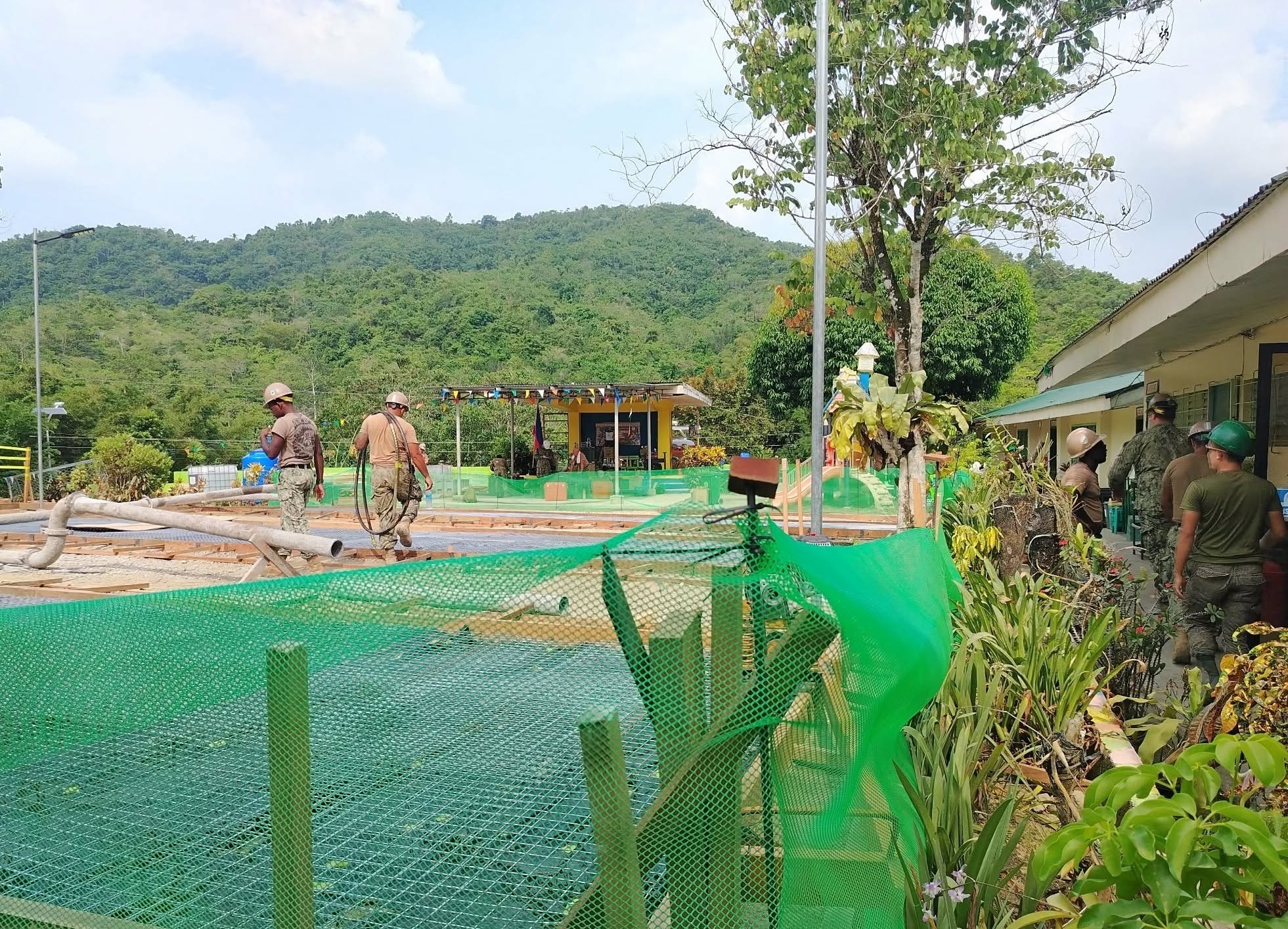
US Navy and Philippine Army are improving infrastructure at Lorenzo Daa Memorial School in Tacloban City, addressing long-standing issues like a broken water system and deteriorating classrooms. The project aims to enhance the school's environment for teaching and learning, potentially allowing for a school canteen and a larger library for students. This is AI-generated. Read the article for full context. Report any errors. TACLOBAN, Philippines – Before the main activities of Pacific Partnership 2026 begin in Eastern Visayas in September, work is already underway at a public school in Tacloban City. At Lorenzo Daa Memorial School in Barangay 103-A Paglaum, US Navy construction personnel and the Philippine Army are working on improvements that include repairs to the school’s water system, concreting portions of the school grounds and rehabilitation of two classrooms. For the 143 pupils who attend the school, the project is more than an engineering activity. For years, the school has struggled with a broken water system, muddy grounds during heavy rains, limited storage space and classrooms that need repair. One of the most immediate problems has been water. Because the school’s well and pump stopped working, pupils have had to bring about a liter of water from home, mainly for use in the school toilets. “Teachers and learners, they ask their parents to bring one liter per learner,” principal Eric John Estoque said. “They have to bring one liter of water para CR.” Now, the school hopes it will no longer have to rely on that arrangement. Lorenzo Daa Memorial School is one of two public schools in Tacloban City selected to receive an infrastructure project through the US Navy’s Naval Mobile Construction Battalion 5 and the Philippine Army as part of Pacific Partnership 2026. The work is expected to address some of the school’s long-standing problems. The water system will be repaired, portions of the grounds will be concreted and two deteriorated classrooms will be rehabilitated. For Estoque, the changes could also give the school room to do more. He is considering using one of the repaired spaces for a school canteen so pupils can have a proper place to eat. He also hopes to improve the school’s library, which currently shares a small space with his office. A larger library would give pupils more room to sit, read and study. “We are very much grateful for the help that they extend to us,” Estoque said. He said the improvements would also help the school provide a better environment for teaching and learning. Pacific Partnership is an annual US Navy-led multinational mission focused on humanitarian assistance and disaster preparedness in the Indo-Pacific. It brings together military personnel, medical teams, engineers, government agencies and community partners for activities including medical services, engineering projects, disaster-preparedness training and professional exchanges. Pacific Partnership 2026 includes activities in Vietnam, Indonesia, Malaysia, the Philippines and Timor-Leste, with enduring projects in Fiji and Palau. Australia, Canada, Germany, Japan, New Zealand, South Korea, Singapore and Britain are also listed among participating countries, although their involvement does not necessarily mean they will send personnel to Eastern Visayas. In the Philippines, a coordination hub was established in Subic Bay in June to prepare medical, disaster-management, engineering and outreach activities. Preparing before disaster strikes For the Philippine Army, Pacific Partnership provides an opportunity to work with international partners and civilian agencies before an emergency. Lieutenant Colonel Joseph Sabas, public affairs chief of the Philippine Army’s 8th Infantry Division, said the Army is coordinating with the US military, partner nations, national government agencies and local governments. “The primary objective is to strengthen humanitarian assistance and disaster-response capabilities while enhancing interoperability among the participating forces and civilian agencies,” Sabas said. The training allows responders to become familiar with each other’s procedures before they have to work together during an actual disaster, when time may be limited to arrange transportation, move supplies, maintain communications or reach isolated communities. Why Eastern Visayas? The focus on disaster preparedness is particularly relevant in Eastern Visayas, which regularly experiences tropical cyclones, heavy rain, flooding, landslides and storm surges. The region was among the areas hardest hit by Super Typhoon Yolanda (Haiyan) in 2013, and coastal and vulnerable communities remain exposed to flooding, landslides and storm surges. The Philippine Army’s role includes logistics, transportation, coordination, security and community engagement during humanitarian activities. Where will the activities be held? Specific locations for Pacific Partnership 2026 in Eastern Visayas are still being coordinated. Sabas said communities are being considered based on their needs, disaster vulnerability, accessibility, existing preparedness programs and the feasibility of conducting activities. Local governments will help identify community needs and coordinate activities with residents to ensure they complement local disaster-risk-reduction and development priorities. Some communities in Eastern Visayas are far from urban centers and can be difficult to reach, particularly during bad weather. Paglaum is one example. It has no regular jeepney route directly serving the area, and residents and visitors often rely on private vehicles, motorcycles and other available transportation. Heavy rain or flooding can make access more difficult. Sabas said preparations include planning transportation routes, staging areas, communications, medical support and backup arrangements. The Army is working with local governments and other agencies through early planning, coordination and contingency measures. What remains after the mission For Sabas, the value of Pacific Partnership should extend beyond the departure of participating teams. Training and exchanges can help responders identify gaps in communication, coordination, logistics and resource management, with lessons applied to future disaster exercises and contingency planning. “More importantly, the activity is expected to contribute to a more resilient Eastern Visayas by helping communities and local responders improve their preparedness and ability to respond to natural disasters,” Sabas said. At Lorenzo Daa Memorial School, the impact is more tangible: a repaired water system, rehabilitated classrooms and school grounds that will be easier to use during rain. The improvements could also give pupils a better place to eat and a larger space to read. For years, pupils have had to bring water from home because the school could not provide enough. If the repairs are completed as planned, that extra liter may finally stay at home. For the children of Barangay 103-A Paglaum, that means one less thing to carry to school and one less problem to worry about. – Rappler.com
One less thing to carry: US Navy, PH Army bring help to Tacloban school
Full Article
Original Source
Read the full article at Rappler →KhanList aggregates and links to publicly available news content. We do not host full articles from third-party sources. Always verify important information with original sources.