
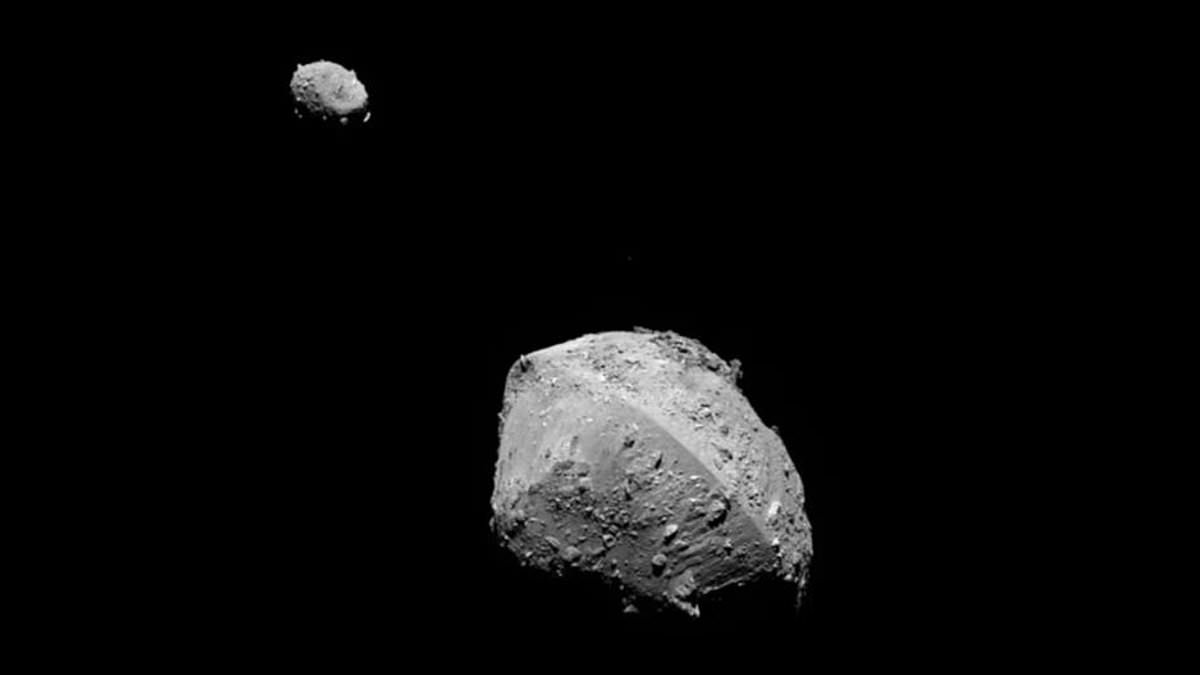
A European Space Agency (Esa) spacecraft has beamed back the results from the Armageddon-style mission to knock an asteroid out of its orbit.In September 2022, Nasa smashed a half-tonne spaceship named Dart (Double Asteroid Redirection Test) into the asteroid Dimorphos.Echoing the 1998 sci-fi blockbuster, the goal was to see if humanity could save itself from deadly asteroid impacts by nudging a space rock off its collision course.Now, a spacecraft called Hera has arrived at the scene and begun a six-month mission investigating the aftermath.Stunning images and videos reveal that the impact flattened an entire face of the 496-foot-wide (151m) asteroid, producing a crater the size of a football stadium.And for the scientists working to protect Earth from the threat of 'city killer' asteroids, this new data brings some extremely welcome news.Hera mission manager Ian Carnelli: 'Sixty-six million years ago, an asteroid impact changed the course of life on Earth.'Today, for the first time in history, humanity is validating how to prevent such an event from happening again.' A European Space Agency (Esa) spacecraft has beamed back the results from the Armageddon-style mission to knock the asteroid Dimorphos (top) out of its orbitNasa's Dart mission targeted a pair of asteroids 120.2 million miles (193.5million km) from Earth: the smaller moonlet Dimorphos and the massive 2,395-foot-wide (730m) asteroid Didymos.Dimorphos was chosen because changes in its orbit around Didymos would reveal how effective Nasa's battering ram space defence really was.The vending-machine-sized spacecraft hit the smaller space rock at 14,000 mph (23,000km/h), packing enough punch to knock the asteroid tumbling.While the rock, which is about the size of the Pyramid of Giza, normally orbits its partner in 11 hours and 55 minutes, telescope observations showed that Dart had shortened that by 33 minutes.However, scientists still needed to see exactly what had happened to Dimorphos, which is where Hera comes in.Patrick Michel, principal investigator of Esa's Hera mission, says: 'Hera is a sort of Inspector Columbo going back to the crash scene to investigate what is the outcome of this impact.'These observations reveal that the collision was far more destructive than researchers had initially suspected, creating a crater spanning almost the entire asteroid.Although Dimorphos's overall structure hasn't changed, researchers discovered that the asteroid is now tumbling wildly in its orbit. In September 2022, Nasa smashed a half-tonne spaceship into the asteroid, producing a football-stadium-sized crater that has now been revealed by the Esa spaceship Hera. Pictured: Dimorphos before (left) and after (right) the collision The Dart mission wanted to see whether hitting an asteroid with a spaceship could knock it out of a potential collision course. Pictured: The last image produced by Dart before hitting Dimorphos Sabina Raducan, of the International Space Science Institute, said in an Esa press briefing this morning: 'Before, Dimorphos was more like our own Moon, always showing the same face [to Didymos].'Now it is very chaotic, tumbling, rolling like a barrel around Didymos.'But the biggest surprise was the discovery that Dart seems to have knocked hundreds of boulders into a swirling blizzard of debris.Scientists aren't quite sure where the boulders came from, but this could be a serious problem for Hera as it tries to continue its crash-scene investigation.Esa scientists said that the spacecraft will now only approach to a distance of eight miles (13km) rather than five miles (8km) as originally intended.But the real problems will start in January when Hera releases two tiny 'cubesat' spacecraft, Juventas and Milani, which will venture much closer.Juventas plans to use radar to see whether Dimorphos is a loose pile of rubble or a solid chunk of rock.Milani, meanwhile, will look at the rock's mineral composition and help work out the asteroid's mass. Hera has travelled to the asteroid to act like a 'crash scene investigator', working out exactly what effect the Dart mission had In an unexpected discovery, astronomers found that the crash had released hundreds of boulders (pictured) ranging from the size of footballs to the size of washing machinesThese craft have no means of knowing when a flying boulder is coming or getting out of the way in time, meaning they could easily be smashed apart by the debris field.Margherita Cardi, a space engineer and executive at Tyvak International who oversees Milani, told reporters that the boulder field was a 'nightmare' challenge for her team.However, the data Hera and its tiny companions will send back is critical for understanding how effective the Dart mission really was and whether we could deflect a serious threat to Earth in the future.Earth is periodically rocked by colossal asteroid impacts capable of triggering mass extinction events, like the one that wiped out the dinosaurs 66 million years ago.Scientists don't think that any of these 'planet killer' asteroids are likely to hit Earth any time soon, but smaller asteroids still pose a pressing threat.For example, in 2013, a 65-foot (20m) asteroid exploded over the Russian city of Chelyabinsk, injuring around 1,600 people and damaging thousands of buildings.If scientists want to be able to bat these asteroids out of the way before they hit Earth, it's crucial that we know what effect their mass and composition have.Given enough warning, almost any asteroid might be safely nudged out of Earth's path, provided we know the right way to hit it.And with the data now being beamed back by Hera, that could soon be possible.WHAT COULD WE DO TO STOP AN ASTEROID COLLIDING WITH EARTH?Currently, NASA would not be able to deflect an asteroid if it were heading for Earth but it could mitigate the impact and take measures that would protect lives and property.This would include evacuating the impact area and moving key infrastructure.Finding out about the orbit trajectory, size, shape, mass, composition and rotational dynamics would help experts determine the severity of a potential impact.However, the key to mitigating damage is to find any potential threat as early as possible.NASA and the European Space Agency completed a test which slammed a refrigerator-sized spacecraft into the asteroid Dimorphos.The test is to see whether small satellites are capable of preventing asteroids from colliding with Earth.The Double Asteroid Redirection Test (DART) used what is known as a kinetic impactor technique—striking the asteroid to shift its orbit.The impact could change the speed of a threatening asteroid by a small fraction of its total velocity, but by doing so well before the predicted impact, this small nudge will add up over time to a big shift of the asteroid's path away from Earth.This was the first-ever mission to demonstrate an asteroid deflection technique for planetary defence.The results of the trial are expected to be confirmed by the Hera mission in December 2026.
One giant nudge for mankind! Spacecraft beams back results from the 'Armageddon'-style mission to alter an asteroid's orbit - revealing a stadium-sized crater in the space rock
Full Article
Original Source
Read the full article at Dailymail →KhanList aggregates and links to publicly available news content. We do not host full articles from third-party sources. Always verify important information with original sources.