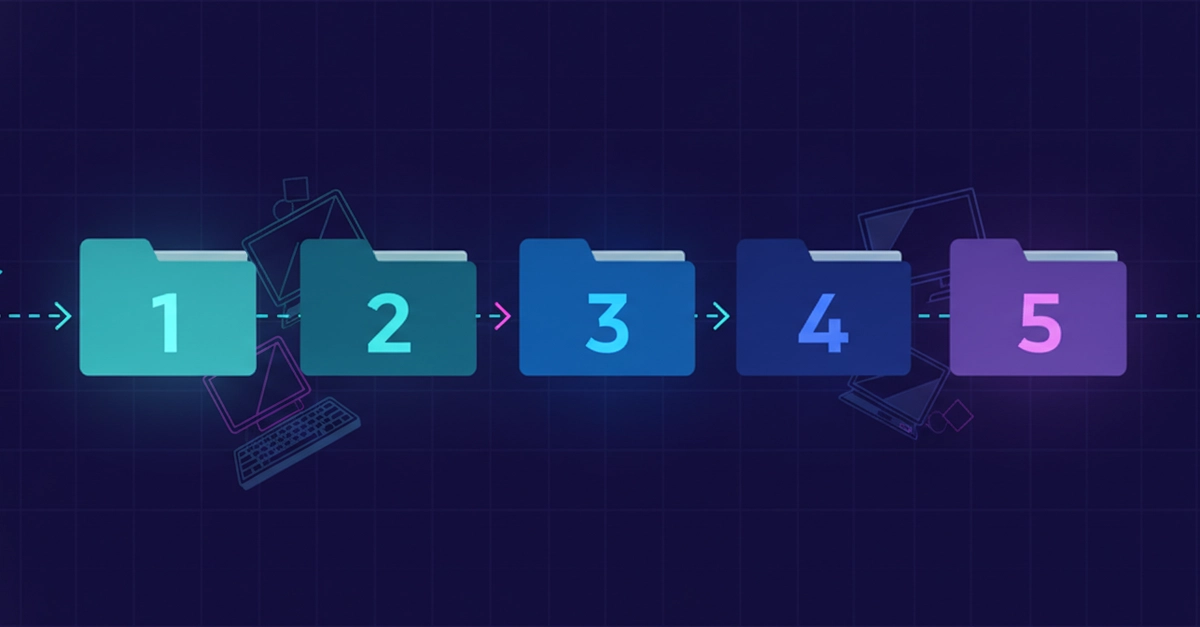
TL;DR I merged several training courses into one monorepo and gave every course the same numbered folder shape: 00-planning → 04-post-training. A _TEMPLATE/ you copy to start the next one, an _ARCHIVED/ you park old stuff in, and a CLAUDE.md that makes the convention machine-readable. The trick that makes it stick: templates use , and "done" is a grep that returns nothing. I had course material scattered across repos — planning notes here, marketing copy there, facilitator run-sheets in a third place. Every new course started from a blank page, and I re-invented the folder layout each time. So I collapsed everything into one monorepo with a single rule: every course has the identical shape. The lifecycle, as folders The insight isn't "use folders" — it's that a course has a lifecycle, and numbered folders make that lifecycle the primary axis instead of file type. Plan it, sell it, teach it, run it, follow up. Five stages, always in order: Folder Stage What lives here 00-planning/ Prepare Syllabus (source of truth), specs 01-marketing/ Sell Positioning master + channel assets 02-content/ Teach Modules, one file each 03-delivery/ Run Run-sheet, pre-flight checklist, fallback plan 04-post-training/ Follow up Feedback form, follow-up email, post-mortem The numeric prefix isn't decoration. It forces sort order to match the actual workflow, so the folder listing reads like the process itself. Same reason migration files are timestamped — order is information. / 00-planning/ -> derives everything below 01-marketing/ 02-content/ 03-delivery/ 04-post-training/ --. post-mortem findings | ^------------------' feed back into 00..03 Enter fullscreen mode Exit fullscreen mode That loop at the end matters: the post-mortem doesn't sit in a graveyard folder. Its findings flow back into the syllabus, the run-sheet, the marketing. The structure runs the same feedback loop it's supposed to teach. _TEMPLATE/: a course starts as a copy Starting a new course is one line: cp -r _TEMPLATE my-new-course Enter fullscreen mode Exit fullscreen mode The template is the full lifecycle skeleton with the writing already stubbed. What you must fill is marked as — , , and so on. Everything not in a slot is standing structure you keep. The part I like most is the definition of done. A course is ready when this returns nothing: grep -rn '<' --include='*.md' . Enter fullscreen mode Exit fullscreen mode No slot hits = no unfilled blanks. It turns "is this finished?" from a judgment call into a command with an exit code — the same instinct as a failing test. If I were wiring this into CI, that grep becomes the assertion. _ARCHIVED/: park it, don't delete it Retired formats and old campaigns go into _ARCHIVED/, in dated subfolders with a note on why it was retired and what replaced it. One rule keeps it honest: nothing live may reference anything in there. If a live file still links to it, it isn't archived — it's just moved. Why keep it at all? Because a retired price, a killed campaign style, or an abandoned format is a recorded decision. Deleting it loses the "we already tried that, here's why it didn't work." Git history technically has it, but nobody spelunks reflog for a pricing decision. CLAUDE.md: the convention, machine-readable The last piece is a CLAUDE.md at the root that spells out the layout, the naming rules, and the standing decisions. It's written for an AI coding agent, but the real value is broader: it's the one file where the convention lives as text instead of as tribal knowledge in my head. Any collaborator — human or agent — reads one file and knows where things go. The takeaway The pattern generalizes past courses. Any repeatable body of work with a lifecycle — client engagements, product launches, incident write-ups — benefits from the same three moves: one fixed shape, a copy-to-start template with a grep-checkable done state, and a parking lot for retired decisions. Consistency you can grep beats consistency you have to remember.
One folder shape for every course: a lifecycle monorepo convention
Full Article
Original Source
Read the full article at Dev →KhanList aggregates and links to publicly available news content. We do not host full articles from third-party sources. Always verify important information with original sources.