
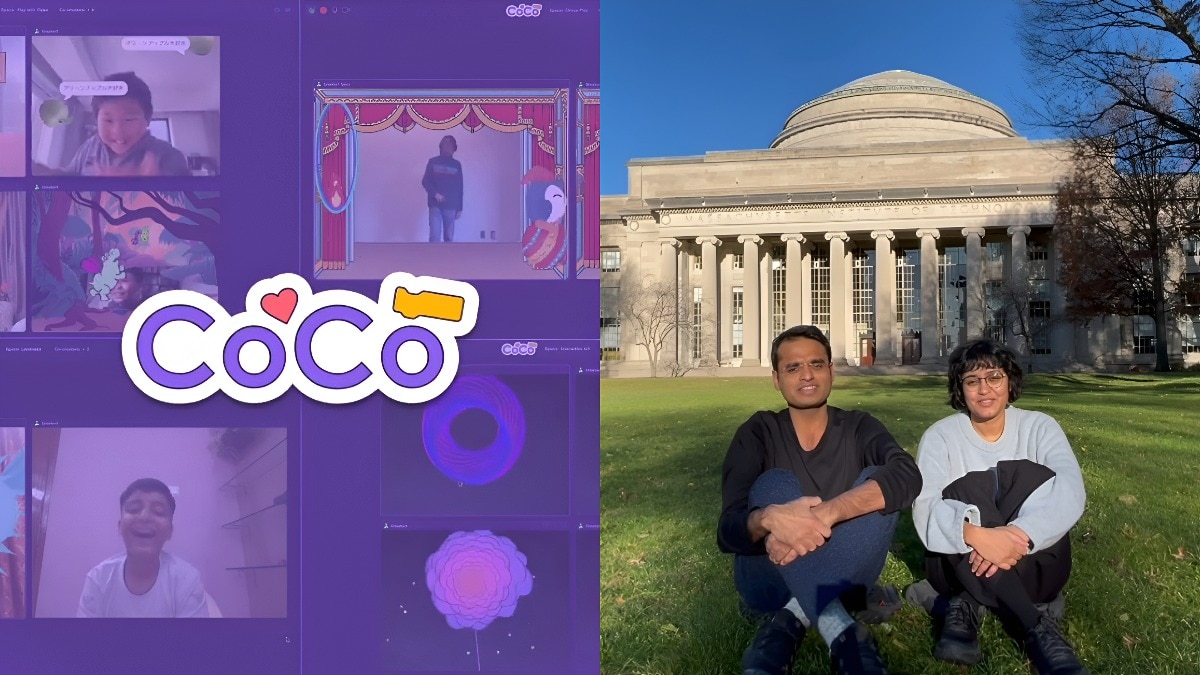
Imagine being eight years old and being told you are going to learn artificial intelligence.The first thought might be: Do I really have to understand all those complicated things? Shruti and Manuj Dhariwal are approaching the question from a very different direction.Instead of asking children to sit down and learn AI as another difficult subject, the two researchers want them to play with it, experiment with it and create alongside it.That idea has taken the couple from educational games in India to research at the Massachusetts Institute of Technology (MIT) and, eventually, to CoCo: a platform designed around children creating and learning together. But their story did not begin with AI. It began with games. (Photo: Screengrab from youtube/@COCO) BEFORE MIT, THERE WAS A GAMELong before the Dhariwals were working on AI education, they were already interested in one thing: making learning more engaging for children. The couple worked together on educational and social games through their company MadRat Games. Their work reached more than 3,000 schools and over 300,000 families, according to MIT.Manuj's work included games for language learning and for supporting neurodiverse children. MadRat Games was also recognised among India's Top Ten Innovative Companies by the Technology Development Board under the Department of Science and Technology.Shruti studied Computer Science Engineering and later completed an MBA. At the company, she went on to become Head of Product Development, leading the creation of educational and social games that reached more than 250,000 families.Manuj took a more design-and-technology route. He studied Design at the Indian Institute of Technology Guwahati before moving to MIT for a master's in Electrical Engineering and Computer Science. He later pursued doctoral research at the MIT Media Lab, focusing on creative learning tools and experiences for children and young people.And then came a move that would change the scale of their work. (Photo: Screengrab from youtube/@COCO) FROM INDIA'S CHILDREN TO MIT'S LABSIn 2015, the Dhariwals moved to Cambridge, Massachusetts, for graduate studies at MIT.Shruti joined the Media Lab's Lifelong Kindergarten group, while Manuj continued his research in the same broad ecosystem of creative learning and technology. Eventually, both became PhD researchers in the group.But even inside MIT, their focus remained remarkably familiar: children and how they learn.Then, in 2019, an encounter with a group of children gave them another idea.While volunteering at a children's mindfulness retreat, they met children between eight and 12 who were spending hours playing multiplayer games online.The question was almost impossible to ignore: if children were already spending so much time together online, could those spaces become places where they made things together, rather than simply played or consumed content?That question became the starting point for CoCo. (Photo: Screengrab from youtube/@COCO) LESS SCROLLING, MORE CREATINGCoCo is built around a deceptively simple idea: children should be able to create together in real time.A child can use it for coding, digital art, creative writing and other projects. They can work independently while sharing a space with friends, exchange code and media, or collaborate on the same creation.The platform builds on tools such as Scratch and p5.js, but its bigger goal is not simply to teach children how to code.It is to make learning social and creative. And that becomes particularly interesting when AI enters the picture.SO, HOW DO YOU TEACH A CHILD AI?The Dhariwals' answer is: don't begin by treating AI as something mysterious that adults operate behind a screen.Their work includes Little Language Models, a project aimed at children aged eight to 16.The idea is to introduce young learners to foundational concepts behind generative AI through hands-on, co-creative experiences.Instead of merely asking an AI chatbot for an answer, children can experiment and see how these systems work and why they sometimes produce different results.The aim is also to develop probabilistic thinking alongside computational thinking, helping children understand that AI does not always work in simple right-or-wrong terms.That could become increasingly important as AI becomes part of everyday life. (Photo: Screengrab/coco.build) THE INTERNET, BUT BUILT AROUND CREATIONThere is another interesting part of the Dhariwals' idea.CoCo is not designed around the familiar social-media formula of individual profiles, likes and followers. Its emphasis is on shared creative spaces.The question is no longer just, "What can AI do for children?"It becomes: What can children create when AI becomes part of their creative toolkit?The idea has already attracted attention beyond MIT. When CoCo's beta was introduced in 2023, educators from 68 countries had signed up. Their wider research has since included pilots involving more than 2,000 young people and educators.In 2024, it was also named a winner of the 2023-24 Learning Engineering Tools Competition, supported by organisations including the Gates Foundation, OpenAI and Ballmer Group. (Photo: Screengrab from youtube/@COCO) FROM MAKING GAMES TO MAKING AI MAKERSThere is a neat thread running through Shruti and Manuj Dhariwal's journey.They began by asking how children could learn through games. At MIT, they kept asking how technology could make children more creative and collaborative. Now, they are applying that thinking to one of the biggest technologies of their generation.CoCo is therefore not just another AI learning platform. At its heart is an older idea: children learn by doing.The Dhariwals are simply asking what happens when "doing" includes artificial intelligence.And perhaps that is the more interesting way to introduce the next generation to AI, not by telling children what it is, but by giving them the space to experiment, make mistakes, build something and figure it out together.- EndsPublished By: Princy ShuklaPublished On: Sep 4, 2026 13:11 IST
One did MBA, one went to IIT. Now this MIT couple is changing the way kids learn AI
Full Article
Original Source
Read the full article at Indiatoday →KhanList aggregates and links to publicly available news content. We do not host full articles from third-party sources. Always verify important information with original sources.