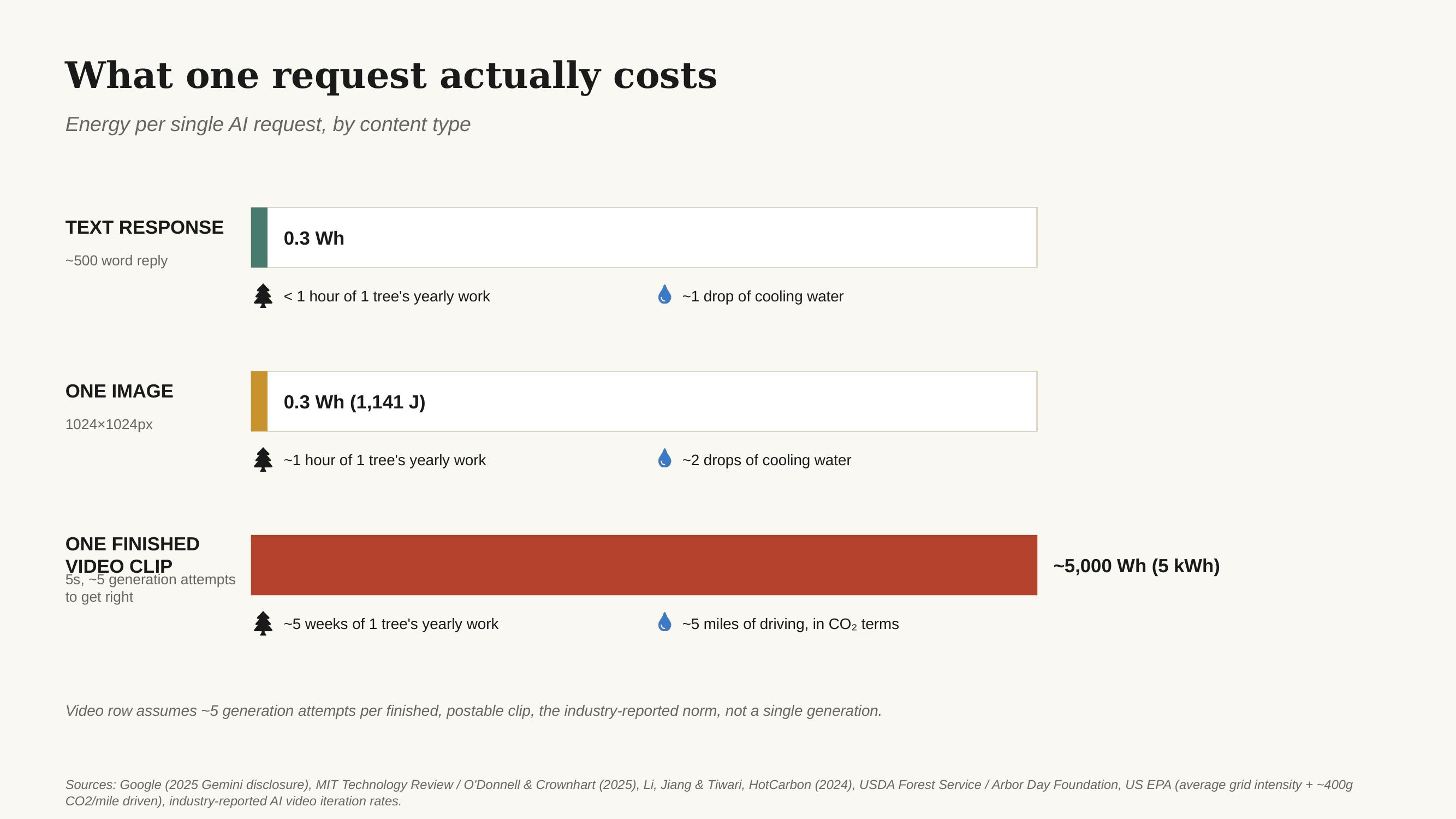
You typed one sentence, and six seconds later you had a video. It felt free, and that's the whole design, not an accident. The number that actually matters isn't easily visible at all. Here's the receipt. Before it shut down in March 2026, OpenAI's Sora cost the company about $15 million a day to run, and reporting from eWeek and Cybernews put the compute cost of a single 10-second clip at roughly $1.30. Divide one by the other and you get somewhere around 11.5 million 10-second clips generated per day, from one product, at its peak.Now do the energy math. MIT Technology Review's research puts a 5-second AI video clip at roughly 1,000 watt-hours, in the range of running a microwave for an hour. Even using a conservative, non-scaled estimate for a 10-second clip, not the steeper nonlinear jump a 2024 HotCarbon study actually found, that's still north of 23 million kilowatt-hours a day, from generation volume alone. At the US grid's average carbon intensity, that lands around 9,200 tonnes of CO2 in a single day. A mature tree absorbs roughly 22 kilograms of CO2 a year. Divide it out and you get the equivalent of about 420,000 tree-years of carbon absorption, undone in 24 hours. At a typical mature forest density of around 500 trees per hectare, that's roughly 800 hectares of forest, several times the size of Hyde Park, wiped off the annual carbon ledger by one day of one app. That number is hard to see, and that’s the problem. The numbers, without the hand-waving Vague claims about AI and the environment have made people numb to the topic, so here's what's actually documented, not implied: Text. Google disclosed in 2025 that a median Gemini text query uses about 0.24 watt-hours, a figure the company says is roughly 33 times lower than its own estimate from a year earlier. That's real progress, and it's worth saying plainly: efficiency work on text models is working. OpenAI has cited a similar figure, around 0.34 watt-hours per query. Images. MIT Technology Review, working with researchers O'Donnell and Crownhart, found that Stable Diffusion 3 Medium takes about 1,141 joules of GPU energy per 1024×1024 image, in the same ballpark as the energy in five seconds of microwave use, roughly the same order of magnitude as a text query. Video costs more, for two separate reasons. A 2024 HotCarbon study by Li, Jiang, and Tiwari found that a six-second clip consumes four times the energy of a three-second one, a nonlinear jump that makes video categorically different from image generation rather than just a bigger version of it. On top of that there's iteration: 3 to 10 attempts per usable clip, because text-to-video models reinterpret the same prompt differently every single time, so consistency is the exception. The per-generation number and the per-finished-clip number are two different statistics, and every piece of marketing copy about "sustainable AI" quotes only the smaller one. Here's what one request of each type actually costs, side by side: Cost of Generative AI Sources: Google's 2025 disclosure, MIT Technology Review, Li/Jiang/Tiwari (HotCarbon 2024), USDA Forest Service tree absorption data, EPA average grid carbon intensity. A mature tree absorbs roughly 22 kilograms of CO2 per year, per USDA and Arbor Day Foundation figures. One finished, 5-attempt video clip at roughly 2 kilograms of CO2 is close to five weeks of one tree's total yearly output, or about the same as driving 5 miles using the US EPA's own figure of roughly 400 grams of CO2 per mile, undone in the time it takes to get a clip somebody's happy with. Generating video isn't inherently catastrophic, but the entire product experience is built to make regeneration frictionless, and frictionless things don't get budgeted, they get spammed. Multiply that by 11.5 million clips a day and you get the forest from the top of this article. Who this is actually about The person hitting generate isn't really the problem. They weren't given the information to make a different choice, and blaming individual behavior for something the product itself is engineered to produce is exactly the deflection the industry benefits from. The companies are the problem: the ones that could put a cost estimate on screen before generation and don't. The ones that could default new users to the lowest-cost, lowest-resolution option and instead default to the flashiest, most expensive one, because that's the version that gets shared and drives adoption. The ones that could rate-limit or nudge after the third regeneration attempt and instead make attempt eleven exactly as frictionless as attempt one. None of that is an oversight. It's the product working as intended, for a business model that wants generation volume, not restraint. Compare that to literally any other engineering discipline. No credible cloud provider ships a product where compute cost is invisible until the bill arrives; that's considered a dark pattern, and teams get paged over runaway spend. AI generation products have simply decided the same standard doesn't apply to environmental cost, because nobody's sending an invoice for it. Data centers already account for roughly 180 million tonnes of indirect carbon emissions globally, and the International Energy Agency projects data center electricity demand could hit 945 terawatt-hours by 2030, more than Japan's entire annual consumption today. AI is the fastest-growing slice of that number, and the products driving the growth have no interest in showing you why. What to actually do about it None of this means using AI less. It means matching the model to the job instead of defaulting to whatever's open, because the biggest, most capable model is almost never the efficient choice, and most tasks don't need it. For brainstorming, drafting, and everyday questions, use the cheapest tier from any provider. This is the single biggest lever most people never touch. Claude Haiku 4.5, GPT-5.4 mini or nano, and Gemini 3.1 Flash-Lite are all built specifically for this: fast responses, a fraction of the energy and cost of the flagship models, and genuinely good enough for outlining an email, summarizing a document, rewriting a paragraph, or answering a quick question. If you're using a full-price flagship model for a task like this, you're paying premium-tier compute for a job the budget tier handles fine. For wireframing, mockups, and UI drafts, a lightweight model is enough. You don't need frontier-level reasoning to lay out a login screen or sketch a dashboard. Haiku-tier or mini-tier models can generate a working HTML or Figma-style layout from a description just as well as the expensive ones, because layout and boilerplate structure isn't where the hard reasoning lives. Save the bigger model for the one screen with genuinely tricky interaction logic, not the twelve that are just forms and cards. For real coding work, debugging, or anything with actual logic to get right, step up to a mid-tier model. This is where Claude Sonnet 5, GPT-5.4, or Gemini 3.1 Pro earn their higher cost, tasks with real reasoning, multi-step logic, or code that has to actually work. Even here, the efficient move is routing: let a cheap model handle the easy 80% of requests (formatting, simple lookups, boilerplate) and only escalate to the expensive model for the genuinely hard 20%. Several routing tools exist specifically to automate this split. Reserve the largest, most expensive model for what actually needs it. Complex multi-step reasoning, high-stakes writing, or a problem you've already watched a cheaper model get wrong. That's what Claude Opus, GPT-5.5, or Gemini 3.1 Pro's full tier are for. Using them as your default for routine tasks is like hiring a specialist consultant to answer a question the intern down the hall already knows. For images, pick resolution and model tier to match where it's actually going. A concept sketch to show a client direction doesn't need the same resolution as a final deliverable. Most image tools let you choose a draft or fast mode; use it for anything you're not certain is final. For video, don't default to full generation at all. Storyboard the shot list with a cheap text model first, get the framing and pacing right in words, then generate only the one or two shots you genuinely can't get another way, at the lowest resolution that still tells you if the shot works. Full-resolution generation is for the version you're actually going to use, not the version you're using to decide if you like it. Decide what you want before you generate, not after. Most waste comes from generating first and figuring out intent second. A specific prompt beats five vague ones and a coin flip on which is least bad. Edit instead of regenerating. If something's close, fix it. Full regeneration for a one-word tweak is one of the most common and most avoidable habits, and it's slower for you too. Turn on caching if you're building anything that sends the same context repeatedly. Every major provider now offers prompt caching, up to a 90% discount on the repeated portion of a prompt. If your system prompt or reference document doesn't change between calls, caching alone can cut that part of your bill by most of an order of magnitude, and it's usually a one-line change. Write like tokens cost something, because they do. A precise prompt uses less on both ends of the exchange than a long one that makes the model guess. Precision is a form of restraint, and restraint is currently the one thing no product interface asks of you. This isn't about guilt. It's about refusing to let a spinner and a lack of a meter make the decision on your behalf, because the technology genuinely can free up time and energy for better things. That promise is worth defending, which means it's worth not spending on a fourth take of a video you were going to forget by tomorrow. Sources: Google's 2025 Gemini environmental disclosure; MIT Technology Review, "We did the math on AI's energy footprint" (2025); O'Donnell & Crownhart, MIT Technology Review (2025); Li, Jiang & Tiwari, "Carbon in Motion," HotCarbon (2024); International Energy Agency, Electricity 2025 report; USDA Forest Service and Arbor Day Foundation tree carbon sequestration data; average mature-forest tree density (~500 trees/hectare); US EPA eGRID average grid carbon intensity; US EPA, "Greenhouse Gas Emissions from a Typical Passenger Vehicle" (2023, ~400g CO2/mile); industry-reported AI video iteration rates (3-10 generation attempts per usable clip); Sora daily compute cost and per-clip cost as reported by eWeek and Cybernews (2026); model pricing and tier positioning from OpenAI, Anthropic, and Google's own published API pricing pages, current as of July 2026. Methodology note on the headline figure: the "one day" estimate uses Sora's own disclosed daily compute spend (~$15M) divided by its reported per-clip compute cost (~$1.30/10s clip) to estimate daily clip volume, then applies MIT Technology Review's per-5-second energy figure, scaled conservatively and linearly to 10 seconds, well below the steeper nonlinear scaling HotCarbon's research actually found. It reflects Sora at its reported peak usage, not the AI video industry as a whole, and is presented as an order-of-magnitude estimate, not an audited figure.
One Day of AI Video Generation Undid a Forest's Work
Full Article
Original Source
Read the full article at Hackernoon →KhanList aggregates and links to publicly available news content. We do not host full articles from third-party sources. Always verify important information with original sources.