
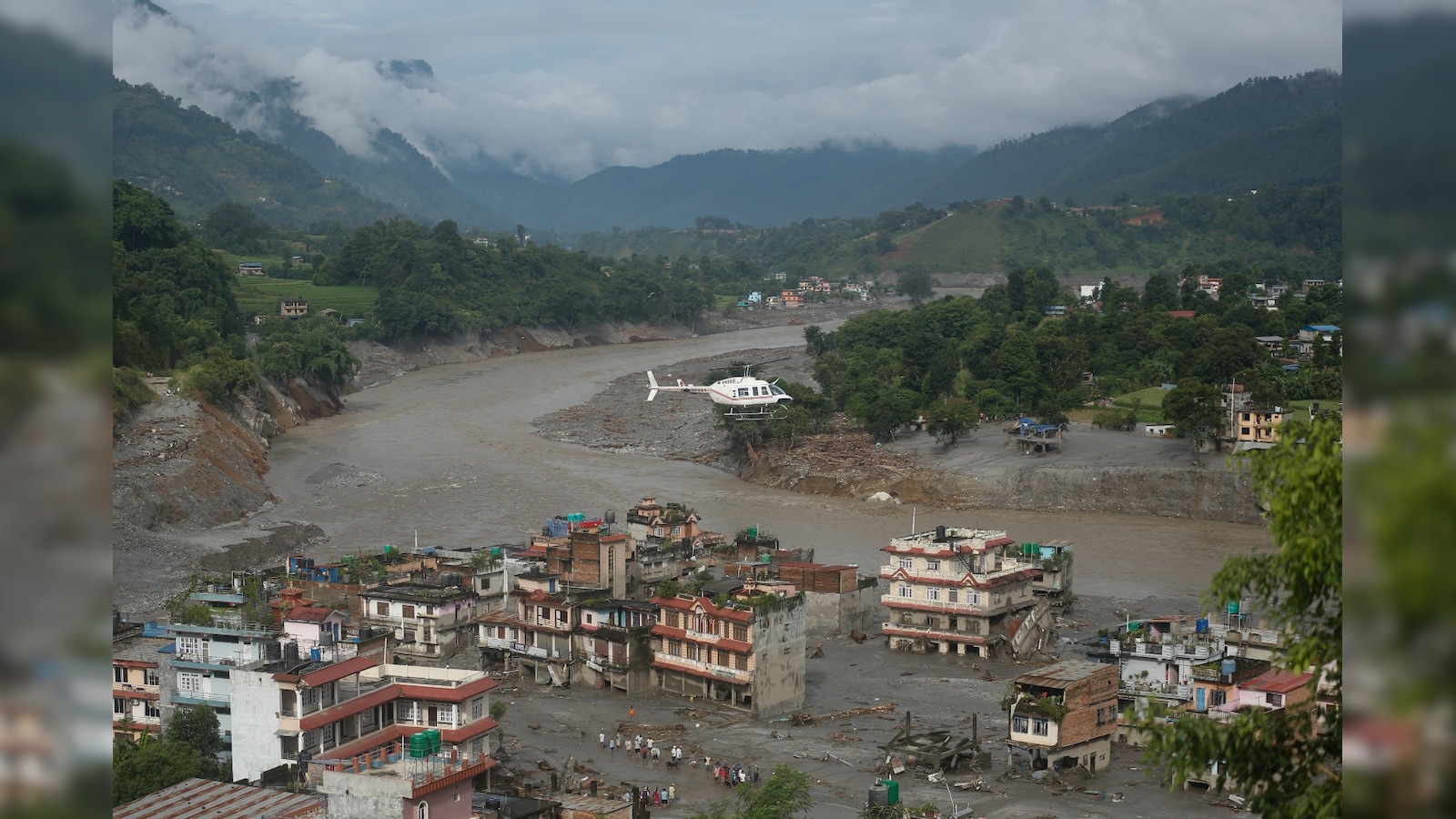
Investments in infrastructure by a developing nation tend to generate economic returns over time. Spend Re 1 on a bridge, road or power project and the economy is expected to get several rupees back through trade, jobs and productivity.But Nepal is facing a frustrating problem: it keeps building infrastructure that disasters keep destroying.Here's how the cycle moves: a plan is prepared, money is sanctioned, a bridge or road is built, and before the investment has generated its full economic value, a flood, landslide or earthquake damages it. Then the rebuilding begins. Advertisement - Scroll to continue In effect, Nepal is repeatedly investing in the same infrastructure without fully realising its returns. The philosophical equivalent is the Greek myth of Sisyphus, who was condemned to push a giant boulder uphill only to watch it roll back down before he reaches the top.In Nepal, however, this is not mythology. It has a very real economic cost.Flash FloodsThe water came fast on Wednesday (August 26) morning. A wall of mud, rocks and water swept through Nepal's northern border region. Settlements, roads and bridges were hit. Hydropower projects were damaged. The Kathmandu-Kerung trade corridor was disrupted. The human toll had touched 177 at the time of publishing this report. Tourists, workers and security personnel went missing.Advertisement - Scroll to continueBut the economic damage will extend far beyond the immediate cost of rescue and reconstruction. "The true economic cost of a monsoon disaster is rarely contained in the first damage estimate," Dikshu C Kukreja, Urban Planner and Managing Principal at CP Kukreja Architects, told NDTV.For a small, landlocked economy, repeated shocks to agriculture, tourism, transport and hydropower can be particularly damaging. These are also the sectors Nepal is relying on to generate jobs, income and future growth.One Flood Can Hit Several Parts Of EconomyThe latest disaster began in the Himalayan border region around Rasuwa.The destruction did not stop at homes. Officials said 19 motorable bridges and around 40 km of road were damaged. Hydropower projects were affected and the important border trade route with China was disrupted.Preliminary satellite analysis later pointed towards an ice-rock avalanche in the high Himalayas. This makes the disaster particularly destructive. A sudden high-altitude flood carrying rocks and debris can wipe out roads, bridges and power infrastructure within minutes.The region had already suffered a major glacial flood in July 2025. That disaster damaged the Rasuwagadhi border crossing, the Nepal-China Friendship Bridge, roads, the dry port and several hydropower projects. Around 16 km of road between Syafrubesi and Rasuwagadhi was rendered impassable. The 111-MW Rasuwagadhi Hydropower Project was among the projects badly hit.Now, the same broad region has suffered another catastrophic event. This is where Nepal's disaster problem becomes an economic problem. The country is not merely rebuilding after disasters. It is rebuilding infrastructure that can be damaged again before it has generated its full economic return.Nepal's Disaster Bill Is Already Running Into BillionsThe September 2024 floods and landslides provide a clear example. The World Bank estimated damage from the disaster at NPR 46.7 billion, equivalent to around 0.8 per cent of Nepal's FY25 GDP.Infrastructure accounted for NPR 38.9 billion of the damage. Roads alone suffered around NPR 28 billion of losses. Hydropower damage was estimated at NPR 3 billion, while water supply and sanitation suffered NPR 5.9 billion of damage.Agriculture suffered another NPR 7.2 billion in losses. The floods killed 249 people, injured 177 and displaced more than 10,000 families. Nearly 6,000 houses were completely destroyed and another 13,000 were partially damaged.The 2017 floods were even more damaging in relative economic terms. The floods affected 35 of Nepal's 77 districts. In substantial parts of the Terai, around 80 per cent of the land was inundated.Nepal's Post Flood Recovery Needs Assessment estimated total damage and losses at NPR 60.7 billion, or about $584.7 million at the time. That was nearly 3 per cent of GDP. Recovery needs were estimated at NPR 73.2 billion, or roughly $705 million.Housing suffered the largest loss at $187.9 million. Irrigation damage stood at $168.1 million, livestock losses at $102.7 million and agriculture at $69.5 million.Agriculture Takes The First HitFor Nepal, agriculture is not just another industry. It is a livelihood system. The 2021 census found that agriculture, forestry and fishing accounted for 57.3 per cent of people engaged in economic activity.Around 60.3 per cent of households were engaged in agriculture in 2022-23, according to the National Statistics Office's Living Standards Survey. In Karnali, the share was more than 82 per cent.A flood can destroy a crop just before harvest. But the damage does not necessarily end there. Livestock can be lost. Seeds and farm equipment can be destroyed. Irrigation channels can be washed away. Fertile soil can disappear.A farmer may then have to borrow money to plant again. As Kukreja explains, a farmer can lose "not only the standing crop but also topsoil, seed, livestock, irrigation channels and the ability to cultivate the following season."That is how a one-day disaster becomes a multi-season economic shock.Geography Multiplies The RiskNepal effectively has two disaster economies: the hills and mountains face landslides, debris flows, avalanches, flash floods and glacial lake outburst floods; the plains face river flooding and inundation.More than 6,000 rivers and rivulets flow largely from north to south. Major rivers such as the Koshi, Narayani, Karnali and Mahakali originate in the Himalayas before passing through the hills and into the plains.This creates a dangerous economic chain. A disaster in the mountains can damage a highway or hydropower project. Water and debris can then move downstream. Agricultural areas can flood. Roads can become unusable. Markets can shut. Tourists can get stranded.Tourism Can Lose Money Without A Building Being DestroyedTourism is one of Nepal's biggest economic opportunities. It is also highly sensitive to disasters. A tourist does not need to see a hotel collapse to cancel a trip. A blocked road can be enough. A damaged trekking route can be enough. A destroyed bridge can make a destination inaccessible.The latest flood has exposed that vulnerability again. Hundreds of tourists were reported missing in the Rasuwa disaster. The economic consequences will spread across the tourism chain.Hotels can lose bookings. Guides lose work. Transport operators lose fares. Restaurants lose customers. Porters and local shops lose daily income. Tour operators face cancellations.Nepal had been rebuilding its tourism economy after the pandemic. The Nepal Tourism Board recorded around 1.15 million tourist arrivals in the first 11 months of 2024. Repeated disruptions will make the economic recovery very costly.Wasn't The First Time, Probably Won't Be The LastThis is not the first time Nepal has suffered an economic catastrope due to a natural disaster. After the 2015 earthquake, tourism revenues and visitor spending remained below normal for an extended period. Hotels, trekking trails and other tourism infrastructure needed reconstruction.If the latest flood demonstrates the speed of disaster, Nepal's 2015 earthquake shows its scale. The government-led Post Disaster Needs Assessment estimated physical damage at more than NPR 500 billion and economic losses at nearly NPR 200 billion.Together, damage and losses were equivalent to roughly one-third of Nepal's GDP at the time. The World Bank estimated the combined value at around $7.1 billion, including $5.2 billion in physical damage and $1.9 billion in economic losses.GDP growth slowed sharply after the earthquake. Growth was estimated at 3.4 per cent in FY15, around two percentage points below the previous year.Nepal's Fiscal TrapDisasters put governments in a difficult position. Tax collections can weaken as businesses shut and economic activity slows.At the same time, spending rises. The government has to fund relief. Roads and bridges have to be rebuilt. Homes, schools and hospitals need repairs. Farmers and households need assistance. Power infrastructure has to be restored.All this happens when government revenues may already be under pressure.The IMF has identified frequent and severe natural disasters as a major risk to Nepal's economy. Its disaster stress test assumes a shock that could add 10 percentage points of GDP to the debt ratio, while reducing real GDP growth by 1.5 percentage points and exports by 3.5 percentage points in the year of the shock.Difficult To Put A Final Price On DisasterIt is too early to put a single rupee figure on the August 26 disaster. Rescue operations are still underway. The full damage to roads, bridges and power projects is still being assessed. Tourism cancellations will take time to measure. Agricultural losses will become clearer only after the floodwater recedes.But Nepal's recent history provides a sense of the scale. The 2017 floods caused about $584.7 million in damage and losses and required about $705.1 million for recovery. The 2024 floods caused NPR 46.7 billion in damage. The 2015 earthquake caused about $7.1 billion in damage and losses. The 2025 Rasuwa disaster showed how quickly a single high-altitude event can disrupt trade, roads and electricity generation.Often, the first bill is easy to see. Destroyed homes. Broken bridges. Washed-away roads. Damaged power plants. Lost crops. Closed businesses.The second bill is harder to measure. Lost wages. Cancelled hotel bookings. Lower trade. Household debt. Delayed investment. Lost school days. Reduced government revenue. "The cost of preparedness is visible; the much larger cost of repeated disruption often is not," added Kukreja.Nepal Needs Resilient InfrastructureNepal needs roads. It needs electricity. It needs hydropower. It needs tourism infrastructure. It needs better agricultural connectivity. The nations needs to invest in early-warning systems, stronger bridges, safer road alignments, resilient hydropower designs, better watershed management and restrictions on construction in high-risk areas.If public assets are repeatedly destroyed, the return on investment falls. "A cheaper road that repeatedly fails is not truly economical," says Kukreja. The same applies to bridges, hydropower projects and all public assets.Nepal cannot prevent every earthquake, landslide or glacial collapse. But it can reduce how much each disaster costs.
One-Day Disaster, Multi-Season Economic Shock: How Nepal Is Stuck In A Loop
Full Article
Original Source
Read the full article at Ndtv →KhanList aggregates and links to publicly available news content. We do not host full articles from third-party sources. Always verify important information with original sources.