
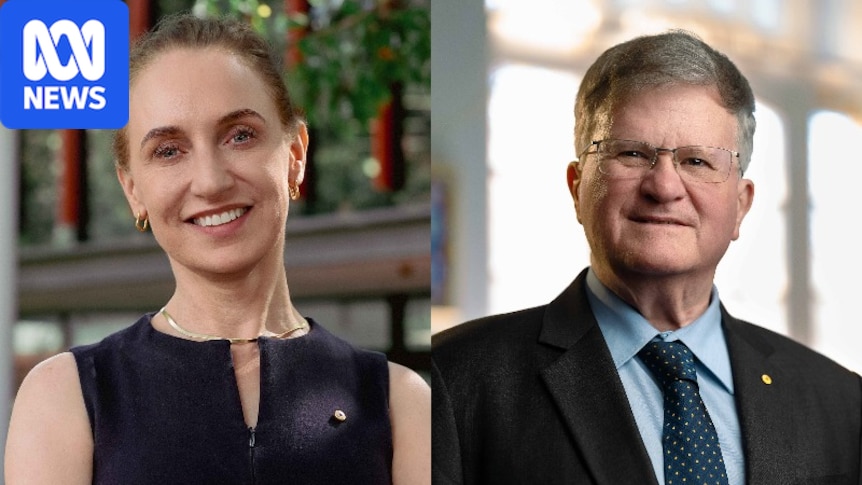
A medical oncologist whose research has transformed melanoma treatment and a physicist whose discoveries have reshaped the world's understanding of the universe have been awarded Australia's most coveted prize for scientific research.Georgina Long from the University of Sydney and Melanoma Institute Australia and Anthony Thomas from Adelaide University each won the $250,000 Prime Minister's Prize for Science tonight at the annual awards.It is the first time two scientists from completely different disciplines have won the accolade.Georgina Long has led clinical trials that have led to improved melanoma treatment worldwide. (Supplied: Prime Minister's Prizes for Science)Professor Long was "taken by surprise" when she learnt she had jointly won the top prize.But she also pointed to the diverse achievements of winners across industries such as teaching, renewable electro-chemicals, physics and environmental engineering in other award categories.This, she said, was a reflection of the widespread opportunities in science."Science is everywhere," she said."The phone in your hand, the apps you use, the car you drive, the clothes you wear, the house you live in, the gadgets in your house."Science is curiosity and asking why."'My goal is to cure cancer'Growing up, Professor Long said her family sat down for dinner every night at 6:30pm.At those dinners, Professor Long, her five siblings and parents — both doctors — spoke about life, death and "big thinking ideas".Georgina Long has dedicated her career to trying to find a cure for cancer and improving patient outcomes. (Supplied: Prime Minister's Prizes for Science)After finishing her PhD in chemistry, Professor Long studied medicine and said she felt like a "pig in mud" bringing the two specialties together."Because my PhD was all about drug binding and anti-cancer drugs, it was just a natural progression, and now I'm a drug developer," she said."My goal is to cure cancer."Professor Long and her team's research has changed the lives of people diagnosed with melanoma.She led an international effort to find the first effective drugs to treat melanoma, which improved survival rates for people with stage 4 disease 10-fold and 24-fold for those with secondary cancers in their brain.Her work also led to updated melanoma management guidelines in Australia, Europe and the United States.Earlier this year, Professor Long was awarded the Eureka Prize for Scientific Research.In 2024, she was jointly awarded Australian of the Year with the late Richard Scolyer.For the love of physicsProfessor Thomas is a world-renowned theoretical physicist who studies how things work on the smallest scale to explain big mysteries of the cosmos.Early in his career, he helped develop a model describing the structure of protons inside the nucleus of an atom.This model has helped scientists understand the nature of matter and antimatter, and predicted phenomena such as neutron stars before they were discovered by astronomers.He has also developed ways to test for unknown particles and forces to help scientists hunting for mysterious dark matter interpret their results. Professor Thomas said his fascination with physics started in high school because it helped him understand the world around him."Why the Moon moves around the Earth, how a lever works," he said."All these very simple things that were part of our everyday world."Anthony Thomas says winning the Prime Minister's Prize for Science came as a "huge surprise". (Supplied: Prime Minister's Prizes for Science)Professor Thomas said his parents were "surprised and delighted" by his career choice."I don't think anyone in my family had completed high school [until then]," he said. "I was very lucky to go to a good school with excellent teachers.Now a teacher himself, Professor Thomas has supervised more than 50 postgraduate students.Anthony Thomas considers himself lucky to love and be challenged by his job. (Supplied: Prime Minister's Prizes for Science)He said his research was a "continual back and forth" with international colleagues, drawn together by a "common desire to figure out how the world works"."It's a weird job because so many days you finish feeling more stupid than when you went to work that morning because you've been trying to solve problems and just going backwards," he said.But on the days everything fell into place?"It's like hitting a good golf shot," he said.Seven other winnersThe Prime Minister's Prize for Science was one of eight prizes awarded on Tuesday night.Four additional science and innovation prizes, one knowledge systems prize and two science teaching prizes were awarded to:Mark Smythe from the University of Queensland was awarded the Prime Minister’s Prize for InnovationAsha Bowen from The Kids Research Institute Australia, Perth Children’s Hospital and University of Western Australia was awarded the Frank Fenner Prize for Life Scientist of the YearFengwang Li from the University of Sydney was awarded the Malcolm McIntosh Prize for Physical Scientist of the YearJoseph J Richardson from startups SWIFF and Bionica was awarded the Prize for New InnovatorsChris Matthews from the University of Technology Sydney was awarded the Prime Minister’s Prize for Aboriginal and Torres Strait Islander Knowledge SystemsGabrielle Oslington from Arden Anglican School was awarded the Prime Minister’s Prize for Excellence in Science Teaching in Primary SchoolsNicci Wheaton from The Glennie School was awarded the Prime Minister’s Prize for Excellence in Science Teaching in Secondary SchoolsEntries are now open for the 2027 awards, with nominations to close on January 7.
Oncologist and physicist both win Australia's top science prize
Full Article
Original Source
Read the full article at Abc →KhanList aggregates and links to publicly available news content. We do not host full articles from third-party sources. Always verify important information with original sources.