
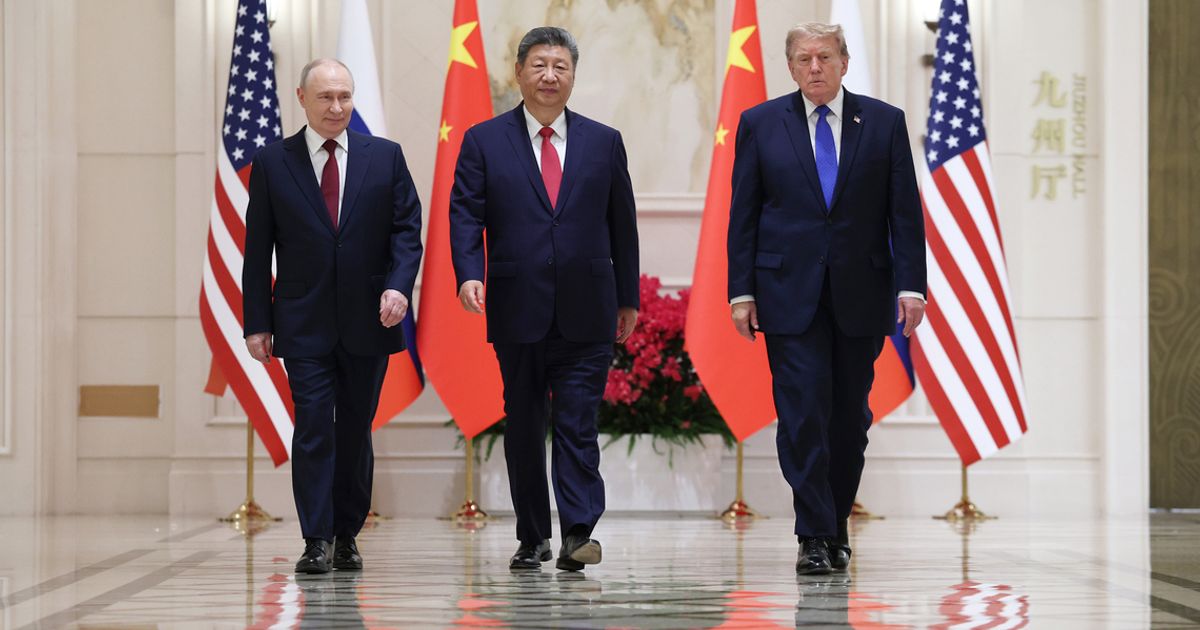
SHENZHEN – In a capacious reception room within a sprawling hillside resort in the southern Chinese tech hub Shenzhen, the leaders of the world’s three biggest powers sat at a round table and spoke for 90 minutes in a meeting that was once unthinkable.The historic trilateral talks between Chinese President Xi Jinping, US President Donald Trump and Russian President Vladimir Putin on the sidelines of the Asia-Pacific Economic Cooperation (APEC) summit yielded a joint “peace declaration” and effusive assessments from the three leaders.But while some believe the success of the meeting could have a stabilising effect on an international order in turmoil, the broad consensus among analysts is that this first-of-its-kind meeting worked more as a confidence-building exercise between the rival nations rather than an immediate, concrete cure to the world’s ills.According to a joint statement released after the Nov 19 meeting, which started two hours later than scheduled and came after a separate bilateral summit between Xi and Trump, the three leaders had an “in-depth exchange of views on the current international situation” and committed themselves to maintaining strategic stability and international security.They agreed on four points, including a commitment to reform the United Nations and plans to increase the supply of refined petroleum products.The leaders also said they would hold a dialogue on reducing nuclear risks and preventing the proliferation of nuclear weapons, and agreed that the International Criminal Court (ICC) and similar institutions “must not abuse their jurisdiction”.In his opening remarks at the meeting, Xi noted the responsibilities that lie on the shoulders of major powers.“Their positive interaction is not optional, but a must,” he said, adding later that the three countries should maintain regular high-level engagement, keep channels of dialogue open at all levels and establish crisis communication and prevention mechanisms.Trump, meanwhile, continued a long-running call for a reduction in nuclear weapon stockpiles and railed against “rogue globalist organisations”, pointing the finger at the ICC, which his administration has been working to dismantle.Trump also defended his enthusiasm for the three-way talks with China and Russia, which would traditionally have been considered anathema for a US president.“No peace was ever forged by declining opportunities for engagement. Together, we are choosing a different course,” he said.Like the other two leaders, Putin noted a shared responsibility for maintaining global peace and security and spoke of shared interests in tackling issues like transnational crime. But top of his agenda was the war in Ukraine, which Putin said he had discussed when he met Xi and Trump separately.Win-win-win?Analysts told The Straits Times that all three leaders appeared to have got something out of the trilateral meeting, with Beijing and Russia the biggest winners.For China, being the host country meant it could shape the agenda and spotlight the country’s centrality within the global order, said Nanyang Technological University associate professor Hoo Tiang Boon, who studies China’s foreign policy.Wu Xinbo, dean of the Institute of International Studies at Fudan University in Shanghai, said the success of the meeting has had a positive effect on China’s international status and influence, and it also reflects Beijing’s diplomatic power in being able to bring the three parties together.For Putin, getting a seat at the table with China and the US is a sign to the world that Russia is a peer power, despite its growing disparities with the other two. “It’s another opportunity for Russia to break out of global isolation,” said Hoo.As for Trump, Hoo believes there is a desire on Trump’s part to reassert US global leadership after heavy midterm losses have left him a lame duck at home. “The thing about Trump is that he seems to crave attention-seeking events... He likes the optics of doing unconventional stuff that no other American leader has done and a three-way meeting is good for the cameras.”These views have been given some validation by the leaders in their comments after the meeting.In concluding remarks, Xi described the talks as “positive, constructive and fruitful” and in footage released by the Kremlin, Putin told Xi: “I don’t think anyone even expected everything to go so well.” Putin later told a press conference that the meeting was “open” and “very useful”.Symbolism over substanceHowever, doubts remain over whether the trilateral meet will be more than a one-off photo opportunity, given the lack of concrete progress on thorny issues, including the wars in Ukraine and Iran.Hoo said the joint statement from the three leaders was a minor achievement, but a low-hanging fruit. “The meeting was certainly more symbolism than substance. But perceptions and optics matter to some extent in international politics,” he added.Others said having the meeting itself is significant as it sends out important signals that the three major powers have the capacity to manage their differences and competition through dialogue.Fudan’s Wu said: “This summit is not for negotiations... In the end, you still need the parties directly involved to resolve the issues themselves. For example, Russia and Ukraine, or the United States and Iran. That is their business. So this summit cannot directly resolve these issues.”Zhang Yun, an international relations professor at Nanjing University, made a similar point, noting that the trilateral talks can create positive momentum.“This summit is definitely a good thing as it sends a reassuring and positive signal for an uncertain world... But we should not expect one summit meeting to resolve all problems.”Cui Hongjian from Beijing Foreign Studies University said one potential benefit of the trilateral meeting is that it can help the three countries boost mutual trust, which in turn can help to stabilise the current international situation.“It’s a bit like how we understand traditional Chinese medicine. It doesn’t directly target the symptoms. It aims to improve the overall condition of the body and its constitution, working on the root cause,” added the director of the Center for the European Union and Regional Development Studies at the university.The historic trilateral talks between Russian President Vladimir Putin, Chinese President Xi Jinping and US President Donald Trump yielded a joint “peace declaration” and effusive assessments from the three leaders. PHOTO: APAlarm bells for smaller countriesGiven the relative success of the trilateral meeting, some scholars believe there could be more trilateral interactions in the future.Nanjing University’s Zhang said he believes that Xi’s comments on the need for regular high-level exchanges mean that the trilateral format may be institutionalised.“In multilateral settings like APEC, the possibility of handling trilateral matters is high... Let’s see what happens at the G20 in Miami next month,” he added.But analysts also sounded alarm bells for middle powers and smaller countries which may feel cut out. “You don’t want rules and key decisions to be made only among those with more power,” Hoo said.For Europe, the singling out of the ICC in the leaders’ joint statement will be a concern as it reinforces the assessment that Trump is more aligned with leaders like Putin and Xi than he is with his traditional allies, said Eva Seiwert of the Mercator Institute for China Studies, a German think-tank.“But I think we can be happy as it could have gone much worse. It was all quite vague statements at the end of the day,” said the senior analyst, who studies Sino-Russian ties.
Once unthinkable, Trump-Xi-Putin summit makes Russia and Beijing the biggest winners
Full Article
Original Source
Read the full article at Straitstimes →KhanList aggregates and links to publicly available news content. We do not host full articles from third-party sources. Always verify important information with original sources.