
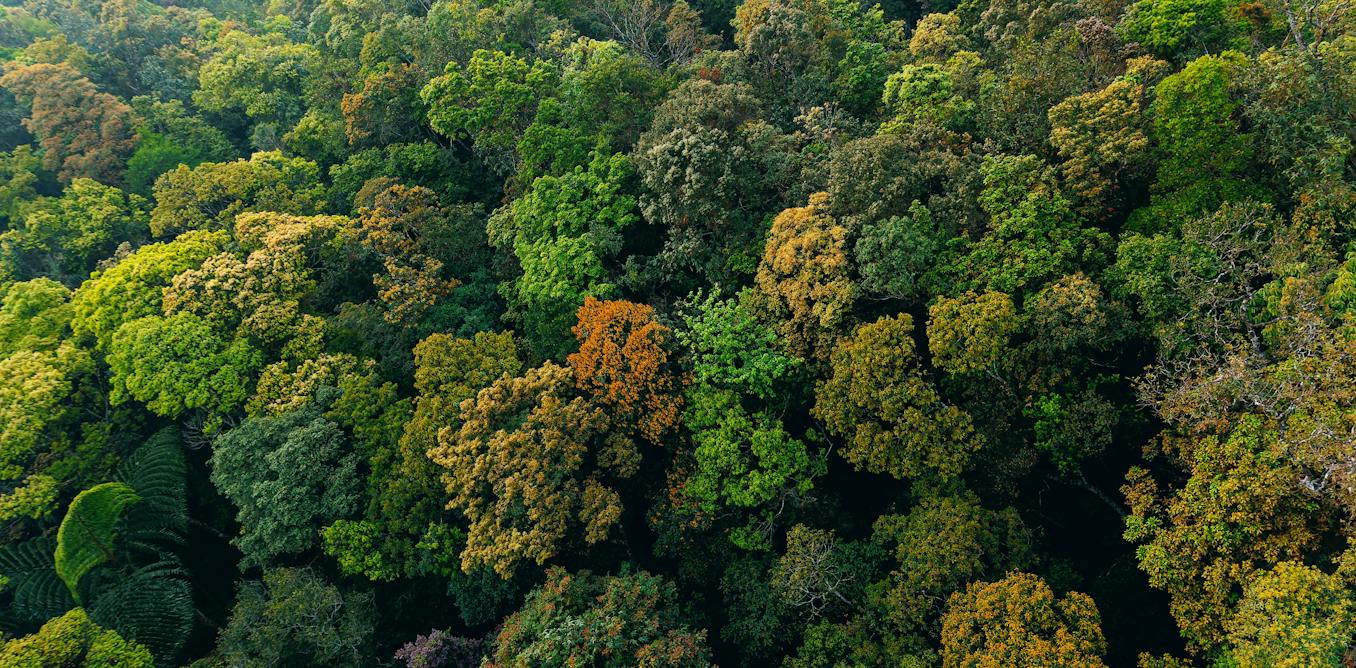
Deep in the jungle of central Vietnam, the heat is heavy, the mosquitoes are relentless and the terrain offers no easy paths. My colleagues and I don’t hike on clear trails, we wade up riverbeds, stepping carefully over slippery rocks to access the thousands of trees we have been measuring for the last decade. In 2024, I spent nearly two months camping in the forests of Động Châu–Khe Nước Trong, a nature reserve in central Vietnam. I worked with a field team of 12 people, in the gruelling conditions required to gather long-term ecological data. Logging was particularly intense in the tropical forests of Vietnam between 1982 and 2007. As a result, the forest cover and the quality of those forest ecosystems has declined substantially. While forest cover in Vietnam has increased since the 1990s due to plantations and natural regeneration, the quality of forest recovery is less clear. We visited every tree in our 24 study plots to measure them by hand in a meticulous, physically exhausting process that has been carried out four times since 2016. By identifying the species of each tree, measuring their diameter with a tape measure and noting any trees that have died, we tracked how these once-logged forests were recovering. Our findings challenge a key assumption about tropical forest regrowth. Both governments and global carbon markets (a trading system that incentivises cuts in greenhouse gas emissions) invest in natural climate solutions. This often involves investing in schemes to plant new trees that absorb atmospheric carbon during photosynthesis in order to offset other carbon emissions. But these schemes rely heavily on an assumption: that once logging stops, tropical forests will naturally bounce back and recover, rapidly taking up carbon dioxide and storing it in growing trees. In our latest study, published in the journal Environmental Research Letters, we show that rapid and predictable recovery may be overly optimistic. Field researchers walk a measuring tape through dense trees to mark out a permanent forest plot in central Vietnam. Amy Bennett, CC BY-ND Since 2007, when selective logging in the region ended, these forests have not recovered as expected. Between 2016 and 2024, the forests showed no net increase in the carbon stored in their trunks and branches. The trees are still growing, but carbon gains from growth were almost entirely offset by tree deaths. Recovery rates were far below what the UN’s Intergovernmental Panel on Climate Change estimates for the region and rates reported for comparable logged forests in Southeast Asia. Heat restricts growth Part of the explanation lies in the very conditions that made our fieldwork so challenging – rising temperatures. Since we have been monitoring these forests, temperatures have risen sharply, and we linked rising maximum temperatures to lower carbon gains. In 2024, the region where our forest plots are located endured severe, prolonged heatwaves in April and four in a row in August. Heat is already limiting tree growth here. A field team member carries a ladder across a shallow, rocky river in Động Châu–Khe Nước Trong Nature Reserve, central Vietnam. Amy Bennett, CC BY-NC-ND These ecological constraints have financial and policy implications. Southeast Asia is central to carbon markets and the ecosystem restoration industry, hosting the majority of profitable forest restoration projects. Protecting young, regrowing forests from being cleared again helps limit greenhouse gas emissions by keeping the carbon already stored in the trees safe, as recovering forests are particularly vulnerable to repeated logging and clearing. Yet, when calculating the value of protecting or restoring these forests, projects tend to assume steady, rapid tree growth, rather than measuring true forest function under the stress of extreme heat. Without long-term ground monitoring, schemes risk both underfunding necessary protection and overestimating carbon removal that may not be happening. Despite harsh conditions and past disturbance, the forests managed to keep almost all the carbon stored in their trunks and branches intact. Long-term monitoring by our team and partners provided the evidence base that helped designate Động Châu–Khe Nước Trong as a nature reserve in 2020. Protection as a nature reserve has helped prevent further degradation through logging, securing these forests and the carbon they store. Easy to overestimate However, mechanisms allowing countries to work together toward their climate pledges under Article 6 of the Paris climate agreement tend to rely on generalised estimates of recovery. Those mechanisms also risk overestimating how much carbon recovering tropical forests can actually absorb. To achieve realistic climate solutions in a warming world, policies must remain grounded in committed, local field surveys, no matter how hard those data are to collect. Sleeping in hammocks in humid jungles, enduring insect swarms and battling steep terrain isn’t just about collecting data; this research offers a true insight into how forests are functioning in a changing world.
Once logging stops, recovery of Vietnam’s tropical forests isn’t guaranteed
Full Article
Original Source
Read the full article at Theconversation →KhanList aggregates and links to publicly available news content. We do not host full articles from third-party sources. Always verify important information with original sources.