
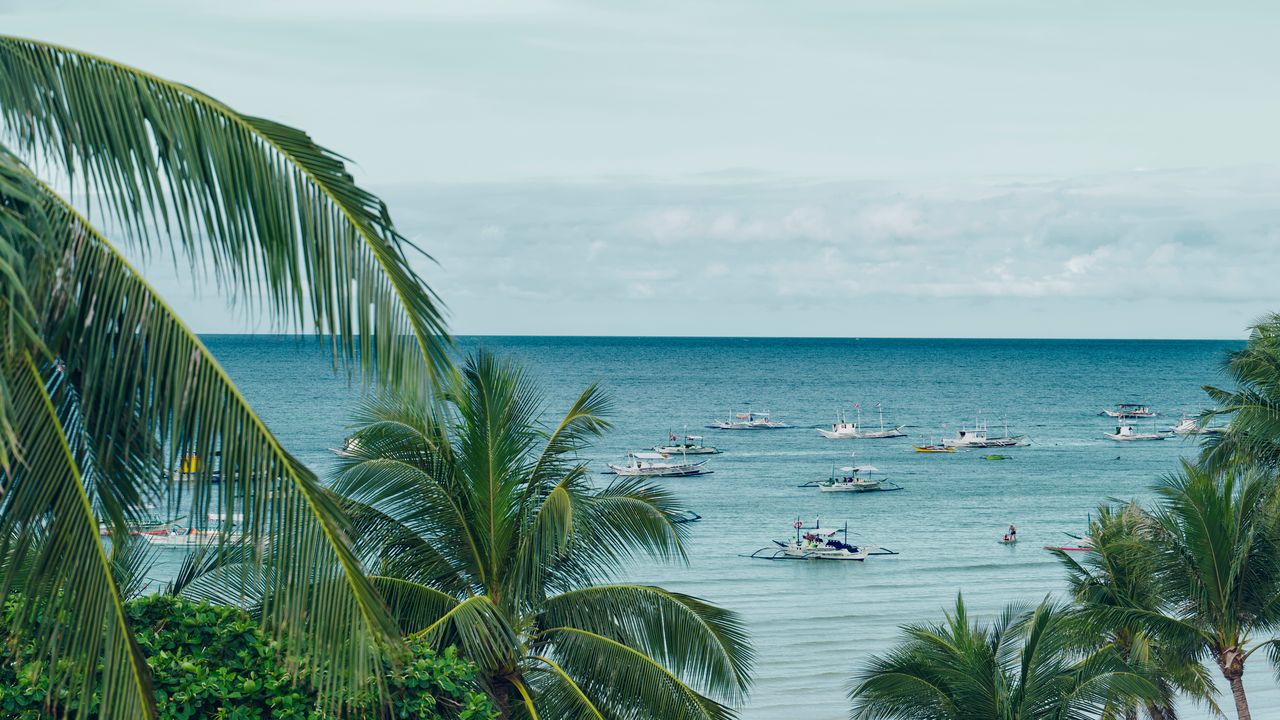
“Fun and sunshine, there's enough for everyone,” says a neon sign before me at the discotheque Club Tropicana on Boracay, a four-square-mile island at the heart of the Philippines. The lyrics are from a buoyant 1983 song, also called “Club Tropicana,” by Wham!. But tonight's playlist is cribbed from the 2010s. As midnight nears, Jennifer Lopez's voice sounds over the speakers, “If you're a party freak, then step on the floor.” So I twirl under a disco ball with gleeful strangers in bikini tops, cargo shorts, and Havaianas flip-flops, beers and gin and tonics in hand.The effect is transportive. I'm flung 10 years into the past, back when Boracay was the locus of an exuberant, if at times debauched, nightlife scene on the creatively named White Beach. Crowds raved until sunrise and woke up on some of the world's softest sand. They had budget hostels and three-star inns, 24-hour shops, water sports and boats, and eateries of all stripes to keep them entertained until nightfall. Then came the parties, VIP bottle service, and the voice of Kesha speak-singing over sound systems, “Tick-tock on the clock, but the party don't stop, no.”The thing is, it did. Boracay had to shed its hedonistic streak after a series of closures curtailed tourism. First there was the government-imposed cleanup in 2018 ordered by then president Rodrigo Duterte to correct rampant overdevelopment and environmental negligence. Then there was the COVID-19 shutdown from 2020 to 2022, when the Philippines was closed to foreigners. Boracay lost an estimated $845 million in tourism revenue in 2020 alone and counted only 260,000 visitors. Compare that with 2017, when it raked in roughly $1.1 billion by welcoming more than 2 million travelers who dug their toes into a White Beach clogged with the debris of multiday concerts and ragers thrown by local hosts and corporate mega-sponsors. Broken bottles, cigarette butts, and waste—plastic and otherwise—came in and out with the tides.The writer (right) aboard a paraw tour at White Beach Graydon HerriottDespite growing up in Manila, about an hour away by plane, I never got to see “old” Boracay before immigrating to the United States in 2003. In the 1990s it was beloved for its rustic milieu and unfussy hospitality, though it was already a resort island with more than 100 hotels. My family knew it best in the '80s, when backpackers from Europe and the US began to arrive after the German writer Jens Peters called it, in his 1978 guidebook to the Philippines, “paradise on Earth.” In those halcyon days, paradise had no electricity or potable water. Ice was brought in from the mainland to chill San Miguel Pale Pilsens in Coleman coolers. Even my stepfather, a reluctant traveler, fondly remembers the Boracay of yore: “Your mother and I had only the sea and the stars.”Boracay is changing yet again. Since 2022 it has vowed to revitalize its economy without sacrificing its environment. Laws now enforce a maximum of 19,000 tourists per day. Smoking, alcohol, littering, single-use plastics, and parties directly on the beach are forbidden. Visitors are not permitted without reservations at accredited lodgings—no more sleeping overnight on the sand. No longer raw as it once was, neither an unspoiled Eden nor a profligate Sodom, this grown-up Boracay is what I've come to see for the first time. As I gaze at the stars above a pristine White Beach, I think, So far, so good.“Boracay was stuck in a mode,” says entrepreneur Nowie Potenciano as we have brunch at his restaurant Percy Seafood, part of his beachfront hotel Seaworthy Boracay. He's referring to both the island's party animal years and its old culinary scene. Back when sustainability and dairy alternatives weren't yet part of the vernacular, diners usually packed their own food from the cities or bought fresh fish at wet markets to have them grilled or fried at canteens called paluto, meaning “to have something cooked.” They remain part of Boracay's charm today, but now we also have the dishes on our table like mango and tuna ceviche, seafood tagine with prawns and mussels, and grouper marinated in sambal. Dessert is a mélange of coconut-pandan ice cream, mango cubes, and crispy rice from Coco Mama, another Potenciano venture. The entire treat is vegan, and I, lactose intolerant, am grateful.A seafood platter at Percy Seafood, right on the beach Graydon HerriottPecho, a popular chicken dish at Island Chicken Inasal, served with frozen calamansi Graydon HerriottThe owner of multiple Boracay restaurants, Potenciano prioritizes sourcing locally. Mahi-mahi and grouper come from nearby Roxas City, oysters from marshy New Washington, and lobsters from the colorful reefs of Palawan. Last October he opened a new restaurant, Hello, Po, inspired by open-fire cooking and smoking traditions from all over the Philippines. As much as possible the ingredients come from Panay, the main island off which Boracay sits. “I want tourists to realize that Boracay is at the center of so much wealth in terms of food and culture,” he says. “It's not just another beach.”That said, judging it solely as a beach, I get why Boracay is beloved. The sand is soft like confectioners' sugar. The shallows are so vast the waters are basically a giant kiddie pool. Behind a fence of palm trees, all tall and outstretched, as if they're fighting for a cab, there are countless bars, restaurants, canteens, shops, resorts, and hostels. They're divided into “stations” typified by vibe: Station 3, the backpackers haven; Station 2, the busy commercial hub; and Station 1, the home of high-end hotels. Yet wherever your accredited accommodations may be, you can park a blanket anywhere on White Beach. Everyone's welcome to do nothing but sit here and watch the blazing postcard-perfect sunsets.But I do no such thing. Having missed out on Boracay's previous eras, I am anxious to play catch-up and pack my calendar with activities. While staying at The Lind Boracay, I board a paraw, a traditional outrigger sailboat, and zip along the shore with guides who balance on the watercraft with surprising grace. I go for a snorkeling safari (stunning) and my first try at paddleboarding (nauseating) at the sumptuous Shangri-La Boracay's private Punta Bunga Beach. In the clamorous whirl of D'Mall in Station 2, I shop at the boutique Hiyas, scoring a watch with a pearl bracelet, then grab lunch at Island Chicken Inasal Boracay for grilled birds marinated in calamansi. I have a cocktail at Exit Bar, where a band plays “Easy” (“Easy like Sunday morning…”). After dark the vibe shifts: A handsome, leathery, maybe Swedish DJ busts out his turntables. As I join the crowd untz-ing to the electro-house beat, a fog seems to roll in. It's smoke from cigarettes and vapor from vapes.The swimming pool at The Lind Boracay Graydon HerriottThough it leaves me breathless, this rapid-fire succession of capital-E experiences feels natural, like what one is meant to do here. On Boracay the surf shops, tiki bars, karaoke venues, and all-you-can-eat buffets are arranged like dominoes, each address falling into the next. One night I catch a band of dads singing Filipino love songs at Nigi Nigi Nu Noos, a down-home resto-bar with casitas, before I go to Rainbow Cafe and Lounge, where a drag queen performs to a RuPaul song, leaping from a chair and landing in an earth-shaking split. This cornucopia of options can be overwhelming to some and a boon to many. Travelers, alone or otherwise, choose their own adventures and curate vibes by the hour. After decades of being many things to many people, today's Boracay now has everything everywhere all at once.More people are on the way. Visitor numbers are back to pre-closure levels and only increasing: 2.1 million travelers arrived in 2025, up 3.7 percent from the previous year. To handle them all, a new passenger terminal at Godofredo P. Ramos Airport in Caticlan, the gateway to Boracay, is meant to open in December. Domestic travelers currently outnumber the big spenders from abroad nearly five to one (the split was 50-50 before 2018). But there's still the sense, among business owners I meet, that Boracay is meant to represent the best of the Philippines—not just to foreigners but to ourselves as well.That's the goal at Subo, a modern Filipino restaurant that straddles Stations 2 and 3. Its chef-owner, Jian Sacdalan, takes guests on a culinary field trip through the country's diverse regions with vegetable pinakbet from Luzon, pork belly pochero from Visayas, and coconut-rich sulu laksa from Mindanao. Subo gets a lot of, as Sacdalan calls them, “intros”—those being introduced to the Philippines for the first time. Staff instruct visitors to leave their flip-flops and Birkenstocks at the entrance. This is a Filipino house after all, and I feel my heart flutter when I'm made to do the same.“And we get the balikbayans,” Sacdalan says, smiling. Translated literally: country returners, like me. “They long for our culture and heritage, and they get that here.”When I have breakfast at True Home Hotel, I'm still wet and sandy from spending the already-warm day on White Beach. As co-owner and chef Peter Montemayor hands me Bacolod-style chorizo pudpud, garlic rice, and eggs, he says it's good I'm enjoying the beach. It's what brought him back here after working at resorts in Southeast Asia and the Caribbean: “I said, if I ever return, there's only Boracay.” Another balikbayan.Sunset dining at Shangri-La Boracay Graydon HerriottBut Montemayor thinks not enough tourists are relishing White Beach, especially after all that's happened to clean it up. During the 2018 closure True Home Hotel shrank from nine rooms to three to comply with new regulations that forbid permanent structures within 98 feet of the shoreline. He's critical of the government's execution (locals who had to move residences or close businesses weren't supported financially) but admits, “When the island closed, it healed.”He laments how today's tourists stay dry in the shade, viewing Boracay only through their cameras, or cram their schedules with shopping malls, kiteboarding, windsurfing, and booze cruises where water slides catapult passengers off a ship's stern. “Sounds like my itinerary,” I say, and he laughs. “The island's magic throughout all its iterations,” Montemayor responds, “is how it rewards you when you stand still.”I taste that peace at Real Coffee and Tea Cafe, a diner in Station 2 styled like a bahay kubo, a stilt house with a thatch roof and bamboo walls. Nearly every surface is covered in sun-bleached photos of guests dating back to when it opened in 1996. The delightfully sour calamansi muffin, it's said, hasn't changed in 30 years. The place feels like a brush with what my family must have longed for: that placid and sweet vibe attached to a Boracay of the past—a contentedness with the here and now.Inspired to take a breather, I find a spot on White Beach, use my shirt as a blanket, and make to watch the world go by. Instead I drift into a nap. I get to sleep on the sand after all. When I wake, I don't find I've missed out. There's still fun and sunshine. There's enough for everyone.The pathway over the koi pond at Shangri-La Boracay Graydon HerriottWhere to stayThe part of White Beach with fewer folks and the softest sand is Station 1, home to Filipino-owned The Lind Boracay. Most of the 118 rooms have sea views, and some have private plunge pools; the brand will come to on-the-rise Philippine island Coron in 2027. The sumptuous Shangri-La Boracay is set on a secluded corner of the island, informally dubbed Station Zero. The 30-acre, 219-key resort has a spa, four restaurants, a PADI-certified water sports center for everything from diving to kitesurfing, and two beaches: the private Banyugan Beach and Punta Bunga Beach, which it shares with sleek Crimson Resort and Spa Boracay and lush Mövenpick Resort & Spa Boracay.Where to eat and drinkIt's easy to fuel up everywhere on the island, especially Station 1: Percy does local seafood dishes; the cocktails at Hello Sailor spotlight Pinoy botanicals; and almost every dessert at Coco Mama is vegan. All are part of the sweet seven-room Seaworthy Boracay. The cozy True Home Hotel and Bistro, with three rooms and an all-day kitchen, is a few doors down. Get a calamansi muffin and an iced latte—there's oat milk—at Real Coffee and Tea Cafe, a 30-year-old oasis amid the hectic vibe of Station 2. In D'Mall, Island Chicken Inasal Boracay serves the titular barbecued bird, one of the region's specialties. At D'Mall's beachside entrance, find Exit Bar for sundowners that become all-nighters. The new Nigi Nigi Too, an eat-drink-and-stay all-in-one, is the latest iteration of a 36-year-old institution. On the border of backpacker haven Station 3 and commercial center Station 2, Subo (meaning “a bite” or “feed”) offers a primer on Filipino regional cuisines. Next door is Boracay Island Brewing Company, with locally made ales on tap.After sunsetFor a taste of classic Boracay nightlife, hit the dance floors at intimate Club Tropicana, neon-lit Om Boracay, and epic Epic, a storied survivor of the island's closures. If you're looking for a dive-y feel, hit Rainbow Cafe and Lounge for some nibbles and drag shows, and Frendz Resort and Hostel Boracay for a spot of community karaoke (the crowd is young; request some current Top 40).All of White Beach is yours to claim. Be respectful, do not litter, and leave only footprints.This article appeared in the December 2026 issue of Condé Nast Traveler. Subscribe to the magazine here.
Once a Filipino Party Isle, Boracay Has Reinvented Itself
Full Article
Original Source
Read the full article at Cntraveler →KhanList aggregates and links to publicly available news content. We do not host full articles from third-party sources. Always verify important information with original sources.