
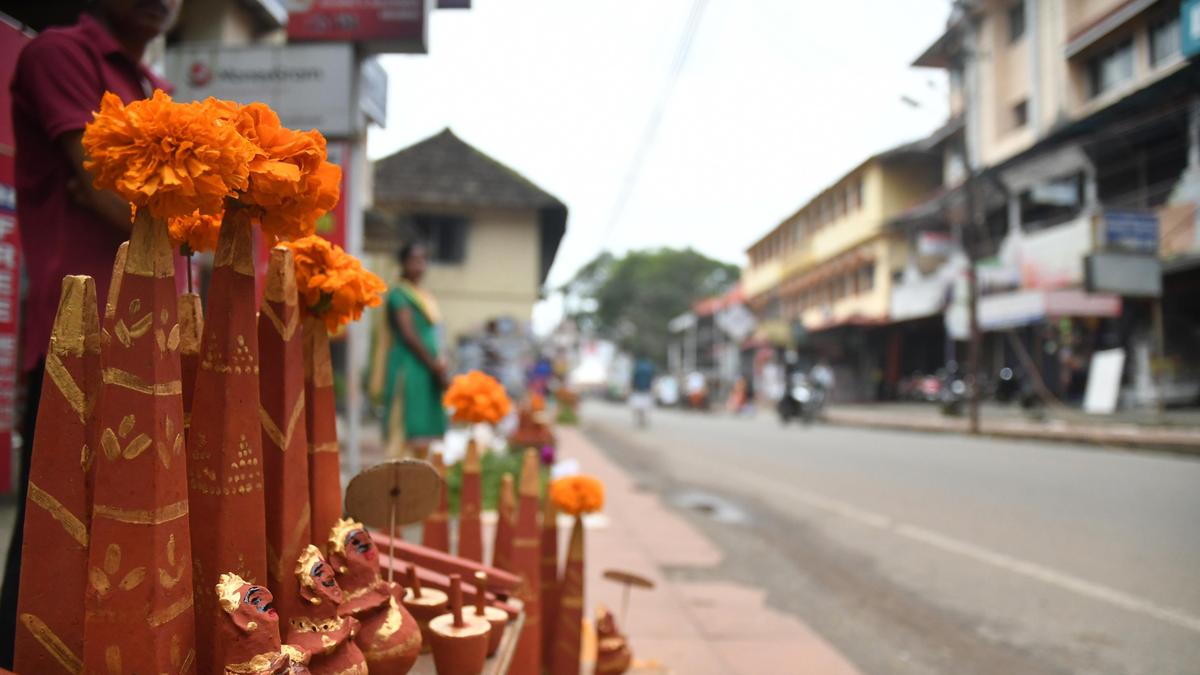
The Onam we know falls in the first month of the Malayalam calendar year, Chingam. Starting on Atham day, it is celebrated for ten days, culminating on Thiruvonam. The festival pivots around the arrival of the benevolent Asura ruler, King Mahabali, amid a dazzle of pookkalams, sadyas and payasams.But beyond this popular narrative, there is more to Onam. It is a multi-layered construct built by myth, legend and local traditions. Celebrations take on diverse hues across regions and communities. For instance, in certain pockets of Palakkad, people start making pookkalams from the month of Karkkadakam, the month preceding Chingam. This spills over to the following month of Kanni, as well.Girija Varier, a retired teacher from Palakkad, says that they start laying the pookkalam from Thiruvonam day in Karkkadakam and stop on Atham day in Chingam, the day when the rest of Keralam begins laying pookkalams!Onam without pookkalam“Instead, we place pyramid-shaped figures made of clay or sand — Mathevar or Onathappan. Three of them will be placed on leaves of turmeric plant for the next six days with flowers placed on top of them. Five new ones are placed on the seventh day with turmeric leaves replaced by banana leaves. The number goes up to seven, nine and finally 21 on Thiruvonam day. In our belief, these figures symbolise Lord Vishnu. On Thiruvonam day, we place a bigger figure representing Mahabali,” says Girija. The figures are adorned with flowers and a kolam (rangoli with rice paste) decorates the space. Girija Varier with the Onathappans arranged at her courtyard | Photo Credit: SPECIAL ARRANGEMENT Once these figures are taken away on a specific date, they begin laying the pookkalam again. “The floral carpets will be made till the 16th day, which falls on Makam. That day, we place Makathadiyan, a figure representing Lord Siva. Made of mud, it has carvings to indicate the snake with a raised hood on his neck and the flowing river Ganga on his head.”The pookkalam continues to be made till Ayilyam star in Kanni, believed to be the Onam day for the farming community. “That is when the paddy harvest will be over, bringing cheer to the farmers. On this day, three small figures are placed in the courtyard, named Ayilyam Unnikal. It is with Ayilyam that our Onam festivities conclude.” Mathevar, the pyramid-like structures arranged during Onam | Photo Credit: SPECIAL ARRANGEMENT Manjusha PP, a food blogger and history buff from Palakkad, adds that they lay the pookkalam till Uthradam day, after which the Onathappan (Thrikkakkarappan) will be placed. She also remembers making Makathadiyan and Ayilyam Unnikal.A day for VindhyavaliAccording to historian and researcher Vellanad Ramachandran, there are certain beliefs associated with the festival followed in some parts of central Travancore in connection with the four main days of the festival — Uthradam, Thiruvonam, Avittam and Chathayam, respectively called Onnaam Onam, Randaam Onam, Moonnaam Onam and Naalaam Onam. Uthradam day is for Onathamma, who stands for King Mahabali’s wife, Vindhyavali. She visits every household to see the preparations for the next day. “The belief is that she goes inside every home to be rest assured that all arrangements are in place for the sadya and other activities for Thiruvonam before Mahabali pays a visit on Thiruvonam.”Moonnaam Onam is called Ammayi Onam. “When the matrilineal system was in place, the wife would stay at her home and husband is more or like a guest there. It is on Avittam day that she visits her mother-in-law or ammayi and she is expected to take new clothes and bunch of tobacco.”Girija adds to this, “In our home, we make pulissery(yogurt-based dish) with ripe banana on AmmayiOnam.”Chathayam day is called Nathoon Onam, a day for the wife to visit her husband’s sister(s), with a bunch of dishes and other goodies. A traditional lamp has to be kept lit on five days starting with Uthradam inside and outside the house, Ramachandran continues. Pookkalam made with homegrown flowers | Photo Credit: Manjusha PP Gopalakrishnan, who opened Sarang, an alternative school, with his wife Vijayalekshmi near Attappady in Palakkad four decades ago, remembers a custom prevalent at his native place, Kothamangalam. “We used to make the pookkalams till Uthradam. After that we would place the Onathappan. On Chathayam day, we bid farewell to the king for which we place umikkari (rice husk charcoal powder), water and an umbrella.”The many layers of athamIn Thiruvananthapuram, pookkalam has another name — atham. On Thiruvonam day, atham is laid two times. Once in the morning and in the evening. Suchitra Nair, a homemaker, says the pookkalam comprises odd numbered layers — three, five or seven. “After it is laid in the evening, small branches of the mango tree (with leaves) are laid on the atham, on which a yellow kodi (a piece new cloth) is laid. On that, three steamed appams (ada/ rice cakes made in plantain leaves) are placed. A male member of the family (usually a child), using a homemade bow and arrow, shoots the appam. Once the appam is pierced, they are taken off as prasadam (offering). Following this, the atham is removed and placed on the compound wall, next to the main gate/entrance of the house/property where it sits until is disintegrates.”A curry out of leftoversBack in the days when there were no refrigerators to store left over curries of the multi-course sadya, homemakers in central and southern Keralam would make a new dish out of them — pazhamkoottan. Mix the leftovers, keep it overnight, boil it and have it in the morning itself.Interestingly, even this has its variations with the regard to curries that go into the mix. In some houses all curries are blended. Suchitra says, “Yoghurt-based dishes, pickles and rasam etc are added in small quantities only to avoid getting fermented quickly.”However, KS Kumari, a retired bank official, from Alappuzha, prefers to limit it to sambar, avial, moru curry (pulissery) and the sweet pachadi. “If pachadi is less, add a little jaggery to the mix. We prefer to have more sweetness in our pazhamkoottan.”
Onam: The many ways Keralam celebrates
Full Article
Original Source
Read the full article at Thehindu →KhanList aggregates and links to publicly available news content. We do not host full articles from third-party sources. Always verify important information with original sources.