
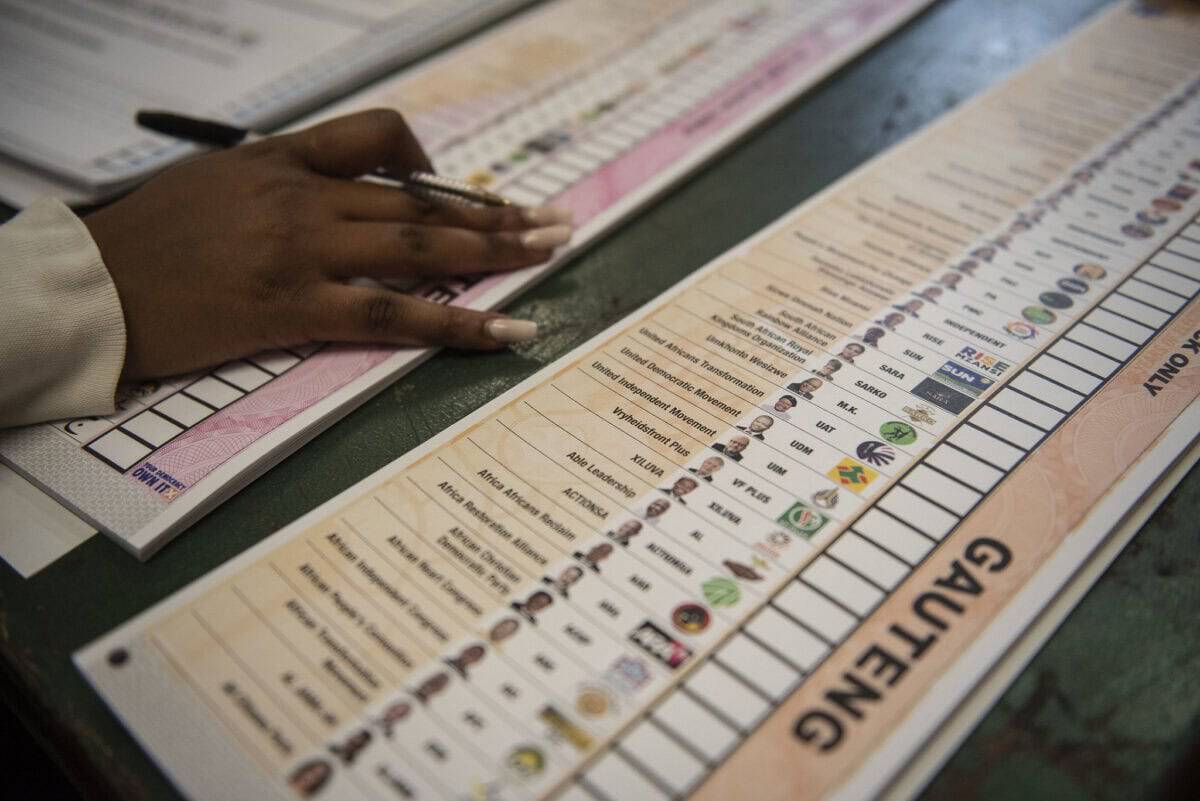
Although only some of the ANC's lost support appears to have gone to the DA, the shift has nevertheless changed the arithmetic of coalition. With the local government elections just days away, the ANC is reeling under a flurry of punishing polling figures. The polls could deliver another heavy blow to a party in relentless electoral decline under President Cyril Ramaphosa. When he succeeded Jacob Zuma in 2018, he inherited a ANC parliamentary majority of 62%. That slipped to 58% in the 2019 general election, 46% in 2021 and in the 2024 general election, the ANC slumped to just 40%. What the polls say Now, the Social Research Foundation/ Common Sense survey, conducted between September and October, with a 2% margin of error, puts the ANC at just 32%, against the DA’s 26%. In just over two years, the ANC’s 18 percentage-point lead over the DA in 2024 has seemingly narrowed to just six points. That’s a stunning reversal. The DA, however, claims a narrower gap. It says its internal polling put it at 28.4%, just 1.2 percentage points behind the ANC’s 29.6%. The eNCA/MarkData poll, conducted in August-September with a 3% error margin, has further evidence of the ANC’s predicament. Covering the six largest metros, it suggests the ANC’s decline is particularly pronounced in the urban centres that drive SA’s economy. In 2021, the ANC was still the largest party in four of these six – Johannesburg, Ekurhuleni, Tshwane and eThekwini – although it failed to secure an outright majority in any. It came second to the DA in the remaining two, Cape Town and Nelson Mandela Bay. Now, the two polls say, across all six, the ANC leads in none. Coalition arithmetic Although only some of the ANC’s lost support appears to have gone to the DA, the shift has nevertheless changed the arithmetic of coalition. The stark choices confronting the ANC and DA – the government of national unity’s Monday 10 2 November 2026 (GNU) two lead actors – come sharply into focus. On the face of it, the numbers favour extending their national partnership into local government. In four of the five metros surveyed outside Cape Town, their combined support exceeds 50%. Such an arrangement offers a simpler route to governing majorities than the unwieldy alliances with smaller parties. There is even public support for such an arrangement. The Common Sense poll finds that 68% of voters favour ANC-DA coalitions in municipalities where neither party has a majority but the two together can form one. That includes 83% of ANC and 77% of DA supporters. A shift in bargaining power But the arithmetic cuts both ways. The ANC’s diminished strength increases the DA’s bargaining power. It also strengthens the hand of uMkhonto weSizwe party (MK) and the EFF, should the ANC seek to govern without the DA. The obvious precedent is Gauteng, where after the 2024 election the national GNU partnership was supposed to provide the basis for a provincial arrangement. Instead, premier Panyaza Lesufi formed a minority administration that excluded the DA. This week, Lesufi reiterated his preference for governing without an “antitransformation” DA. But then one gets to KwaZulu-Natal, historical tensions and personal antipathies between the players highlight why tidy solutions are so rare in politics. In eThekwini, the polls put MK at 43%-48%, the DA second at 25%-28% and the ANC at a derisory 13%-15%. Together, the ANC and DA would fall well short of a majority. Coalition arithmetic, governance stability and public sentiment all point towards an ANCDA tie-up. The ANC is running out of ways to arrest its decline. Worse, every remaining option carries a substantial risk of accelerating it.
On the road to nowhere
Full Article
Original Source
Read the full article at Citizen →KhanList aggregates and links to publicly available news content. We do not host full articles from third-party sources. Always verify important information with original sources.