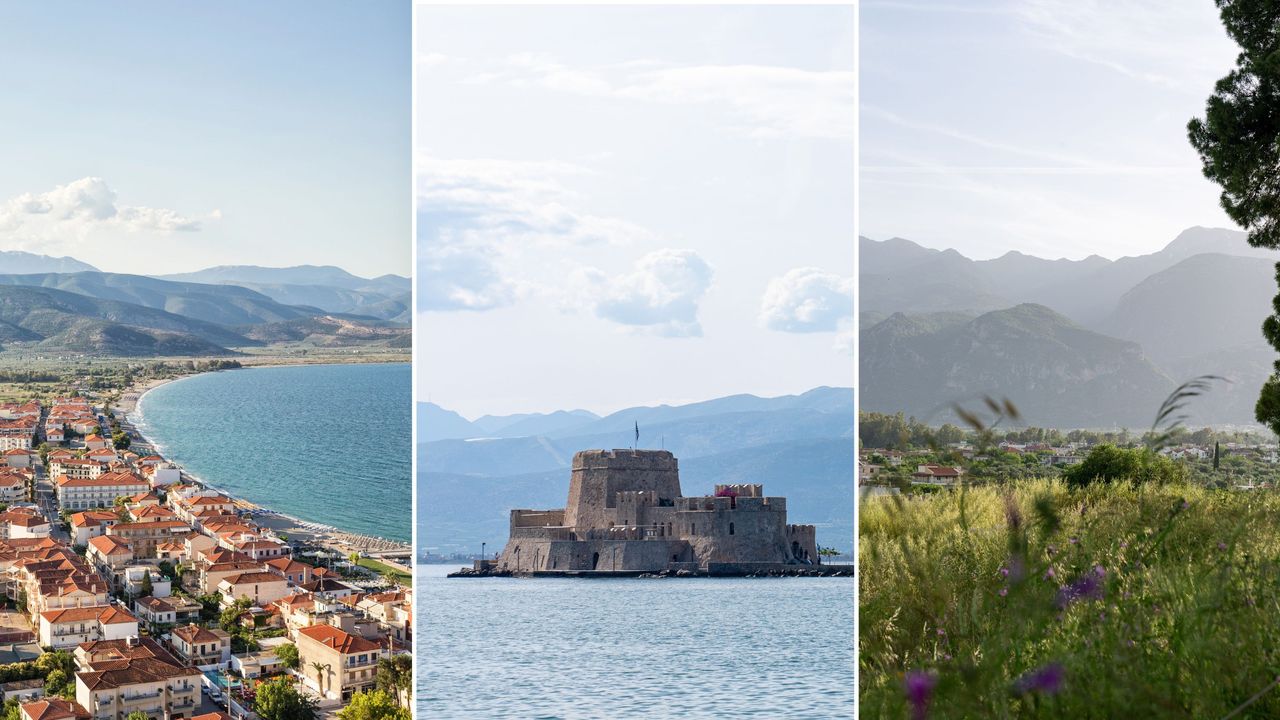
I’m standing in ankle-deep emerald seawater so clear I could count every pebble at the bottom. Earlier this morning, I arrived on the uninhabited island of Daskalio, as 1970s hits from a legendary Greek duo, Stelios Kazantzidis & Marinella, blasted from the boat that got me there. The captain, Giorgos Georgidakis, is pulling souvlaki off the boat’s grill while his niece, Sofia, passes me plates of spanakopita made by her grandmother to bring ashore.We eat lunch on the quiet beach, before I hike up the path to a small chapel where Giorgos, Sofia, and other residents of the nearby village of Tolo gather once a year for post-Easter service and snacks. From above, emerald, sapphire, and cobalt-hued water surrounding the Peloponnese Peninsula—which is roughly the size of the country of Slovenia—stretches as far as the eye can see. “Greeks are very attached to the sea,” Irini Dusendschoen from Trekking Hellas, the company that organized my trip, tells me. “We need to be able to see it.”From the tiny uninhabited island of Daskalio near Tolo, another island of Romvi is seen in the distance. Yulia DenisyukFamily-run John & George hotel in Tolo, Argolis, organizes boat trips to nearby islands in the Argolic Gulf. Yulia DenisyukHugged by three seas—the Ionian from the west, the Mediterranean from the south, and the Aegean from the east—the 860-some miles of twisting, jagged Peloponnese coastline and its mountains have been Greece’s well-kept secret for decades. Only 3 in every 100 foreign travelers reached this westernmost Greek peninsula in 2025, even though it’s just a few hours by car from Athens. That’s about to change, though. Christopher Nolan’s new blockbuster, The Odyssey, revisits Homer’s 3,000-year-old story this year, and with it, shines a light on real-life places where the mythical Greek king Odysseus lived, fought, and loved.Shot partially on location in southernmost Messinia, one of five administrative regions making up the Peloponnese, the film follows a harrowing journey of a man trying to return home against all odds. The Greek concept of xenia—the unwritten hospitality contract binding guests and hosts to a set of rules—is a major theme in The Odyssey, as is nostos, translated loosely as homecoming.It’s a story perhaps all too familiar to people like Nikos Stakias, who has dedicated the next chapter of his life to the land where he was born. Stakias worked in hospitality in England, Cyprus, Athens, and elsewhere over the course of two decades before returning to the peninsula for its slower pace and quality of life. For the past three years, he’s been part of an effort to launch the community-led Peloponnese Trail Network, the largest hiking network in Greece, which connects nearly 1,200 miles of ancient footpaths to the Peloponnese’s many small villages.This new trail project is the latest effort to open the peninsula to the world: In the early 2000s, new highways and tunnels made the commute from Athens much faster. Costa Navarino eco-retreat by Messinian ship captain Vassilis Constantakopoulos opened its doors about a decade ago; Constantakopoulos wanted to transform his birthplace into a premier travel destination, while also putting a plug on the exodus of Peloponnese residents to the capital and beyond. (Costa Navarino now leases its land to the likes of W Hotels and Mandarin Oriental—opened in 2022 and 2023, respectively—and brands like Four Seasons and Six Senses are expected to follow suit next year.)Now, as Nolan's film puts a bigger spotlight on Messinia—with movie-set locations like Nestor’s Cave (where Matt Damon’s Odysseus battles the Cyclops), and Methoni Castle (where his son Telemachus, played by Tom Holland, awaits his father’s return)—the Peloponnese is getting its due. And there is plenty to see beyond Messinia, where locals who have been waiting for the chance to welcome travelers onto their land. The Peloponnese Trail Network is a means of getting there, but also a means of discovery: Most of the 11 newly opened official trails lie in the other four Peloponnese regions.Views of jaw-dropping Kokkinovrachos (translated as "Red Rock" from Greek) tower over the town of Leonidio in Arcadia, on the Parnon Trail. Yulia DenisyukDays earlier, I arrived on the peninsula to hike two of them. At the start of the 64-mile Argolis Trail in the northeastern region by the same name, I encountered one of Greece’s best-preserved ancient theaters, Epidaurus. In this sanatorium from the 4th century BC, performances were prescribed as therapy to ailing patients. Near the trail’s midpoint, I traveled centuries ahead, climbing Ottoman-era stone paths to Palamidi, a Venetian fortress overlooking the town of Nafplio.On day five of my trip, I take the scenic coastal drive from Nafplio down the Argolic Gulf. My destination is Mount Parnon, a mountain range in the southeast of the peninsula so massive, it’s visible from Athens on a clear day. I follow my guide, George Alexandrou, from the mountain village of Pera Melana into these rugged, remote parts of the Peloponnese, part of the 143-mile circular Parnon Trail. As we embark on the four-hour hike, Alexandrou tells me that his father used to take these paths to school in Leonidio, a town of 4,000 tucked between precipitous red cliffs, which has become a spot for world-class mountain climbing in recent years.With the waters of the gulf shrouded in mystery on this overcast day, I pause to sniff wild bushes of rosemary, thyme, oregano, and sage. Lemon and olive groves give way to mountain cherries and junipers. Cedars tower in the forests above. By my feet, a wildflower with delicate pink petals blankets the trail. This is hairy pink flax, a wilder cousin of the linen plant that Odysseus and his men used to craft the sails in their boats.Stunning views of Nafplio town and the Bourzi Fortress can be earned by climbing Ottoman paths up to Palamidi on the Argolis Trail. Yulia DenisyukNafplio town center offers views of the 17th-century Palamidi Fortress, one of the largest and best-preserved Venetian castles in Greece. Yulia DenisyukWe pass remote village homes, sheep's bells clinking on the hillsides. Beyond the cliffs I can see Aegean islands looming in the distance. At a lone chapel dedicated to Prophet Elias, Alexandrou pulls out heaps of walnuts, oranges, and koulourakia (biscuits made with local olive oil and citrus zest). Then, we let the path draw us back inland for the grand finale: the stunning vertical limestone rocks of Leonidio.This part of Greece is rarely seen, and it surprises me, given the role the Peloponnese has played in the country’s long, fabled story. Eons before The Odyssey, another hero fought the first six of his twelve Herculean labors on the peninsula: In the premier wine region of Nemea, Hercules overtook a monstrous lion. In the mountainous Arcadia, where both Zeus and Hermes were born, he trapped the Erymanthian boar. Mycenae in Argolis gave birth to the first Greek civilization, the Mycenaeans, and inspired one of its most prominent characters, the Mycenaean king Odysseus.The impact didn’t stop with the ancients: the Byzantine Empire’s last stronghold, Mystras, is in the Peloponnese. Greece’s fight for independence from the Ottoman Empire originated here, as did the new country’s first capital, Nafplio.Wearing a traditional Tsakonian dress, Eleni Manou greets visitors at the Polytimou Mansion in Leonidio. Yulia DenisyukIn Arcadia, the Parnon Trail goes through the shepherding village of Pragmateftis with fewer than 200 residents. Yulia DenisyukPost-WWII and the bitter civil war that followed, the Peloponnese, along with other Greek regions, experienced periods of severe devastation and death, internal displacement, and waves of emigration. More recently, the 2008 financial crisis disrupted the rebounding population again, forcing many young Greeks to leave for places like Northern Europe or Australia. Some of the most remote parts of the peninsula experienced rural flight, turning hillside Vamvakou in Laconia with nine year-round residents or the no-resident village of Lasta in nearby Arcadia into literal ghosts.Back in Leonidio, I step into a 19th-century stone mansion to meet author and educator Eleni Manou. With her striking red-black-and-gold skirt flapping in the wind, Manou explains that, alongside other Leonidio residents, she’s Tsakonian, a direct descendant of ancient Spartans. The isolated villages in this part of the Peloponnese were cut off from the outside world by the hard-to-pass Parnon range until the 1950s, when modern roads were built. The topography of the land helped this branch of Spartan to survive, but as the area opened up, Tsakonian started vanishing. Today, less than a quarter of the 10,000 Tsakonians carry the rare dialect from the Bronze Age, most of them elders. Manou has published children’s books in Tsakonian and organized workshops in an effort to preserve the language that predates modern Greek by three millennia, because, as she tells me, “Language is not just words, it’s a culture alive.” In Leonidio, an annual festival held in July translates Tsakonian traditions into present-day context, and street signs in town are now proudly displayed in Tsakonian alongside Greek.Fourteenth-century Eloni Monastery is cut into the steep cliffsides of the Parnon mountains near Leonidio, Arcadia. Yulia DenisyukAt Geraki Weaving in the Laconia region, students of all ages come to learn this tradition, part of Greek National Intangible Heritage, for free. Yulia DenisyukCutting through the Parnon mountains the next day, we reach Geraki, a village in nearby Laconia equally determined to turn the tide. Chrysoula Stamatopoulou from Geraki Weaving welcomes me into a room where weavers of all ages painstakingly pass wool threads between the warps of a vertical loom. Like magic, their labor turns into kilims, large heirloom rugs with Tsakonian geometry and designs such as the sun or the tree of life representing happiness, fertility, and abundance. Women in Geraki have been weaving continuously on this loom for the last 5,000 years. Penelope, too, sat behind it in The Odyssey as she wove a burial shroud each day and unraveled it at night to stall her unwanted suitors. But the practice has become endangered in modernity.“Five years ago, I was the only one weaving here,” Stamatopoulou recalls. Today, students come to Geraki from across Greece and the rest of Europe to learn for free at one of only two places that offer this knowledge (the other is in Leonidio). “It gives me joy to have people here,” Stamatopoulou adds with a smile.Near the Tsakonian village of Pera Melana, the Parnon Trail offers views of olive groves, coastal roads, and the Argolic Gulf. Yulia DenisyukElsewhere in the region, there are hopeful signs. Laconia’s Vamvakou is now home to 30, thanks to a revival project run by four young entrepreneurs with roots in the village. In Arcadia, social entrepreneur Maria Monastirioti—who herself swapped the stress of Athens for peninsula life—works with local women in rural communities to organize agro- and gastronomic experiences like making trachanokeftedes (fermented milk pasta balls). The dream started with Captain Constantakopoulos in the 1980s, and the Peloponnese Trail Network is its latest imagination.I end my journey through the peninsula at the Acropolis of ancient Sparta, a magnificent spread of ruins and olive groves overlooking the Taygetus mountains. Just a few miles away from where I stand, Spartans built a sanctuary dedicated to Helen, who eventually returned home from Troy. Leaving this “blessed land,” as Monastirioti calls it, I can’t help but think that the Peloponnese of today is going through a homecoming of its own, decades in the making.
On the Peloponnese, Walking the Mountains Where Odysseus Lived, Fought, and Loved
Full Article
Original Source
Read the full article at Cntraveler →KhanList aggregates and links to publicly available news content. We do not host full articles from third-party sources. Always verify important information with original sources.