
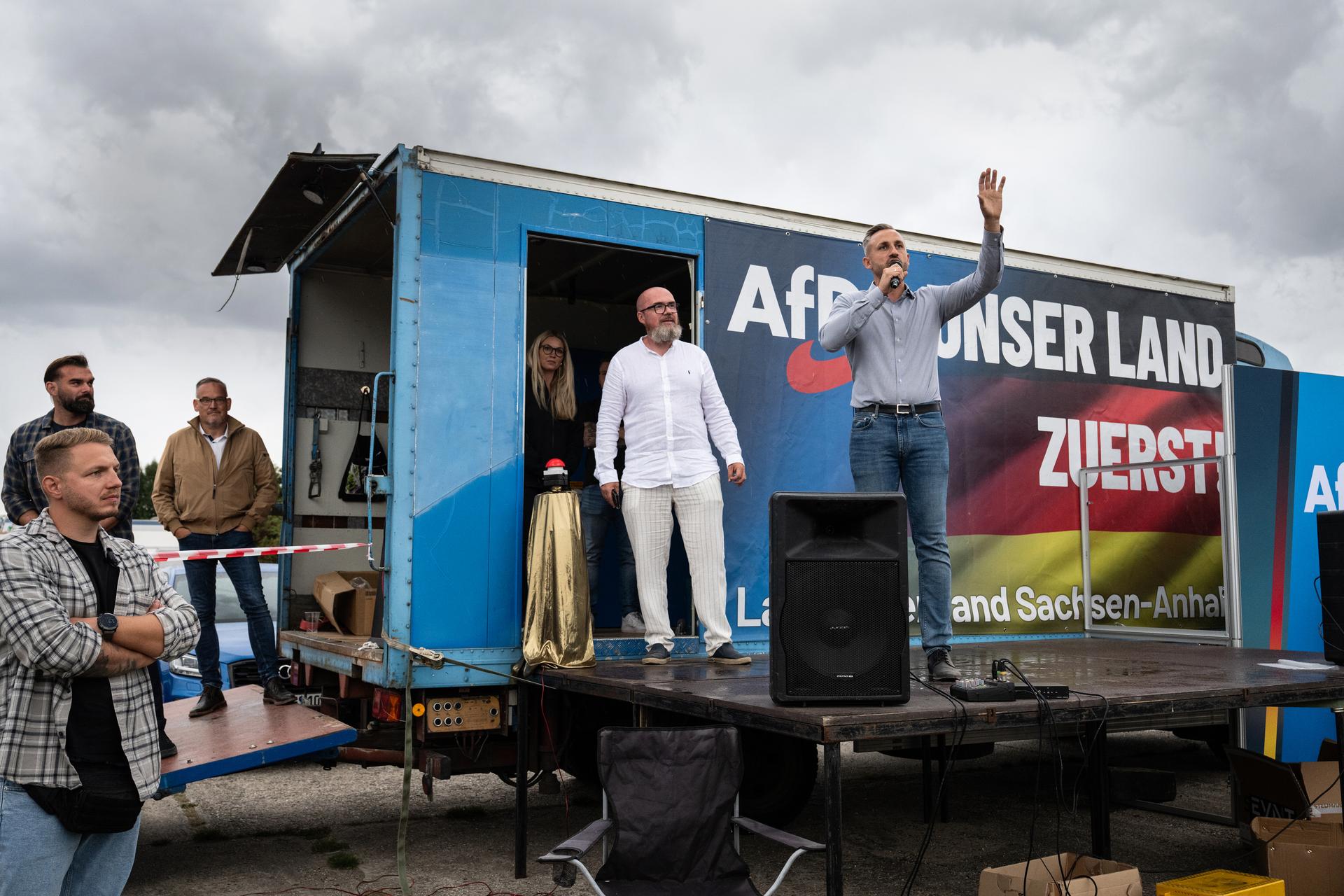
First published in Respekt. The new nationalist right is approaching power in Germany and, in their interviews, its leaders make no secret of their revolutionary plans. Schools take down LGBTI+ rainbow flags from their flagpoles and raise Germany’s black-red-gold banner in their place. Citizens enthusiastically watch a plane bearing the word “Remigration” carry 432 Afghan criminals back to the realm of the Taliban. A Russian soccer team flies to Magdeburg for a friendly match, while German and Russian tricolours flutter in the stands. “I have always supported friendship between nations,” a German footballer said as he shook hands with his Russian opponent. German cities once again look more native, with schnitzel shops, stores named things such as “Emperor Otto”, and, naturally, plenty of German flags. Black refugees smoke shisha in a gutted house and tell one another that they are bored with this Germany and that it is time to return to Africa. They then sit in the street on their suitcases as white German families move into the former asylum accommodation. The story’s main protagonist rides off towards the sunset on a blue East German moped, a flag in his hand. These images come from the comic Uli rettet Deutschland (Uli saves Germany). It depicts what will happen if Alternative for Germany (AfD) wins an absolute majority in Saxony-Anhalt’s state election on 6 September and takes power in the federal state. The booklet was published by Compact, an extremist publishing house based in Saxony-Anhalt, and we bought it at an election rally for “Uli” — Ulrich Siegmund — in a beer garden on the outskirts of Rosslau. The comic’s pathos is not entirely detached from reality. In his home federal state, Siegmund inspires a level of public enthusiasm rarely seen in Germany’s largely uncharismatic politics. Wherever he goes, people queue for two hours or more for a selfie and an autograph. During the week, signed magazines began appearing in eBay auctions and, according to the Bild daily, some sold for €1,000. Siegmund boasts about the cover on social media, considering it excellent political advertising. The 35-year-old Siegmund could become the first AfD minister-president of a federal state in September. According to the latest pre-election polls, 42–43 percent of voters in Saxony-Anhalt would vote for him, 20 percentage points more than for the second-placed Christian Democrats (CDU). The possible outcomes are clear: either he wins an absolute majority of seats and forms a government, or he falls short of a single-party cabinet and everyone else — the centre-right CDU, the Social Democrats and the hard-left Die Linke — joins forces against him. “The sun rises in the east, but it will shine over the whole of Germany. Because we are one nation, one community, one country,” Siegmund predicted in Rosslau. Beneath the stage is parked a blue Trabant with the words “East German and proud” on its bonnet. “A great turning point in our country began here in the east once before,” he said, referring to the democratic revolution of 1989, “and we will manage it again. The east goes first; the west will follow.” AfD has a project spanning generations The AfD has found in Siegmund its first young, energetic and seemingly ordinary, likeable salesman for its ideas. He was born in Havelberg, Saxony-Anhalt, a few months after the fall of the Berlin Wall, grew up in a small town in the family of an electrical engineer, and studied business administration. He sold ambient fragrances to shops, and in his university thesis examined how such scents could psychologically influence customers’ decision-making. Twelve years ago, the Berliner Morgenpost wrote that his start-up, Berlin duftet (Berlin smells good), had offered Berlin public transport operators fragrances intended to reduce aggression and passengers’ propensity for vandalism. In him, the AfD suddenly presents itself differently: not as a protest force radiating bad moods which have fuelled its growth so far. At his rallies, there is a cheerful, smiling atmosphere and a sense that “we” in eastern Germany are the new centre of society.
On the campaign trail in Saxony-Anhalt with Alternative for Germany: nationalism, ‘remigration’ and a radical agenda
Full Article
Original Source
Read the full article at Euobserver →KhanList aggregates and links to publicly available news content. We do not host full articles from third-party sources. Always verify important information with original sources.