
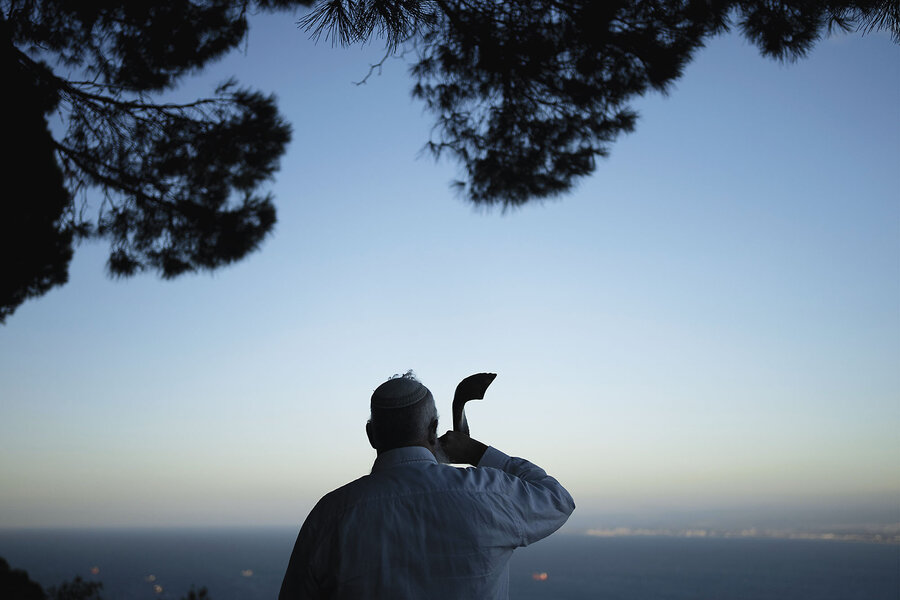
The early train ride from Jerusalem to Tel Aviv is dramatic, especially during the first 20 minutes after pulling out of Yitzhak Navon station.Navon – named after Israel’s fifth president – is an engineering marvel. To build it, workers excavated large chunks of the Judaean Hills and installed four steep escalators to steer passengers to the platforms below. At 260 feet underground, it is one of the deepest stations in the world.As the train emerges from the tunnel, pitch darkness alternates with sudden bursts of sunlight through openings in the bedrock. Passengers blink, trying to adjust. It feels impossible – and a bit disorienting – to keep up with the rapid-fire light and dark. Eventually, though, the train bursts from its tunnel, and there are spectacular views of limestone adorned by Mediterranean wildflowers, which eventually give way to the densely populated suburbs and high-tech skyline of Tel Aviv.In the southernmost car, dozens press together and sway in their prayer shawls to the hymns of the morning service. This, too, is a marvel of the modern Jewish state – the unusual multitasking of commuting and worshipping.If you’ve ever flown the Israeli airline El Al, you have noticed that, at some point during transatlantic flights, there will be a duel for galley space between flight attendants who are trying to prepare meals and travelers attempting to coalesce into an improvised shul. As an observant Jew myself, I never know for whom to root. Fortunately, on the train, one need not take sides. An understanding has been reached that the last car can, indeed, be repurposed into such a makeshift temple every morning, at least for the 6:09 departure from Navon.Last summer, in the August heat, I rode that very train on what turned out to be the first day of Elul, the final month of the Jewish calendar year. When Elul concludes, Rosh Hashana – the Jewish new year – is celebrated.In order to buffer the intensity that characterizes the 10-day stretch between Rosh Hashana and Yom Kippur, the Jewish day of judgment, Elul is leveraged as a warmup period – an on-ramp, if you will, for the reflection and repentance of our High Holy Days.As part of this period, there is an addition to morning prayers: the blowing of the shofar .These ancient trumpets, usually made of a ram’s horn, date to the biblical period. They are first mentioned during the encounter at Sinai, when Moses received the Ten Commandments. The shofar plays a simple, solitary call, designed – according to the scholar Maimonides – to “awaken sleepers from their slumber.” I highly doubt that Maimonides, a medieval rabbi and physician, was foreshadowing the military tradition of sounding reveille with a bugle. He seemed to be prescribing a spiritual alarm clock.For most of the year, passengers in the other cars of the train are happy to coexist with (if not ignore) the religious activity in the caboose.But on the first day of Elul, something changes. A request makes its way to the rear of the train to hold off on blowing the ram’s horn until all the doors between the respective cars are pried open. The anticipation builds until the silence is pierced by the curling cry of the ancient instrument.Ultimately, Elul will dissolve into the month of Tishrei, which is when the new year takes place. The days of repentance that form a bridge between Rosh Hashana and Yom Kippur are referred to as the period between “Kesseh and Assor.” The literal translation of the phrase is “the obscure day and the tenth day,” but it refers to the moon cycle. The obscurity is the darkness when the moon is not visible. The number 10 alludes to Yom Kippur, which falls on the 10th day of Tishrei, when the moon glows brighter.The sages were teaching that life can progress from a state that is concealed to one of revelation and clarity, which, in our tradition, comes with this Day of Atonement. On the 6:09 train, as the shofar sounds, there is a communal pause.After the oscillating light and dark, after the speeding forward, after the commuting or praying or both, this moment seems to hold an extra teaching. There is a time when light is obscured. But we are passengers together. And the disturbing oscillations are a journey from uncertainty to insight, a train ride from introspection to moral resolution. Deepen your worldviewwith Monitor Highlights.Politics with respectGet political stories with respectful analysis.There‘s a world of new ideas in everyBooks newsletter.There‘s more to life, enrich yours withCulture & Learning weekly.Follow humanity‘s discoveries withScience & Nature stories in your inbox.Gain a spiritual perspectivefrom the stories in your inbox.Want to understand the deeper impact of critical events? Learn the Monitor‘s insight.Already a subscriber? Log in to hide ads. The shofar sounds, and for a heartbeat, on that sleek locomotive, time bends toward the eternal.■ Dr. Ben Corn is a professor of oncology and directs The Institute for the Study of Hope, Dignity and Wellbeing at the Hebrew University of Jerusalem. ALREADY A SUBSCRIBER? LoginReal news can be honest, hopeful, credible, constructive.The Christian Science Monitor was founded in 1908 to lift the standard of journalism and uplift humanity. We aim to “speak the truth in love.” Our goal is not to tell you what to think, but to give you the essential knowledge and understanding to come to your own intelligent conclusions. Join us in this mission by subscribing.
On the 6:09 train, a traditional sound brings reflection
Full Article
Original Source
Read the full article at Csmonitor →KhanList aggregates and links to publicly available news content. We do not host full articles from third-party sources. Always verify important information with original sources.