
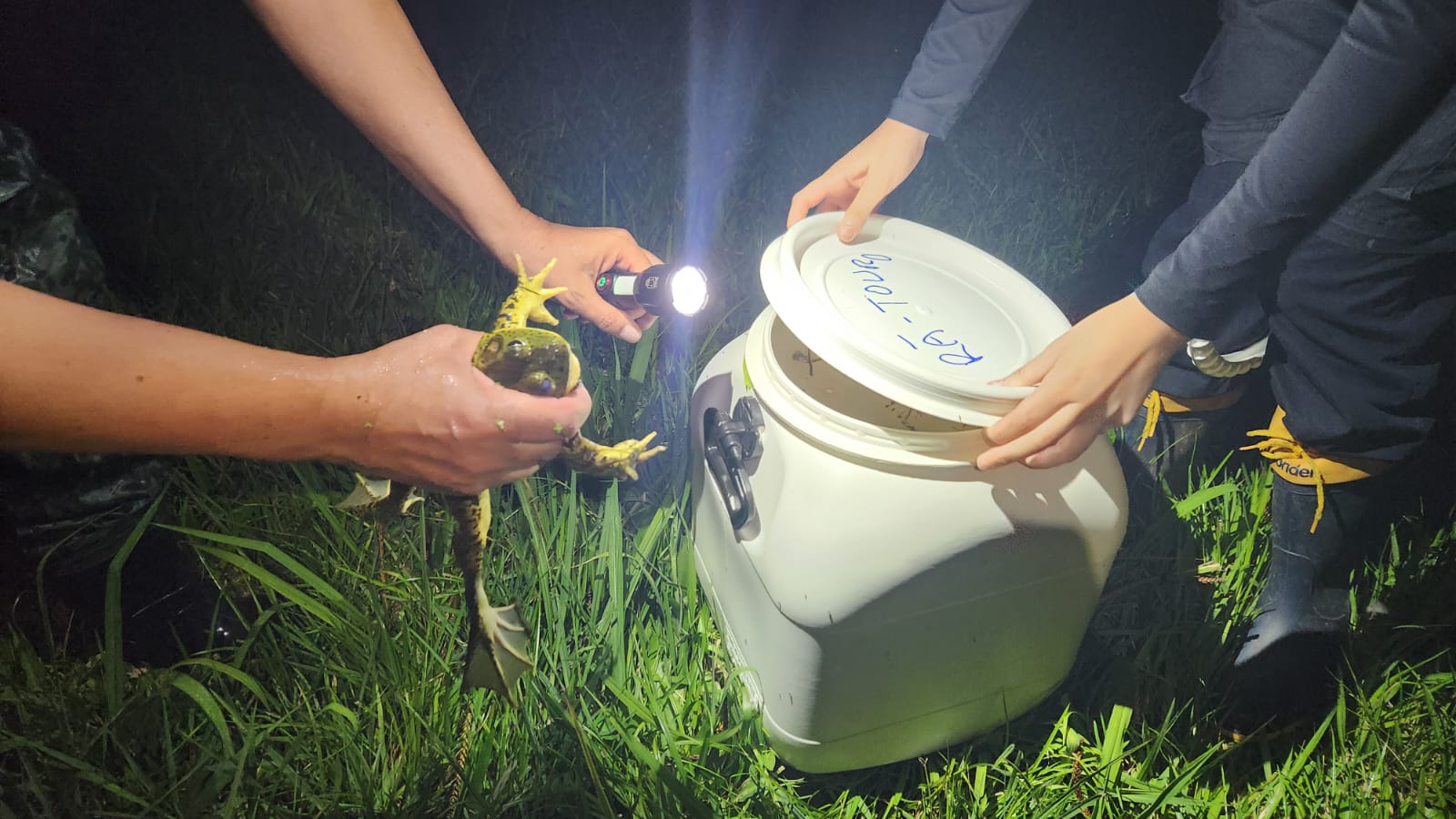
American bullfrogs have long been invasive in Brazil. Their recent discovery in a biodiverse island city has set off alarm bells.FLORIANÓPOLIS, Brazil (CN) — About a year ago, an environmental consultant was reviewing recordings from the Ratones district when he heard a sound resembling a bull.It was the call of an American bullfrog, an invasive species first brought to Brazil in the 1930s to be farmed as a gourmet food item.Unsurprisingly, some escaped or were released from farms and became a threat to local ecosystems.Reaching up to 8 inches long, bullfrogs are voracious predators of snakes, rodents, young birds and other amphibians. Their loud calls produce noise pollution, disturbing other species that rely on sound. They can also carry amphibian diseases like ranavirosis, caused by a virus, and chytridiomycosis, caused by a deadly fungus.American bullfrogs have now been found in at least nine of Brazil’s 26 states. Those include Santa Catarina, a biodiversity hotspot in Brazil’s Atlantic Forest ecosystem where Florianópolis is the capital.Last year’s recording was nonetheless alarming: It marked the first time the species was detected in Florianópolis, which mostly sits on an island.“Someone brought them here,” said Luís Felipe de Toledo, a biology professor at the University of Campinas in São Paulo. “This animal can’t cross the sea. If it falls into the sea, it dies because it can’t tolerate saltwater.”The October 2025 recording from Ratones set off a dash to try to contain American bullfrogs in this stunning island city.Part of that work involves outreach. Officials have distributed pamphlets about the frogs and asked locals to report sightings. These reports have led them to more than 10 locations, though they haven’t found bullfrogs at all of them.“We need residents to tell us where the species is present,” said Priscilla Tamioso, a biologist with the Florianópolis Municipal Environmental Foundation.Searchers scan the edge of a pond in Ratones at night as part of efforts to remove invasive American bullfrogs. (Acervo DEPUC/FLORAM via Courthouse News)Teams have also scoured ponds where bullfrogs could be breeding. Adult frogs are caught in nets when they surface to breathe, explained Mariana Coutinho Hennemann, a city biologist who has joined on expeditions. They’re also trying to remove tadpoles.Efforts were paused over the summer — the winter season in Brazil, when frogs are less likely to breed or vocalize — but have picked up again as Brazilian spring has returned. During one search in September, officials found a bullfrog at a property in Ratones. It escaped and hid before a team could catch it. Another search on Nov. 6 was more successful: A team caught nine bullfrogs in a pond, though two eluded capture and dozens of tadpoles remained.Since 1935, when a shipment of 300 pairs arrived in Rio de Janeiro, frog farming has become concentrated in southern and southeast Brazil. These parts of Brazil account for more than 90% of the country’s frog farms, Toledo estimates.One online listing prices frozen bullfrog meat at 80 reais per kilogram, or about $7.25 per pound — around three times the average cost of chicken breast. In 2019, according to one study, 151 frog farms produced 440,000 pounds of frog meat, much of it for domestic consumption.Not all American bullfrogs remain on farms. According to Toledo, the distribution of invasive bullfrog populations roughly matches where farms are, as escaped or released frogs establish populations outside them.It’s too soon to tell how much the bullfrog has spread on this picturesque island, or if eradication is even possible.A pair of American bullfrogs can produce hundreds of young. Concerningly, researchers have found eggs and tadpoles in Ratones, suggesting the species is already locally breeding.“How do you get them out of a pond? It’s almost impossible,” Toledo said. “You’d have to drain the pond.”The island’s isolation could still help. Although some frogs are already breeding in Florianópolis, there’s no way more could naturally reach the island from the mainland.To gauge the chances of eradication, researchers need to learn how far the species has spread. “If it is concentrated in a few places, eradication becomes more feasible,” Tamioso said. On the other hand, if the species is found widely, “eradication becomes a more complicated prospect.” She added: “What we know now is that we need to remove the animals wherever we find them.”Courthouse News reporter Marília Marasciulo is based in Brazil.A bullfrog tadpole sits among aquatic plants in a net during a search in Ratones, a district of Florianópolis, Brazil. (Acervo DEPUC/FLORAM via Courthouse News)A pond in Ratones, a district of Florianópolis where officials are searching for invasive American bullfrogs. (Marília Marasciulo/Courthouse News)Subscribe to our free newslettersOur weekly newsletter Closing Arguments offers the latest about ongoing trials, major litigation and rulings in courthouses around the U.S. and the world, while the monthly Under the Lights dishes the legal dirt from Hollywood, sports, Big Tech and the arts.Additional Reads
On Brazil’s Santa Catarina Island, officials race to contain a North American pest
Full Article
Original Source
Read the full article at Courthousenews →KhanList aggregates and links to publicly available news content. We do not host full articles from third-party sources. Always verify important information with original sources.