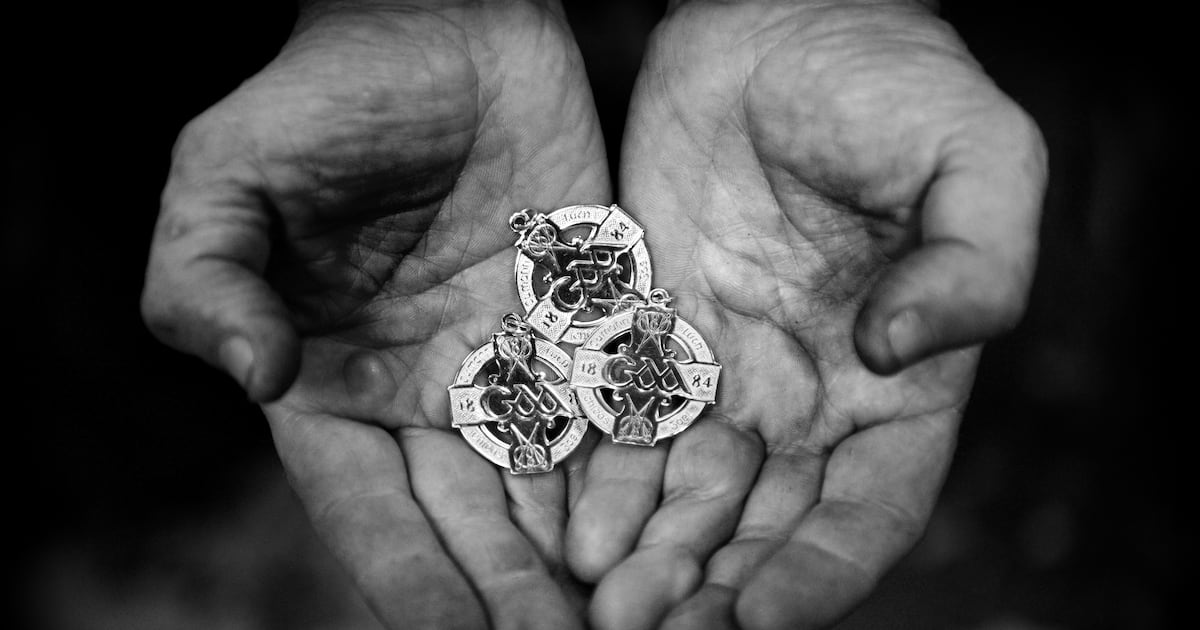
Two medals hit the news cycle last week. On the sentiment index medals would usually register as good news, but these stories were complicated. DJ Carey’s first All-Ireland medal has been put up for auction by a couple who had been conned by the former Kilkenny hurler and convicted fraudster. They had been given the medal by Carey many years ago in debased gratitude for their help. Their hugely honourable intention is to divide the proceeds of the sale between two individuals who had been duped by Carey and whose innocent generosity had ultimately trashed their quality of life. “They are living in dire circumstances as a direct result of their dealings with him,” the owner of the medal said in a statement to the journalist Dermot Crowe. “It is my hope that the sale of this medal will benefit them.” It also emerged last week that Jack Charlton’s family are embroiled in a protracted stand-off with HM Revenue and Customs over the tax status of his World Cup winner’s medal. When Charlton died in 2020, the medal passed to his son John, but this triggered a staggering inheritance tax bill of £200,000 (€233,000). To circumvent that, for the time being the medal is now back in the possession of Charlton’s widow.READ MOREThe afterlife of the 11 winners’ medals from England’s World Cup triumph was traced by Oliver Kay in a bracing and fascinating piece for The Athletic recently. Astonishingly, only three were still in the possession of the players’ families. All the others had been auctioned or sold privately, in some cases because players had fallen on hard times. George Cohen was the first to put his medal on the market in 1998 when he said his earnings from football and a subsequent career in property development had not provided for his retirement. Twelve years later Nobby Stiles went down the same road. In a tearful interview at the time, he said it had been his intention to leave the medal to his sons, but circumstances had forced his hand.For anybody who loves sport, medals are romantic objects. In the overwhelming majority of cases, they have no intrinsic value beyond the memories they invoke. Many of them lead lonely lives in attics. What value could they have without the sweat and the sacrifice that brought them to life in the first place?Alan Ball and Nobby Stiles celebrate after England’s victory in the 1966 World Cup final at Wembley. Photograph: Evening Standard/Hulton Archive/Getty Images The market, though, has an infinite capacity to name a price. Sports memorabilia is a teeming global business now in which medals and other paraphernalia from the glory factory have become collector’s items. In some cases, the buyers regard these trophies as an investment. When Alan Ball sold his World Cup winners’ medal in 2005, for example, it fetched just less than £165,000, but when it came to the market again 13 years later it changed hands for more than a quarter of a million pounds. The market is not infatuated with greatness either. There are mezzanine levels of desirability. When the former Irish international Steve Finnan got into a financial pickle with his brother he put his 2005 Champions League medal up for sale, along with an array of other trinkets from his career. But in the same auction Jeff Kenna offered his Championship runners-up medal, a play-off winner’s medal, a man of the match award for a game against Manchester United and a captain’s armband. Somebody cared enough to buy them.[ Ciarán Murphy: The GAA owes more to women than it realisesOpens in new window ]The appearance of DJ Carey’s first All-Ireland medal on the market is extraordinary for a myriad of reasons, including the simple reason that it is extremely rare in the GAA for the medals of a living player to go under the hammer. The prevailing instinct is to hold them close. For generations they were also strictly rationed. Until earlier this century, it used to be the case that only 21 All-Ireland medals were awarded to the winning county, regardless of how many players were on the panel. That led to an untold amount of quiet grievance. There were occasional eruptions, but very few. The excluded players would have been expected to suck it up and keep their mouths shut, which is a tricky double.Kerry captain Liam Hassett lifts the Sam Maguire in 1997. Photograph: James Meehan/Inpho Not all of them did. Nick O’Donnell, the great Wexford full back who was named on hurling’s Team of the Century, started his intercounty career with his native Kilkenny. But when they won the 1947 All-Ireland O’Donnell was deemed to be the last player on a 22-man panel and didn’t get a medal. Infuriated, O’Donnell transferred to Wexford.“Kilkenny still ‘owes’ me an All-Ireland medal,” he said in Just A Memory, Sean Whelan’s book on Wexford hurling. “I was never bitter about it, but I always felt very disappointed about it.”As long as the GAA held to its 21-medal limit there were bound to be hard cases. When Cork won the double in 1990, they togged out 27 players for the football final and 26 for the hurling final, but at the medals presentation banquet, the players outside the named 21 were given timber plaques, a risible acknowledgment of their unyielding commitment. In Kerry, it came to a head in 1997. Mike Hassett was the Kerry captain, but he was injured before the All-Ireland semi-final and didn’t reclaim his place for the final. When Kerry won, Mike’s brother Liam lifted the Sam Maguire Cup, but when the medals were handed out Mike was omitted. The Hassetts were devastated and for the next season they both withdrew from the Kerry panel.By the time Kerry won the 2004 All-Ireland the medals quota had been increased to 26, but they were still one medal short of their needs. At the medals presentation banquet two young panellists, neither of whom had appeared in the championship, were approached by a county board officer. He had a medal in one closed fist and nothing in the other and after explaining the situation, he asked one of them to pick a hand. For something so precious to be demeaned in this way was unforgivable.In recent years the GAA has relaxed it rules on medals again. Senior All-Ireland winners are now entitled to 35 medals, with the option to buy more of the same quality rather than inferior replicas. As recently as the turn of the decade All-Ireland medals used to cost the GAA €250 each, but the price of gold has soared since the pandemic, and each medal costs a four-figure sum now. If something priceless must have a value.
Omissions, sales and scandals: the chequered tales behind hard-won medals
Full Article
Original Source
Read the full article at Irishtimes →KhanList aggregates and links to publicly available news content. We do not host full articles from third-party sources. Always verify important information with original sources.